

You’ve spent years mastering SEO. You’ve tracked rankings, built backlinks, and optimized every meta tag on your site.
Then one day, someone asks ChatGPT for the best digital marketing agency in their city — and your business doesn’t show up. Not because you did anything wrong. But because the rules just changed.
That’s where Generative Engine Optimization (GEO) comes in.
This guide breaks down exactly what GEO is, why it matters right now, and how you can start using it to get your brand visible in AI-powered search — not just on Google.
What is Generative Engine Optimization (GEO)?
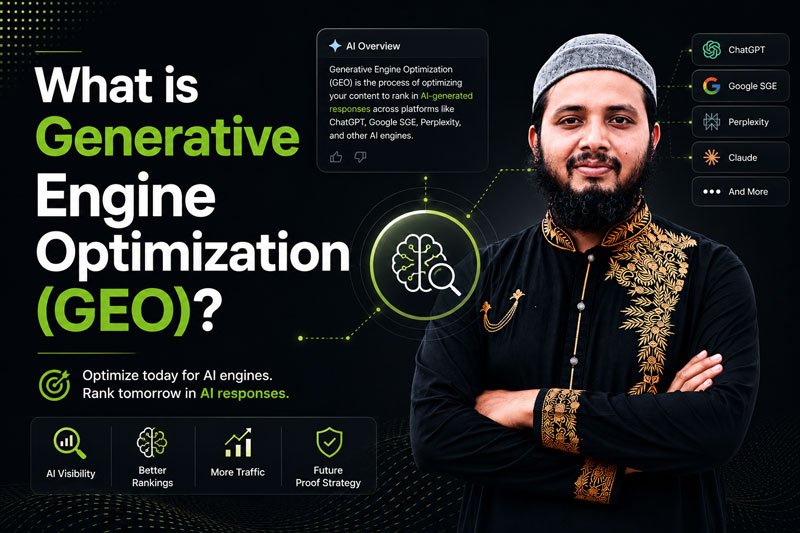
Generative Engine Optimization (GEO) is the process of optimizing your website, content, and brand presence so that AI-powered search engines — like ChatGPT, Google AI Overviews, Perplexity, Gemini, and Microsoft Copilot — include your business in their generated responses.
Think about how traditional SEO works. You optimize a page, Google crawls it, and ideally ranks it on page one. Users click your link.
GEO is different. AI systems don’t show a list of links. They generate a synthesized answer — and they pull that answer from content they trust. Your goal with GEO is to be part of that trusted pool of sources.
In short: SEO gets you ranked. GEO gets you recommended.
Why GEO Is No Longer Optional
Search behavior is shifting faster than most marketers realize.
ChatGPT crossed 100 million users faster than any app in history. Google’s AI Overviews now appear in billions of searches every month. Perplexity’s search volume grew by over 850% in a single year.
People aren’t just Googling anymore. They’re asking AI.
When someone asks Perplexity “What’s the best SEO agency for small businesses?” — it doesn’t return ten blue links. It synthesizes an answer from multiple sources and recommends specific brands. If your brand isn’t part of that conversation, you don’t exist in that moment.
The brands showing up in AI answers right now are capturing attention, trust, and revenue — before users ever click a search result.
GEO vs. SEO: What’s Actually Different?
This is where a lot of people get confused. GEO doesn’t replace SEO — it builds on it.
Here’s the honest breakdown:
SEO optimizes your content so Google can rank it. The goal is a high position in the search results page. You measure success with keyword rankings and organic traffic.
GEO optimizes your content so AI systems can cite it, summarize it, and recommend your brand inside their generated answers. You measure success with AI mentions, brand citations, and AI share of voice.
The foundation is the same — quality content, technical soundness, authority signals. But GEO adds a new layer: making your content extractable and citable by AI systems that process natural language differently than traditional search crawlers.
One important thing the data backs up: pages with statistics, expert quotes, and clearly cited claims get 30–40% more visibility in AI-generated responses compared to pages without them. That’s not a minor difference.
How Do AI Search Engines Actually Pull Your Content?
This matters if you want your GEO strategy to actually work.
AI engines like Perplexity and ChatGPT work by pulling from a massive training dataset — web pages, forums, publications, and more. But they also use live web retrieval for up-to-date queries.
Here’s what influences whether your content gets pulled:
Clarity of information. AI systems prefer content that answers questions directly and without ambiguity. Vague, fluffy content gets skipped.
Structured formatting. Clear headings, bullet points, and well-organized sections help AI parse and extract your content correctly.
Credibility signals. Backlinks from authoritative sites, citations, named authors, and consistent brand mentions across the web all signal trustworthiness.
Unlinked brand mentions. This is underrated. AI systems appear to track brand mentions even when there’s no hyperlink. Every press mention, forum post, or community discussion about your brand adds up.
Server-side rendering. If your website relies heavily on JavaScript to display content, AI crawlers may not be able to read it at all. This alone could be silently killing your AI visibility.
Fresh content. AI tools consistently favor recently updated, current information. A blog from 2019 won’t cut it.
GEO Strategy: How to Start Getting Recommended by AI
You don’t need a completely new strategy. You need a smarter one.
1. Build topical authority around your niche
AI systems trust brands that consistently publish in-depth content on a specific topic. A scattered blog covering random subjects won’t cut it. You need a focused content strategy built around topical authority — covering a subject so thoroughly that AI has no choice but to recognize your brand as an expert source.
2. Structure your content for extractability
Write clear, direct answers early in your content — don’t bury the key information at the bottom. Use descriptive H2 and H3 headings. Add tables for comparisons. Use numbered steps for processes. These formatting decisions make it easier for AI to pull and use your content accurately.
3. Cite your sources and use data
Add real statistics. Reference credible studies. Quote industry experts by name. This kind of content performs significantly better in AI-generated responses. It signals credibility — and AI rewards credibility.
4. Earn brand mentions beyond your website
Get featured in industry publications. Build your presence on Reddit, YouTube, and LinkedIn. Encourage customer reviews on third-party platforms. These mentions teach AI systems that your brand is recognized and trusted across the web — not just on your own pages.
5. Optimize your technical foundation
If your pages have crawlability issues, poor Core Web Vitals, or JavaScript rendering problems, no amount of content work will save you. A clean technical SEO foundation is non-negotiable for AI visibility.
6. Keep your content fresh
Revisit and update your important pages regularly. Outdated content is one of the fastest ways to lose visibility in AI-generated answers. AI tools want the most current information available — give them that.
GEO and E-E-A-T: The Connection You Can’t Ignore
Google’s E-E-A-T framework — Experience, Expertise, Authoritativeness, and Trustworthiness — isn’t just for Google anymore.
AI search systems are built on the same principle. They want to cite sources that are genuinely credible — real experts, real experience, real track records.
That means your GEO strategy and your E-E-A-T strategy should be the same thing. Author bios, original case studies, first-hand experience, and transparent business information all contribute to how AI systems perceive and represent your brand.
This is exactly why AI SEO services built for 2026 need to go beyond traditional keyword optimization — they need to build genuine brand credibility that AI systems can recognize.
How to Measure Your GEO Performance
Unlike traditional SEO, you can’t check your GEO performance with a simple rank tracker. But there are ways to measure it.
Start by manually testing. Ask ChatGPT, Perplexity, and Google Gemini questions related to your business and see if your brand gets mentioned. Do this regularly.
For more systematic tracking, tools like Semrush’s AI Visibility Toolkit can show your brand’s share of voice across AI platforms, how often you’re cited, and which pages get referenced.
Over time, watch for changes in referral traffic from AI platforms in your analytics. As your GEO efforts compound, you should see direct traffic from Perplexity, ChatGPT, and similar sources growing.
The Bottom Line: GEO Is Already Happening
The businesses that show up in AI answers aren’t just lucky. They’ve built something AI trusts — authoritative content, a credible brand presence, and technically sound websites.
GEO isn’t a future trend you can wait on. It’s happening right now, in billions of searches every single day.
If you want your brand to show up when potential customers ask AI for recommendations, the time to start is today. Build your topical authority. Structure your content for AI. Make your brand impossible to ignore.
That’s what next-generation SEO looks like in 2026 — and it’s what separates brands that grow from brands that disappear.