

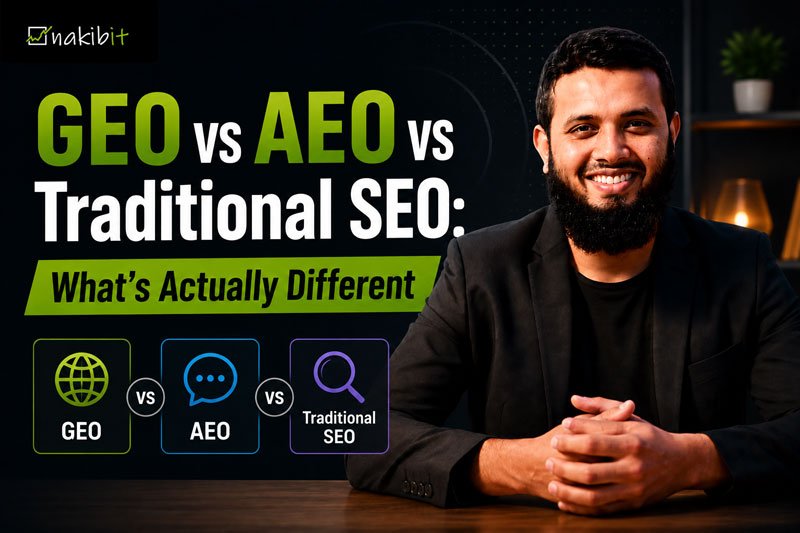
Every few months, a new acronym shows up promising to replace SEO entirely. First it was AEO. Then GEO. Now people are throwing around LLM SEO, AI SEO, and half a dozen other terms as if they’re all interchangeable. They’re not — and if you’re building a search strategy for 2026, knowing the difference isn’t academic. It decides where you spend your time, what you optimize first, and what “success” even looks like.
Here’s the honest breakdown, without the buzzword soup.
The Short Answer
- SEO (Search Engine Optimization) gets your page ranked on a results page so people click through to your site.
- AEO (Answer Engine Optimization) gets your content selected as the direct answer to a specific question — think featured snippets, voice search results, and quick-answer boxes.
- GEO (Generative Engine Optimization) gets your brand cited or recommended inside an AI-generated response, like Google’s AI Overviews, Gemini, or ChatGPT — often without the user clicking anywhere at all.
They’re not competing strategies. They’re three layers of the same search journey, and in 2026, most businesses need to work on all three at once.
Traditional SEO: Still the Foundation, Not the Whole House
Traditional SEO is built around a simple mechanic — Google crawls your site, indexes it, and ranks it against competing pages using relevance, authority, and technical quality signals. The goal is a click. You optimize titles, build backlinks, fix site speed, and structure your content so it satisfies both the algorithm and the reader.
This still matters enormously. Every AI system — Gemini included — pulls its answers from the same indexed web that traditional SEO builds on. If your site isn’t crawlable, fast, and properly indexed, none of the newer strategies below will save you. AEO and GEO don’t replace this foundation. They sit on top of it.
Where traditional SEO falls short in 2026 is that it was never designed to answer a question directly inside the results page. It was designed to earn a click. And clicks are exactly what AI-generated answers are quietly removing from the equation.
AEO: Winning the Direct Answer
Answer Engine Optimization is about structuring content so it can be lifted directly into a quick-answer format — a featured snippet, a “People Also Ask” box, a voice assistant’s spoken response. This isn’t new; smart marketers have been chasing featured snippets for years. What’s changed is how central this has become.
AEO content tends to follow a specific pattern: a clear question as a heading, followed immediately by a concise, direct answer in the first sentence or two, then supporting detail underneath. It rewards precision over persuasion. You’re not trying to convince the reader with narrative — you’re trying to give the algorithm an unambiguous, extractable chunk of truth.
The limitation of AEO is scope. It’s brilliant for single-fact questions (“what is a chargeback,” “how many ounces in a cup”) but it doesn’t help much when the query requires synthesis — comparing multiple options, weighing trade-offs, or recommending a provider. That’s where GEO takes over.
GEO: Becoming the Recommendation, Not Just the Answer
Generative Engine Optimization is the newest and most demanding layer. It’s not about answering a simple question — it’s about being the source an AI model trusts enough to cite, or the brand it recommends when a user asks something like “who’s the best SEO agency for eCommerce” or “what CRM should a 10-person team use.”
This requires more than clean structure. Gemini, ChatGPT, and similar models are checking for signals that traditional SEO and AEO never had to account for:
Entity recognition — does the model already know who you are, confirmed through the Knowledge Graph and consistent business data across the web?
Information gain — does your content say something the other twenty sources on this topic haven’t already said?
Cross-platform consensus — do other trusted sites talk about your brand the same way you talk about yourself?
Extractable authority — is your expertise stated in language a model can quote confidently, rather than buried in vague marketing copy?
We go deeper into how this specific decision-making process works in our guide on how Gemini’s AI search actually works — worth a read if you want to understand the mechanics behind GEO rather than just the definition.
A Practical Comparison
| SEO | AEO | GEO | |
|---|---|---|---|
| Goal | Rank on the results page | Get selected as the direct answer | Get cited or recommended inside an AI response |
| Primary surface | Organic search results | Featured snippets, voice search | AI Overviews, Gemini, ChatGPT, Copilot |
| What earns visibility | Backlinks, relevance, technical health | Clear, concise, question-first structure | Entity trust, information gain, web-wide consensus |
| User behavior | Clicks through to your site | Reads the answer, may or may not click | Often never visits your site at all |
| Content style | Comprehensive, keyword-relevant | Direct, snippet-friendly | Authoritative, original, semantically rich |
Why You Can’t Pick Just One in 2026
Here’s the part most “SEO is dead” articles get wrong: these three don’t compete for the same budget line. They compound. A page with strong traditional SEO gets crawled and indexed reliably. Structure it with AEO principles, and it becomes extractable for quick answers. Layer in genuine entity authority and original insight, and it becomes a source Gemini is willing to cite by name.
Skip the foundation and chase GEO alone, and you’ll have a well-written page that AI models simply never discover, because it’s buried on page four of unindexed results. Skip GEO and lean only on traditional SEO, and you’ll keep ranking for searches that increasingly get answered without a single click ever reaching your site.
What This Means for Your Content Strategy
If you’re auditing your site right now, here’s a practical order of operations:
- Fix the technical layer first. Broken crawlability or slow load times block all three strategies equally.
- Restructure your top-performing pages for direct answers. Add clear question-based headings with concise answers up top — the AEO layer.
- Build entity signals and original insight into your best content. This is where GEO lives, and it’s the layer most businesses haven’t touched yet.
This is precisely the sequence we follow inside our Gemini SEO services — starting with technical validation, then answer structuring, then the deeper entity and citation work that gets a brand actually recommended by AI models, not just indexed by them.
Frequently Asked Questions
Is GEO going to replace SEO completely?
No. GEO depends on traditional SEO fundamentals to work — a page that isn’t indexed can’t be cited by an AI model, no matter how well-written it is.
Should small businesses worry about GEO yet, or focus on SEO first?
Get the SEO foundation solid first, especially technical health and indexing. But don’t wait too long — GEO signals like entity consistency and content depth take months to build, so starting early is a real advantage.
What’s the fastest way to tell if AEO or GEO is working for my site?
Check Google Search Console for “AI Overview” impressions where available, and manually test your target queries inside Gemini and ChatGPT to see whether your brand gets mentioned.