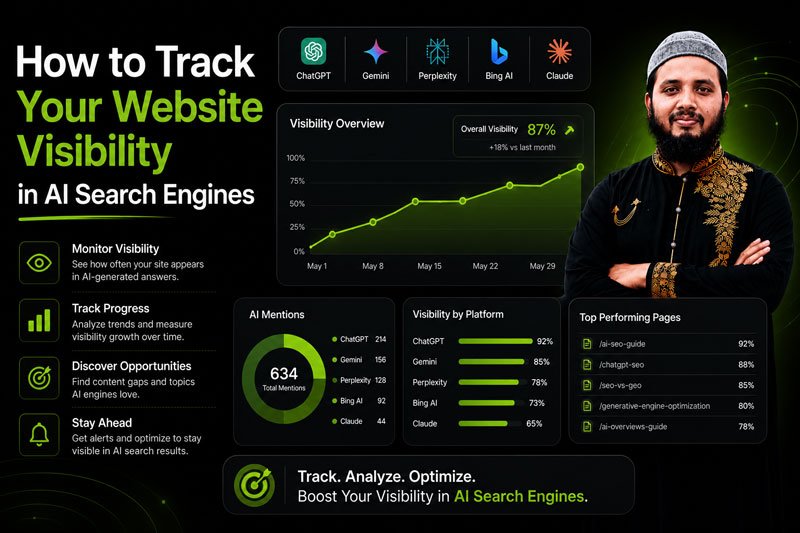
To track your visibility in AI search engines, make a list of the questions your customers ask, run them across ChatGPT, Gemini, Perplexity and Google, and record whether you are mentioned, cited or recommended. Repeat on a schedule and compare against competitors.
Normal rank trackers cannot see this. AI answers do not have fixed positions.
So you track different things: mentions, citations, accuracy and how you compare with others.
I’m Nazirul Islam Nakib, an SEO specialist. Here is a simple, low-cost method you can start today.
Why AI visibility is different
Search results show a ranked list. AI tools write an answer that can change with wording, location and time.
Two people asking the same thing may see different brands. That is why one check proves little. Patterns over time matter.
What to measure
- Mention rate. How often your brand is named for your target questions.
- Citation rate. How often your pages appear as linked sources.
- Share of voice. Your mentions compared with competitors for the same questions.
- Accuracy. Whether what the AI says about you is correct.
- Sentiment. Whether the tone is positive, neutral or negative.
- Which pages get cited. This shows what content works.
A simple manual method
1. Build a question list
Write 20 to 50 real questions: “best [service] in [city]”, “how do I [problem]”, “[brand] vs [competitor]”.
Use customer emails, sales calls and Search Console queries.
2. Test across platforms
Run each question in ChatGPT, Gemini, Perplexity and Google. Use a logged-out or clean session where you can.
3. Record the results
Use a spreadsheet. Note the date, platform, question, whether you appear, which sources are cited and the competitors named.
4. Repeat monthly
Run the same list again. Look for trends, not single results.
Use your analytics too
In Google Analytics, look at referral traffic from AI platforms such as chatgpt.com or perplexity.ai. Not all AI traffic is labelled, so treat the numbers as a floor.
In Search Console, watch impressions and clicks on question queries for changes.
Check your server logs
Logs show which AI crawlers visit and which pages they fetch. This tells you whether your content is reachable.
About tracking tools
Several paid tools now monitor AI answers at scale. Features and prices change quickly.
Judge a tool by how it samples answers, how often it runs and whether you can export the data. A spreadsheet is enough to begin.
Turn data into action
- Not mentioned? Strengthen the page that should answer the question.
- Mentioned but wrong? Fix your own pages and profiles so facts are consistent.
- Competitors cited instead? Study their pages and add what is missing.
- Cited rarely? Build more trusted mentions and links.
Frequently asked questions
Can I track AI search rankings?
Not as fixed positions. You track mentions, citations and share of voice.
How often should I check?
Monthly is a good start. Weekly for important queries.
Do I need paid tools?
No. A spreadsheet and a question list work well.
What if AI says something wrong about my business?
Correct the facts on your site, profiles and listings, and keep them consistent.
Want an expert review? Request an AI visibility audit. Learn the basics in what is GEO, see my AI SEO service, or visit the home page.