Write 15 to 20 buyer questions
Mix four types: the service itself ("best [service] for [customer]"), price ("how much does [service] cost"), comparison ("[A] vs [B]") and place ("who offers [service] in [city]"). Never use your brand name in them.
Before you spend on AI SEO, find out where you stand. I am Nazirul Islam Nakib. I ask ChatGPT, Gemini, Perplexity and Google AI the questions your buyers ask, record who gets named and why, and give you a ranked plan to change it. You get the real answers, not a score.
4.9/5 from 81 reviews · Manual review of real AI answers

Get a free first look
Send your website. I will reply myself with what I see and what I would fix first.
or
Chat on WhatsAppAn AI visibility audit is a structured check of what AI tools say about your business and why. You pick the questions your customers ask. Each one is run in tools such as ChatGPT, Gemini, Perplexity and Google AI Overviews, and the answers are recorded: is your brand named, is your site linked, who is named instead, and is what is said about you correct.
Then the audit looks underneath for causes. Can AI crawlers reach your pages? Do the pages answer clearly? Is your brand described the same way across the web? The output is a written report with the evidence and a ranked list of fixes. People also call it a ChatGPT visibility audit or an AI mentions audit. It is the same idea.
1. Do AI tools name you when buyers ask about your market, and in which tools? 2. When they name you, is what they say accurate and up to date? 3. Who gets named instead of you, and which of their pages or outside mentions are the likely source? 4. Is something technical stopping AI crawlers from reaching or reading your pages? 5. What should you fix first, and what can wait?
The fifth question is the one that matters. Many sites have a long list of possible AI fixes. An audit tells you which two or three will make a difference and which ones are noise.
You can run a basic version of this in an afternoon. It is the same method I use, on a smaller scale.
Mix four types: the service itself ("best [service] for [customer]"), price ("how much does [service] cost"), comparison ("[A] vs [B]") and place ("who offers [service] in [city]"). Never use your brand name in them.
Start with ChatGPT with search on, Google (look for an AI Overview), Gemini and Perplexity. Add Copilot or Claude only if your buyers use them.
Change the wording, not the meaning. Use private windows and fresh chats so earlier answers do not steer the next ones.
One row per question and tool: were you named, were you linked, who was named instead, was the description right. Keep the full text of any answer that mentions you.
Look at the pages that were cited instead of yours. Compare how they open, what facts they show and how recent they are.
Read your robots.txt, ask your host about firewall rules for AI crawlers, view the page source to confirm the text is in the HTML, and compare how your brand is described on your site, your profiles and your listings.
Put the fixes in order of effect and effort. Run the same questions again in a month and compare.
This is the layout, with blanks you fill in. I do not show made-up results here. The report I give you has your real rows.
| Feature | Question | Tool | Named or linked? | Named instead |
|---|---|---|---|---|
| Row 1 | "Best [service] for [customer]" | ChatGPT with search | Yes or no | Brands and sites listed |
| Row 2 | "How much does [service] cost" | Google AI Overview | Yes or no | Brands and sites listed |
| Row 3 | "[A] vs [B]" | Perplexity | Yes or no | Brands and sites listed |
| Row 4 | "Who offers [service] in [city]" | Gemini | Yes or no | Brands and sites listed |
Usually 20 to 40 questions in several phrasings, built from how your customers really ask.
Every answer from every tool, so you can check my conclusions yourself.
Robots rules, firewall and CDN settings, rendering and speed, seen from an AI crawler's side.
How consistently your name, services, location and details appear across your site and the web.
Who is named instead of you and what sits behind it.
Fixes ordered by effect and effort, with the service each one belongs to.
Usually a few days to a week, depending on the number of markets and questions.
Your business, your market and the questions that matter most.
Systematic prompts across several tools and phrasings.
Crawl, content, brand and competitor review.
A short ranked plan you can act on.
I explain the findings and we agree next steps.
They overlap, and many clients take both. The difference is what they test.
| Feature | AI visibility audit | Standard SEO audit |
|---|---|---|
| Main question | What do AI tools say about my brand and why? | Why do my pages not rank in Google? |
| What it tests | Real AI answers and AI crawler access and brand consistency | Crawling and indexing and speed and content and links |
| Evidence | A log of answers from several AI tools | Crawl data and Search Console and rankings |
| Best when | You want to know if buyers using AI can find you | Traffic is low or has dropped |
Most AI visibility problems that I find begin with something ordinary. These are the checks I run.
Crawler access. I check robots.txt, firewall and CDN rules for the crawlers that matter: OAI-SearchBot, GPTBot and ChatGPT-User from OpenAI, PerplexityBot and Perplexity-User from Perplexity, Googlebot, and the Google-Extended setting. Each company documents its own bots, and the rules differ, so I read the current pages each time. See my pages on ChatGPT SEO, Perplexity SEO and Gemini SEO for the details.
Rendering and speed. If the main text only appears after scripts run, or the page loads slowly, it is harder for any crawler to read.
Structured data. I check that any markup on the page matches the visible facts. It is not a requirement for AI answers, but wrong markup can confuse search engines.
Indexing. For Google AI features, a page must be indexed and eligible to show a snippet. I check that first.
AI tools learn about your business from many places, not only your website: your profiles, listings, reviews, news mentions and what other sites say about you. If those disagree, the tool may describe you wrongly or leave you out.
I compare how your name, services, location, prices and key facts appear across your site, Google Business Profile, social profiles, directories and your most-cited mentions. The fixes are usually plain: update an old listing, remove a wrong claim, make your own About and service pages say the same thing everywhere. For local businesses this connects to local SEO work.
The roadmap lists each fix with three things: the evidence from the audit that led to it, how much effect I expect and how much effort it takes. Quick wins come first.
Typical fixes include unblocking a crawler, rewriting a key page so the answer comes first, correcting an old listing, adding a missing comparison page, and earning mentions from sites your competitors are cited on. Each belongs to a service I offer, such as answer engine optimization, generative engine optimization or technical SEO, but you do not have to hire me for any of it. The report is written to stand on its own and you can hand it to your own team.
AI answers vary from run to run, by wording, by day and sometimes by person. That means no audit can give you the exact number of times you are mentioned, and any tool that claims to is estimating. What an audit can show is a pattern across repeated tests: whether you tend to appear, what tends to be said, and what tends to be missing.
I also do not promise that any AI tool will name you after the fixes. Nobody controls that. What you get is knowing what to change and why, and a way to measure whether it moved.
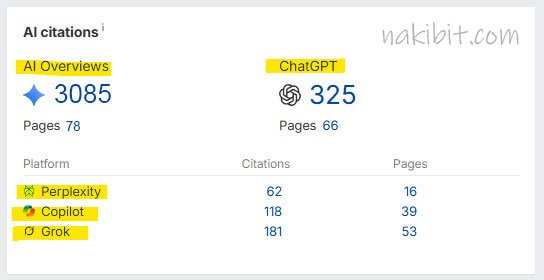
One project where the audit-led work was measured in AI answers.
 AI search
Luxury bags, Spain
Entity and content work that put the brand into Google AI Overviews and ChatGPT answers. Results vary by business, and this is one project.
It is most useful before you spend, or when something has changed.
Find out where you stand so the budget goes to the right fixes.
Check that new pages are reachable and that old facts are gone.
Find out if buyers have moved to AI answers where you are missing.
A wrong price, an old address or a missing service in an AI answer is worth tracing to its source.
Ask three things. Will I see the real answers, or only a score? Will you tell me what is causing the problem, with evidence? And who does the work?
Be careful with a one-click report that gives a single "AI visibility score". A number can look precise while hiding how much the answers vary. I do the testing by hand and keep the log, so you can check my conclusions. I work independently, so the person who audits your site is the person who explains the findings.
To read first, see how to track your website visibility in AI search engines. For the platforms, see ChatGPT SEO, Gemini SEO, Perplexity SEO and Google AI Overviews. The full range is on my AI SEO services page, and ongoing work is in my monthly SEO packages. If you also want your site's wider health checked, a free website audit is the place to start.

Send me your website and three questions your customers ask. I will show you what the AI tools answer today.
No obligation · Reply from Nazirul Islam Nakib himself
 Nazirul Islam Nakib
We usually reply in a few minutes
Leave your email or WhatsApp number and we'll follow up as soon as we're back online.