
Your Google rankings look fine. Traffic seems stable. But somewhere right now, a potential customer is asking ChatGPT for a recommendation in your industry — and your brand isn’t in the answer.
You’d never know. Because traditional rank trackers can’t see it.
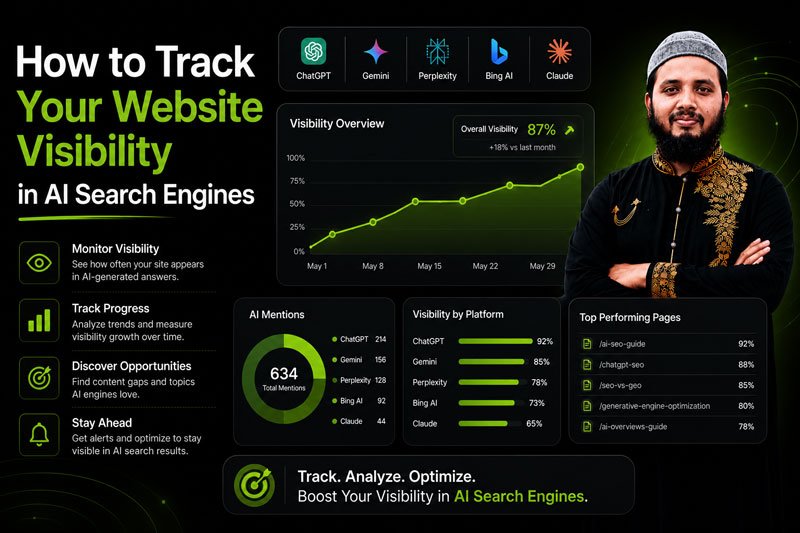
This is the blind spot that’s quietly costing businesses customers in 2026. AI search engines like ChatGPT, Perplexity, Google AI Overviews, and Gemini are answering millions of queries every day — and most businesses have zero visibility into whether they’re being cited, mentioned, or ignored entirely.
Tracking your AI search visibility isn’t optional anymore. Here’s exactly how to do it.
How to Track Website Visibility in AI Search Engines: Start With the Right Metrics
Before you open a single tool, you need to know what you’re actually measuring. AI search visibility is fundamentally different from traditional SEO tracking — and confusing the two leads to the wrong conclusions.
In traditional SEO, you track keyword rankings. Position 1, position 5, position 12. Clear, fixed numbers.
In AI search, there are no fixed positions. AI engines generate probabilistic answers that shift based on query phrasing, user context, and source freshness. So the metrics that matter are different:
Citation Share of Voice — how often your brand gets cited compared to competitors when AI answers queries in your niche. This is the North Star metric for AI visibility. Research from AirOps found that only 30% of brands maintain consistent citations across consecutive AI answers — making this metric highly volatile and worth watching closely.
Source URL Inclusion — which specific pages on your website are being pulled and cited by AI engines. Knowing this tells you what content is working and what needs attention.
Brand Mention Sentiment — when AI mentions your brand, is the framing positive, neutral, or negative? This matters because AI recommendations influence purchase decisions directly.
Prompt Coverage — how many of the relevant questions in your niche does your brand appear in? If you’re a local SEO expert but AI only mentions you for one type of query, you have a coverage gap.
AI Referral Traffic — actual sessions arriving at your website from AI platforms like ChatGPT, Perplexity, and Gemini. This is trackable in GA4 with the right setup.
Method 1: Manual Spot-Checking (Free and Essential)
Every AI visibility strategy starts here — and most businesses skip it entirely.
Manual testing means running your target queries directly into AI platforms and noting what comes up. It’s free, takes 20 minutes a week, and gives you ground-level intelligence no tool can fully replicate.
Here’s how to do it properly:
Open ChatGPT, Perplexity, Google AI Mode, and Gemini separately. Run the same queries across all four — because different platforms pull from different sources and produce different answers.
Use query types that actually trigger citations in your niche:
- “Who is the best [your service] expert in [your city/country]?”
- “What are the top [your service] strategies for [your target audience]?”
- “Which [your industry] websites have the best information on [your topic]?”
- “Recommend a [your service] specialist for [specific problem]”
Track your results in a simple spreadsheet. Note the date, the platform, the query, whether your brand appeared, which page was cited (if any), and the sentiment of the mention.
Do this weekly. Patterns emerge quickly — and when your visibility drops on a platform, you’ll catch it early enough to respond.
This manual habit also gives you competitor intelligence that no paid tool provides. You’ll see exactly which competitors are being recommended, what content they’re getting cited for, and where the gaps in your own strategy are. This directly informs your AI search visibility strategy and content priorities.
Method 2: Set Up AI Referral Traffic Tracking in GA4
Google Analytics 4 doesn’t show AI referral traffic by default. But with a custom channel group, you can track exactly how many users are arriving from ChatGPT, Perplexity, Gemini, Claude, and other AI platforms.
Here’s the setup:
Step 1: In GA4, go to Admin → Data Display → Channel Groups → Create New Channel Group.
Step 2: Add a new channel called “AI Search Referrals.”
Step 3: Set the condition to Session source contains any of the following:
- chatgpt.com
- perplexity.ai
- gemini.google.com
- copilot.microsoft.com
- claude.ai
Step 4: Save and apply. GA4 will begin showing AI referral sessions within 24–48 hours. Historical data won’t be retroactively tagged — so the earlier you set this up, the better your baseline data will be.
Once it’s running, monitor AI referral traffic monthly alongside your organic traffic. As your GEO and AEO strategy matures, this number should grow consistently.
Also check Google Search Console for AI Mode click data under the “Web” filter. Google started surfacing AI Mode impressions and clicks in GSC — this shows you which queries trigger AI-generated results that include your content.
Method 3: Dedicated AI Visibility Tracking Tools
Manual checking is essential. GA4 shows traffic. But for systematic, scalable tracking across multiple platforms and hundreds of queries — you need purpose-built tools.
Here are the best options available in 2026:
Semrush AI Toolkit
Semrush added AI visibility tracking to its platform, allowing you to monitor your brand’s share of voice across Google AI Overviews and other AI surfaces. If you’re already using Semrush for traditional SEO tracking, this is the easiest entry point for AI visibility data without adding a new tool to your stack.
Otterly.AI
One of the most focused AI visibility tools available. Otterly tracks your brand mentions and citations across ChatGPT, Perplexity, Google AI Overviews, and Gemini — running automated prompts daily and showing you trends over time. Strong for monitoring prompt coverage and citation frequency.
Profound
Enterprise-grade AI search tracking with deep competitor analysis. Profound shows which pages earn citations, how your brand sentiment compares to competitors, and where your citation share of voice is growing or declining. Best suited for larger businesses or agencies managing multiple client brands.
Scrunch AI
Focused specifically on brand citation tracking across AI platforms. Scrunch monitors how AI describes your brand, tracks competitor mentions, and alerts you when your visibility shifts significantly. Strong sentiment analysis features.
SE Ranking AI Overviews Tracker
If Google AI Overviews is your primary focus, SE Ranking’s dedicated tracker monitors which of your keywords trigger AI Overviews, whether your pages appear in them, and how your visibility trends over time. More affordable than enterprise options.
AirOps
Originally an AI content operations platform, AirOps now includes brand visibility scoring — calculating how often your brand appears in AI-generated answers divided by total relevant answers in your category. The Brand Visibility Score they developed has become a widely referenced metric in the industry.
Method 4: Competitor Citation Analysis
Tracking your own visibility is only half the picture. Understanding what your competitors are getting cited for — and why — is equally important.
Run your manual checks with a competitor focus. When a competitor appears in an AI answer instead of you, ask:
- Which page on their site is being cited?
- What format is that page — a guide, a comparison, a list, a definition?
- Does that page have schema markup you’re missing?
- Is their content more direct, more recent, or more data-backed than yours?
This analysis directly tells you where to improve. If competitors consistently get cited for “how-to” content in your niche and you don’t have equivalent pages, that’s a content gap. If their cited pages have HowTo schema and yours don’t, that’s a technical fix.
A keyword research and competitor analysis process built for AI search goes beyond traditional keyword gaps — it maps which content types and topics your competitors own in AI-generated answers, so you can build to compete directly.
What to Do When Your Visibility Drops
AI visibility isn’t static. It shifts as platforms update their models, as competitors publish new content, and as your own content ages.
When you notice a drop — fewer citations, lower brand mentions, declining AI referral traffic — here’s the response framework:
Check content freshness first. Pages updated within the last 12 months are twice as likely to earn AI citations compared to older content, according to AirOps research. If a previously cited page hasn’t been updated in six months or more, refresh it with new data, examples, and insights.
Add or fix schema markup. Missing or incorrect structured data is one of the most common reasons pages get dropped from AI citations. A proper technical SEO and AI visibility audit will catch these issues quickly.
Strengthen your E-E-A-T signals. If a competitor has earned more author credibility, more external citations, or more brand mentions since you last checked — your relative authority has declined. Respond by publishing original research, earning press mentions, and strengthening your author profiles.
Expand your prompt coverage. If you’re only appearing for a narrow set of queries, build new content to cover adjacent topics. Topical authority compounds — the more comprehensively you cover a subject, the more consistently AI platforms cite you across related queries.
Building an AI Visibility Dashboard
Once your tracking methods are in place, consolidate everything into a simple monthly dashboard:
| Metric | Tool | Review Frequency |
|---|---|---|
| Brand citation share of voice | Otterly.AI / Profound | Weekly |
| AI referral traffic | GA4 custom channel | Monthly |
| Google AI Overview impressions | Google Search Console | Monthly |
| Prompt coverage | Manual + Otterly | Weekly |
| Competitor citation gaps | Manual analysis | Monthly |
| Sentiment of brand mentions | Scrunch AI / Profound | Monthly |
Review this dashboard monthly as a minimum. For competitive niches, weekly reviews help you respond to shifts before they compound into significant visibility losses.
The Bigger Picture
Tracking AI search visibility isn’t just a new KPI to add to your reports. It’s a fundamentally different way of understanding how your brand performs in search — one that reflects where your customers are actually going to find you in 2026.
The businesses building AI visibility tracking into their workflows right now are the ones who will catch drops early, respond faster, and compound their AI citation authority ahead of competitors who aren’t paying attention.
Start with manual checks this week. Set up your GA4 channel group today. Add a dedicated AI tracking tool when you’re ready to scale.
And if you want a professional strategy that covers both tracking and actively improving your AI search visibility, the monthly SEO packages at nakibit.com are built specifically for this new era of search — combining traditional SEO performance with AI citation growth.