Layered navigation URLs
Filters can create huge numbers of near-duplicate URLs. I decide which combinations are worth indexing and keep the rest from wasting crawl time.
I am Nazirul Islam Nakib, a results-driven Magento SEO expert, SEO consultant and SEO strategist. Magento and Adobe Commerce stores can be very powerful and very complicated. Layered navigation, URL rewrites, caching and store views all affect how Google reads a large catalogue. I untangle them, so your best categories and products get the attention they deserve.
4.9/5 from 81 reviews · Hands-on, store by store

Get a free first look
Send your website. I will reply myself with what I see and what I would fix first.
or
Chat on WhatsAppMagento SEO is SEO for stores on Magento Open Source or Adobe Commerce. These platforms suit large and complex catalogues, with many products, store views and customisations. The same power creates SEO risks, because settings that look harmless can multiply URLs or slow the site.
A Magento SEO expert reviews how layered navigation creates URLs, how canonicals are set, how URL rewrites are growing, how the site is cached and how store views relate to each other. With large catalogues, crawl efficiency matters. If Google spends its time on filter pages, your key categories are visited less.
I also look at the front end. A heavy theme or JavaScript-driven storefront can be slow on phones and hard for crawlers to read.
For how this fits into the bigger picture, see my ecommerce SEO page. For the technical groundwork, see technical SEO.
Filters can create huge numbers of near-duplicate URLs. I decide which combinations are worth indexing and keep the rest from wasting crawl time.
Category and product canonicals are configurable. I check they are on and doing what they should, including for products in several categories.
Rewrites can grow messy as the catalogue changes, causing chains and loops. I clean them and plan redirects when products or categories move.
Full-page caching, image handling, scripts and theme weight decide how fast Magento feels, especially on mobile.
Several store views can duplicate content. I set language and region signals so each audience gets the right version.
Make sure the right page is indexed, not every simple-product variant behind it.
Product markup is checked against what shoppers see, including price, stock and reviews, and brought up to date.
On big catalogues, sitemap and robots settings steer crawlers to the pages that matter and away from the ones that do not.
Large catalogues reward discipline.
Large catalogues hide problems. I crawl category trees, layered navigation and parameters to see what Google really reaches.
Layered navigation, canonicals, caching and rendering, which matter most on Magento.
Category targets first, since they carry most of the search demand in large stores.
Templates for the long tail and hand-written content for the pages that earn the most.
Organic orders and revenue by category, so effort goes where it pays.
A Magento case study is not published yet. These are results from other ecommerce platforms, using the same method.
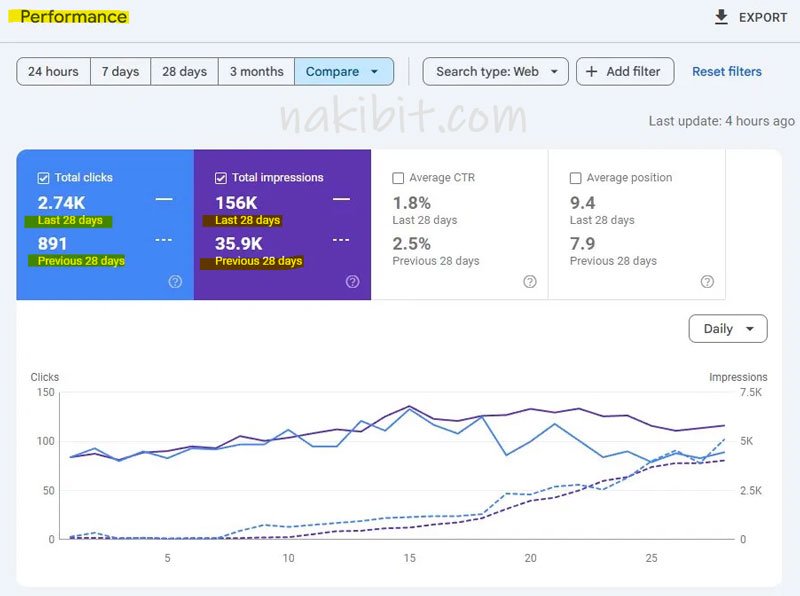 Ecommerce
Organic food store, Chicago, USA
A store that had relied on paid ads for 1.5 years. Technical fixes, schema, on-page work, then content and links.
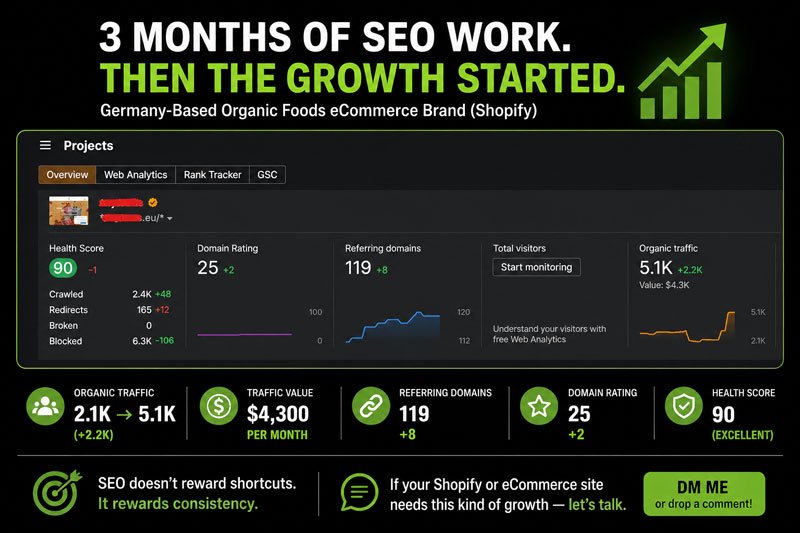 Shopify ecommerce
Organic foods, Germany
A Shopify store stuck at 2.1K visits. Crawl fixes, cleaner redirects, rewritten product and collection pages and white-hat links.
Magento SEO depends on solid groundwork. Technical SEO sorts out crawling and indexing, and Core Web Vitals work addresses speed. International SEO helps if you run several store views for different countries.
Category and product pages are covered by on-page SEO. Schema markup keeps product data accurate. Planning a platform change? See site migration. The overview is on my ecommerce SEO page.
Magento and Adobe Commerce are demanding platforms, and SEO work on them goes wrong when the person advising does not understand the catalogue. When you work with me, I audit the store, write the plan and make or brief every change myself. I hold HubSpot and Semrush certifications and have more than eight years of experience across 1,200+ projects, so you deal with a professional SEO expert, not an account manager relaying messages.
Magento SEO needs both a strategy and a feel for the platform. A specialist who only knows keywords may miss that your layered navigation is multiplying URLs. A developer who only knows code may miss that two categories compete for the same search. I act as the SEO strategist between the two, then hand your developers a short, ordered brief instead of a long report.
If you want the wider picture first, my SEO consultant page explains how I work on every kind of website, and the ecommerce SEO overview shows where platform work fits into a complete store plan.
Layered navigation is one of Magento's best features for shoppers and one of its biggest risks for SEO. Every combination of filters can produce its own URL, so a catalogue of a few thousand products can expose far more addressable pages than anyone intended. I map which filter combinations match real searches and deserve to be indexable, and which should be canonicalised or kept out of the index and out of internal links.
URL rewrites are the second pressure point. Magento stores every product and category address in a rewrite table, and years of renamed products, moved categories and imported catalogues leave chains and loops behind. I crawl the store, trace redirect chains, repair broken rewrites and make sure each page resolves in a single step.
Product addresses need a decision too. When category paths are included in product URLs, one product can be reached by several addresses. Magento has canonical settings for categories and products, and I check that they are switched on and behaving, so Google sees one preferred version of each page. These are the checks I run as part of technical SEO work.
With a big catalogue, you cannot fix everything at once, and you should not try. I start with Search Console and your sales data to find which categories earn money, which have untapped demand and which are dragging the crawl down. The work is then ordered by commercial value: top categories first, then best-selling products, then the long tail through templates.
Templates matter more than hand edits at this scale. I set title and description patterns, heading structure and default copy blocks that give thousands of pages a sensible baseline, then hand-write the pages worth the effort. Thin and duplicate product pages are merged, redirected or improved, and discontinued products get a clear rule instead of lingering as dead ends.
Sitemaps and internal links are reviewed together. A sitemap that lists blocked or redirected URLs wastes attention, and a catalogue where important products sit five clicks deep will struggle regardless of content. I flatten the paths that matter and keep your sitemap limited to pages you actually want found.
Many Magento and Adobe Commerce merchants run more than one store view, each with its own language, currency or domain. That is where hreflang mistakes, duplicated content between views and inconsistent canonicals tend to appear. Google asks that each language version references itself and every alternate, with the references returned in both directions, and that is easy to break at scale.
I check how each store view outputs its alternates, canonicals and sitemaps, and whether search engines can reach every version. Where two views are close variants of one language, I decide whether both deserve to exist in search, and set canonicals accordingly. Where markets are genuinely different, I help plan keyword research per language instead of translating one list.
Magento can be fast, but it rarely is by accident. Full-page caching, a properly configured cache layer, sensible image handling, a lean theme and careful extension choices all play a part. Hosting that is too small or badly tuned shows up immediately in field data. Google judges real visits using Core Web Vitals, with Largest Contentful Paint within 2.5 seconds, Interaction to Next Paint within 200 milliseconds and Cumulative Layout Shift under 0.1 counted as good.
I test home, category, product, cart and checkout separately, since each loads different scripts. I then trace slowness to its cause: unoptimised images, render-blocking scripts, extensions injecting code on every page, or server response times. Findings are written as tasks for your developers or host, in order of effect. Details of the method are in my Core Web Vitals service.
Magento themes and extensions can output product markup, and so can SEO and review modules. When two sources describe the same product differently, search engines see conflicting prices or availability. I audit what each template outputs, keep one accurate version, and check it against what shoppers see. Correct markup does not guarantee rich results, but wrong markup can cost you eligibility. See schema markup for the wider approach.
Content comes next. Supplier text copied across hundreds of sites gives search engines no reason to prefer yours, so I rewrite the descriptions on priority products and strengthen category introductions. Your on-page SEO gets reviewed alongside this, so headings, internal links and titles support each other.
Online shoppers now ask ChatGPT, Gemini, Copilot and Google AI Overviews for product advice before they ever visit a store.
As an AI search specialist, I treat this as an extension of sound ecommerce SEO. Assistants such as ChatGPT, Gemini, Copilot and Google AI Overviews draw on pages that are clear, crawlable, accurate and trusted. For a Magento store that means complete product specifications, consistent product data across markup and feeds, honest delivery and returns information, and comparison or buying-guide content that answers real questions in plain language.
Mentions and reviews on other trusted sites also help these systems recognise your brand as a real business. I cannot promise a citation in any AI answer, and I do not. I can make your pages easy to understand and worth citing. Read more in AI SEO and answer engine optimization.
Rankings alone do not pay for stock, so I report on what a merchant actually cares about: organic clicks and impressions for category and product pages, how much of the crawl is spent on useful URLs, Core Web Vitals on your main templates, and organic orders and revenue from your analytics.
Before changing anything I record a baseline from Search Console and analytics, then keep a dated log of every change. In ecommerce a price change, a stock problem or a seasonal spike can look like an SEO win or loss when it is neither, so the log keeps the reporting honest. The Chicago store in the results section above is the type of evidence I mean: 2,740 clicks in 28 days after technical fixes, schema and on-page work, shown on its case study page with context rather than promised for your shop.
Every project is tailored, but most include a full audit of crawl, index, speed, structure and markup, a prioritised fix list written so your developer can act on it, a keyword map for categories and key products, rewritten copy for the pages that matter most, and monthly reporting on clicks and orders.
You also get plain-language explanations of what I am changing and why, so you stay in control of your own store. Most merchants do not need everything at once, which is why I begin with a free look and a short list of what I would do first.
Whether you hire a freelance Magento SEO specialist, an independent consultant or an agency, ask direct questions. Who will actually work on my store? Can you show relevant results with context? How will you handle filters, variants and duplicate URLs? Will you change anything on the live site without telling me? How will you report on orders, not only rankings?
Magento projects usually involve in-house developers or a Magento partner. I am comfortable working alongside them, and I say plainly which items need development time and which I can handle myself.
Be wary of anyone who promises a ranking, sells a fixed pile of links, or wants to rebuild your whole site before looking at the data. A good company explains trade-offs, admits what needs a developer and shows its work. My about page tells you who I am, and my professional SEO services page explains the services in full. Or send me your store through the contact form and I will tell you what I would fix first.
I work as a holistic SEO expert, which means technical health, content, links and reputation are planned together. Fixing only one of them rarely moves the needle, so I tell you first which one is holding you back. I also work as a programmatic SEO consultant for sites with large catalogues or many locations. The rule is simple: scale only what is genuinely useful, and keep every generated page unique, accurate and worth indexing.
I aim to be a trusted SEO consultant, not just a supplier: I explain every recommendation, show you the data behind it and tell you when SEO is not the right next step.
Large Magento catalogues need careful crawl and filter control. Start from Store Growth for most catalogues, or ask for a custom scope.
Store Startup
from $199 per month
Audit, product and category fixes and technical clean-up for a smaller store.
Store Growth
from $499 per month
Up to 25 product pages, buyer-intent content and link building.
Store Authority
from $999 per month
Full catalogue strategy, digital PR and conversion-focused SEO.
See the full ecommerce SEO plans →
Starting prices in US dollars. I confirm the scope after a free look at your site, so you always know the price before any work starts.
Read the Magento 2 SEO guide and the Magento SEO checklist for the detail behind this service.
Share the address and the category you most want to rank. I will tell you what I see and what I would fix first.
No obligation · Reply from Nazirul Islam Nakib himself
 Nazirul Islam Nakib
We usually reply in a few minutes
Leave your email or WhatsApp number and we'll follow up as soon as we're back online.