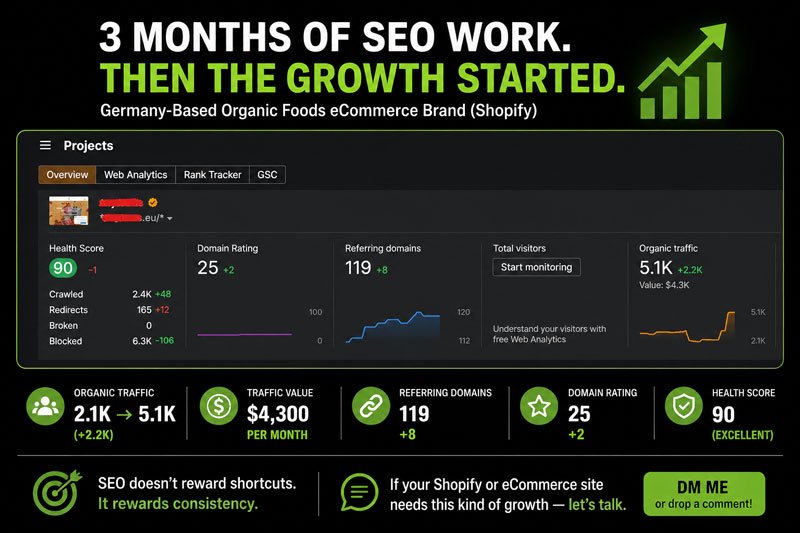
A Germany-based organic food brand on Shopify grew organic traffic from 2.1K to 5.1K visits per month, a 143% increase, in three months. Technical fixes, on-page work on product and collection pages, steady white-hat link building and Shopify-specific clean-up drove the change, and the traffic value moved to about $4,300 a month.
The product was solid and the brand was real. Google just was not sending enough people. Organic visits sat at 2.1K a month, which is the kind of plateau many Shopify stores reach after launch: the basics are in place, but nothing is pushing the store further up.
This is the focused version of the story: what the starting point looked like, what I changed, how to read each number honestly, and what you can take from it for your own store. For a longer case on a similar German store, read the Shopify SEO case study on a German organic food store.
Project snapshot
- Business: organic food brand, based in Germany
- Platform: Shopify
- Starting point: about 2.1K organic visits a month
- Timeline: 3 months
- Work: technical SEO, on-page SEO, link building, Shopify SEO
Results after 3 months
| Metric | Result |
|---|---|
| Organic traffic | 2.1K to 5.1K (+143%) |
| Traffic value | $4,300 per month |
| Referring domains | +8 new domains |
| Domain Rating | 25 (+2) |
| Health score | 90, with zero broken links |
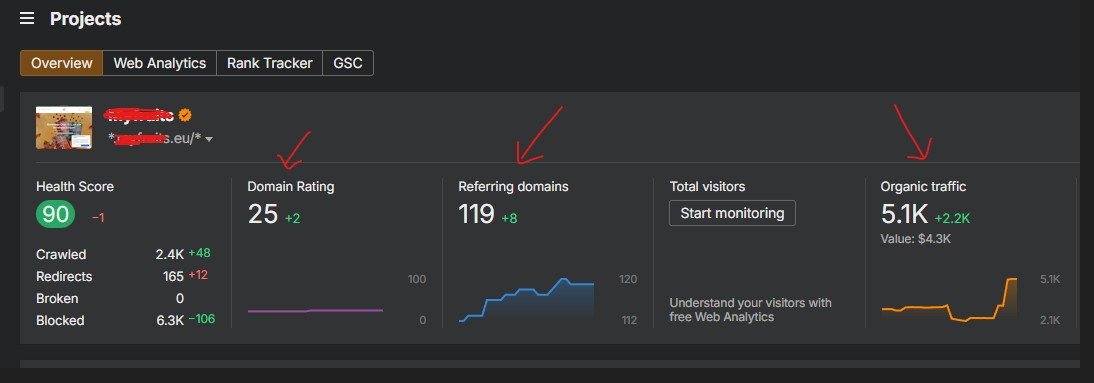
Traffic value and Domain Rating are third-party tool estimates. They are good for comparing one month with the next, but they are not revenue and they are not Google’s numbers.
How to read these numbers
The 143% is real, but the base was small. Going from 2.1K to 5.1K is a gain of about 3,000 visits a month. That is a strong result for a store this size, and it is also why percentages alone can mislead. When someone shows you a huge percentage, always ask what it started from.
Eight new referring domains is modest. That is the point. The growth did not come from a flood of links. It came mostly from fixing what was holding the site back, with a small number of relevant links on top. A Domain Rating that moved from 23 to 25 tells you the same story: authority crept up, it did not jump.
A health score of 90 with zero broken links is a foundation, not a trophy. It means crawlers were no longer wasting time on dead ends, which gives every other improvement a fair chance to count.
What I worked on, and why each piece mattered
1. Technical SEO
Shopify handles hosting and a lot of basics, but it still produces its own problems. Collections can create several URLs for one product, old products leave broken links behind, and redirects pile up as a catalogue changes.
I cleaned up crawl issues, tightened the redirects and removed broken links, so search engines could reach the pages that earn money. If your store has never had this check, a SEO audit is where to start, and the wider technical SEO service covers the fixes.
2. On-page work on product and collection pages
Collection pages usually carry the broadest, most valuable searches in a store, such as a product type or a diet. I worked on making these pages clearer about what they sell and who it is for, and on building authority on product pages.
Clear page purpose is what lets Google match the right page to the right search. Related reading: on-page SEO.
3. Steady, white-hat link building
I grew referring domains at a steady pace, with no paid link schemes and no link farms. Relevance mattered more than a high score on a tool. See how I approach link building.
4. Shopify-specific structure
Shopify fixes its URL paths, so the work is in how collections, tags and navigation are set up around them. Getting this right keeps internal links pointing to the main version of each page. More on the platform in my Shopify SEO page.
The order matters
If I had started with links on a site with crawl problems, much of the effort would have been wasted. The sequence I use on most stores is simple:
- Fix what blocks crawling and indexing. Nothing else counts until this is done.
- Make the money pages clear. Collections first, then best-selling products.
- Add authority. Relevant links, earned slowly.
- Measure and adjust. Look at which pages gained, and why.
What you can take from this for your own store
- Check for broken links and redirect chains. They are common and quick to fix.
- Make sure each collection page targets one clear search, with a short, useful introduction.
- Do not buy links. A handful of relevant ones beats a large number of weak ones.
- Track organic visits month by month, and compare to the starting point, not to someone else’s screenshot.
What this case does not prove
This is one store, in one market, with one starting point. Another store may grow faster, slower or not at all in the same time. Three months is also a short window, and I would not call the work finished. The honest takeaway is that fixing basic problems first made later work count, not that 143% is a number to expect.
Frequently asked questions
How was a 143% rise possible in 3 months?
The starting traffic was low and the site had fixable technical and structural issues. Removing those let existing pages perform, while on-page work and a few relevant links added to the gain.
Do backlinks matter for Shopify stores?
They support authority when earned steadily from relevant sources. In this case, eight new domains helped, but most of the growth came from fixing the foundation.
What does “traffic value” mean?
It is an estimate from an SEO tool of what the same organic visits would cost to buy through ads. It is useful for comparison, not as a revenue figure.
Is Shopify good for SEO?
Yes, for most stores. It is fast and reliable, but it has quirks around duplicate collection URLs that need care.
How long until I see results on my store?
Technical fixes can show effects within weeks. Content and authority usually take a few months. It depends on your competition and starting point.
Want the same kind of review for your store? See my Shopify SEO service, request a free website audit, or contact me. More stories are in the case study library.