This auto parts SEO case study covers a US company’s WordPress website that started almost from zero, where Google clicks grew about 18% (3.12K to 3.68K), estimated organic traffic grew 34% and Google AI-feature impressions grew about 90% in the last 28 days, with the work running since 28 February 2026. The site launched on 12 November 2025, and the work is still running.
I’m Nazirul Islam Nakib, an SEO specialist in Dhaka. I handle all SEO for this site myself through Nakib IT. The client’s name and website are kept private.
Project snapshot
- Client type: auto parts company
- Location: West Virginia, USA
- Platform: WordPress
- Website launched: 12 November 2025
- Work started: 28 February 2026, with the site close to zero in organic search
- Status: ongoing, about eight months in
- My role: Advanced SEO expert and AI search strategist
- Work covered: keyword targeting, topical authority, topic clustering, internal linking, backlinks, technical SEO and advanced schema markup
- Data sources: the client’s own Google Search Console and Semrush (estimates)
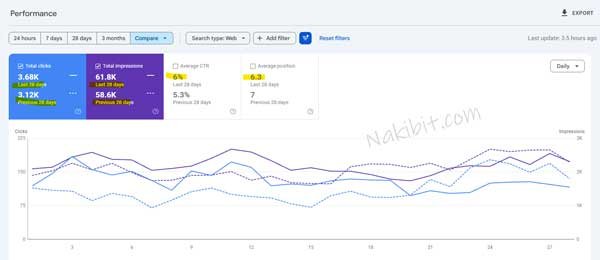
The result at a glance: Google Search Console
| Metric (Google, web search) | Previous 28 days | Last 28 days | Change |
|---|---|---|---|
| Total clicks | 3.12K | 3.68K | about +18% |
| Total impressions | 58.6K | 61.8K | about +5% |
| Average CTR | 5.3% | 6.0% | +0.7 points |
| Average position | 7.0 | 6.3 | 0.7 places higher |
| AI features impressions | 8.14K | 15.5K | about +90% |
Percentages are worked out from the rounded numbers Search Console shows, so treat them as “about”.
The starting point: a new site in a crowded niche
The website went live on 12 November 2025. When I started on 28 February 2026, it had almost no organic visibility. Auto parts search is crowded: big retailers, marketplaces, manufacturers and thousands of local sellers all compete for the same part and vehicle searches. A new site cannot win that with one trick. It needs a clear structure, steady content and trust built over months.
What I work on
Keyword targeting. Each important page has one clear target based on what buyers actually search for, so pages do not compete with each other.
Topical authority and clustering. I organised the content into groups of related pages around the subjects the site should be known for, so each topic has depth instead of scattered posts. See what is topical authority and how to create a keyword topical cluster map.
Internal linking. Related pages link to each other with clear anchors. This guides visitors and helps search engines understand which pages matter most.
Backlinks. I build relevant links from outside the site to add trust signals. I am not sharing the sources, because they would point to the client. See link building.
Technical SEO. I keep the site easy to crawl, fast and clean, so search engines can reach and index the right pages. See my technical SEO service.
Advanced schema. Structured data helps search engines understand what each page is about. See schema markup.
I am not listing each individual change, because the work is still running and the client’s setup is private.
A wider view from Semrush data
Search Console shows real clicks from Google. Semrush adds a wider picture, but its numbers are estimates, so I use them for direction, not as exact counts.
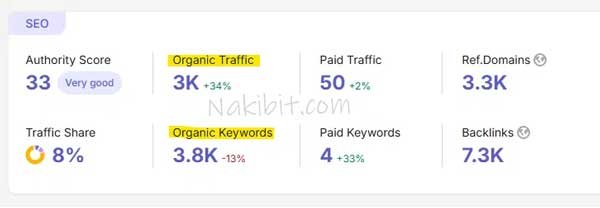
| Metric (Semrush estimate) | Value |
|---|---|
| Authority Score | 33 (rated “very good” by Semrush) |
| Organic traffic | 3K, up 34% |
| Organic keywords | 3.8K, down 13% |
| Referring domains | 3.3K |
| Backlinks | 7.3K |
| Traffic share | 8% |
Organic traffic rose 34% while the number of ranking keywords fell 13%. That can happen when a site gains more on its stronger terms while some very small long-tail terms drop out of the keywords Semrush tracks. I do not treat it as a problem or a win on its own. I watch it, and I focus on clicks and rankings for the pages that matter.
Where the traffic comes from
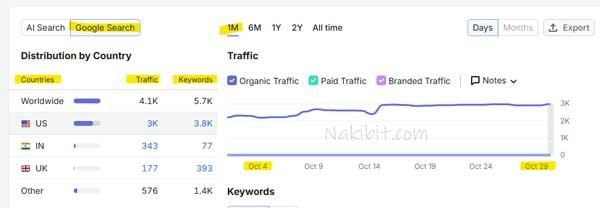
| Country (last month, Semrush estimate) | Traffic | Keywords |
|---|---|---|
| Worldwide | 4.1K | 5.7K |
| United States | 3K | 3.8K |
| India | 343 | 77 |
| United Kingdom | 177 | 393 |
| Other countries | 576 | 1.4K |
About three of every four estimated visits come from the United States, which matches a US auto parts company. The Semrush traffic line for the month stayed steady, with one visible step up in mid-October.
What visitors are searching for
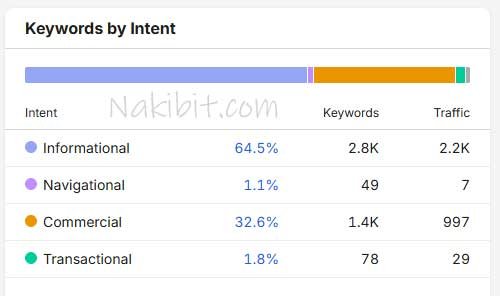
| Search intent | Share of keywords | Keywords | Traffic |
|---|---|---|---|
| Informational | 64.5% | 2.8K | 2.2K |
| Commercial | 32.6% | 1.4K | 997 |
| Transactional | 1.8% | 78 | 29 |
| Navigational | 1.1% | 49 | 7 |
Most of the traffic so far comes from informational searches, people learning about parts and problems. Commercial searches, where people compare options, are the next largest group. Transactional searches, where people are ready to buy, are still very small.
That is the honest gap, and the next focus. Building trust and topical depth with helpful content comes first for a new site. The next step is guiding that audience toward buying pages and strengthening transactional and commercial pages.
Visibility in AI features
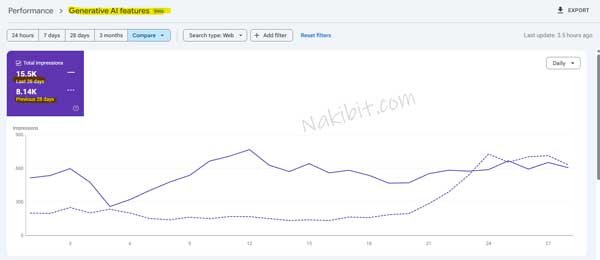
Search Console’s beta report for Google’s generative AI features shows impressions rising from 8.14K to 15.5K, about +90%. An impression here means a link to the site was shown inside one of these features.
Read the chart with care. The earlier period stayed low for most of its days and rose sharply in its last week, so the 28-day totals compare an uneven period. My reading of the daily lines is that AI impressions now sit at roughly 500 to 700 a day, compared with roughly 150 to 250 for most of the earlier period.
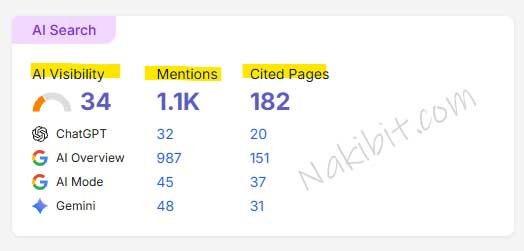
| AI platform (Semrush estimate) | Mentions | Cited pages |
|---|---|---|
| Google AI Overviews | 987 | 151 |
| Gemini | 48 | 31 |
| Google AI Mode | 45 | 37 |
| ChatGPT | 32 | 20 |
| Total | 1.1K | 182 |
Semrush gives the site an AI visibility score of 34. Almost nine in ten mentions come from Google AI Overviews. ChatGPT, Gemini and AI Mode are still small. That is a normal pattern for a young site, and it shows where more work can go.
What the numbers mean
Clicks grew faster than impressions. Clicks rose about 18% while impressions rose about 5%. CTR moved from 5.3% to 6.0%.
Rankings improved. Average position moved from 7.0 to 6.3, so the typical result now sits higher on page one.
AI visibility is the fastest-growing part. It is also the part with the most uneven data, so I watch the daily trend.
How to read these numbers honestly
- Both Search Console windows (the last 28 days and the 28 days before) fall long after work started on 28 February 2026. This shows how the site is growing during the project, not “before and after”.
- The site started almost from zero, so percentage growth is easier to achieve than it would be on an established site.
- Keyword targeting, topical authority, internal linking, backlinks, technical work and schema ran together, so I cannot say how much each one contributed.
- Semrush numbers are estimates and can differ from Search Console.
- Percentages come from rounded numbers.
- The work is still running.
What I learned so far
A new site can earn trust step by step. Structure, content depth, links and clean technical work all added up over eight months.
Informational traffic comes first. Helpful content builds visibility and authority early. Turning that into sales pages is the next stage.
AI features reward clear, structured pages. Most mentions so far come from Google AI Overviews.
One site is not a promise. These results are for this site only. Yours depends on your market, competitors and starting point.
Frequently asked questions
When did the work start?
On 28 February 2026, about three and a half months after the website launched on 12 November 2025. The project is still running, so this is a snapshot.
Can a brand-new auto parts website get organic traffic?
Yes, but it takes steady work on structure, content, links and technical health. This site went from almost zero to thousands of monthly clicks while the niche stayed crowded.
Why does schema markup matter?
It gives search engines a clear, structured description of each page. It is one part of the work and does not rank a page on its own. See my schema markup service.
Can you promise the same growth for my site?
No. I can promise a clear plan, honest reporting and white-hat methods.
Why is the client not named?
I protect client privacy. The numbers are real and come from the client’s Search Console and Semrush.
Want a plan like this for your site?
Start with a free website audit. I’ll reply personally within 24 hours. You can also hire me as your SEO expert, or read more SEO case studies.