Question research
The exact questions your buyers ask search engines and AI tools, grouped by intent.
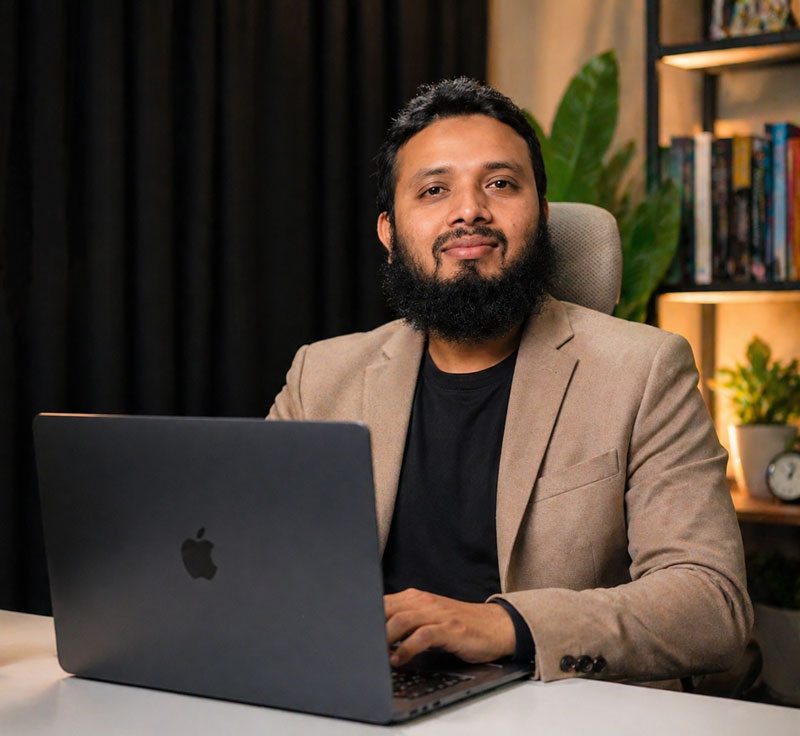
I am Nazirul Islam Nakib, an independent SEO expert and AEO expert. Answer engines pull a short, reliable passage and put it in front of the user. I restructure your pages so the passage they pull is yours: a direct answer first, backed by the detail, with the markup that makes it easy to read.
4.9/5 from 81 reviews · Answer-first content that still reads naturally
Get a free first look
Send your website. I will reply myself with what I see and what I would fix first.
or
Chat on WhatsAppAnswer engine optimization, or AEO, is writing and structuring a page so it can be the answer itself. Featured snippets, voice assistants, AI summaries and chat assistants all do the same thing: they find a passage that answers the question cleanly and lift it.
Most pages fail this test for a simple reason. The answer is buried under a long introduction, spread across several paragraphs, or never stated plainly at all. I fix that by placing a direct answer near the top, then supporting it with context, steps or evidence, with headings that match the way people phrase the question.
This is not about writing for robots. A page that answers fast is better for people too, and that is why it works. It builds on keyword research to find the questions, and on on-page SEO to get each page right.
The exact questions your buyers ask search engines and AI tools, grouped by intent.
A clear answer in the first lines, then the detail, tuned page by page.
Headings, lists and tables that make each answer easy to find and lift.
Structured data that matches the page, such as Article, Service and Breadcrumb.
Updating pages that almost answer a question so they finish the job.
Which answers you now win, measured over time, not guessed.
Two or three sentences that say the thing, before any background.
Numbers, names and conditions, not general statements anyone could write.
Headings that match questions, and lists or tables where they genuinely help.
A named author, clear sourcing and facts that can be checked.
Dates and details that are accurate today, not three years ago.
Search data, People Also Ask, forums and customer emails give the real list.
Each question goes to one page, new or existing, so pages do not compete.
Answer-first copy, tidy headings and markup, written in plain language.
Pages go live with internal links to related answers.
I track snippets, AI mentions and traffic, and refine pages that miss.
AEO shapes your pages. For how language models understand and recommend your whole brand, see generative engine optimization. For Google's AI summary specifically, see Google AI Overviews, and for ChatGPT, ChatGPT SEO. The full picture is on my AI SEO services page, and content SEO is where the writing is planned at scale.
I work as a holistic SEO expert, which means technical health, content, links and reputation are planned together. Fixing only one of them rarely moves the needle, so I tell you first which one is holding you back. I am an independent SEO expert, not an agency account manager. You get direct access to a senior SEO specialist who plans, builds and reports on the work personally.
I aim to be a trusted SEO consultant, not just a supplier: I explain every recommendation, show you the data behind it and tell you when SEO is not the right next step.
Answer engine optimization starts with the question, because an answer engine is built around questions. I collect the real questions your customers ask: from search suggestions, from your own enquiry emails, from sales calls, from reviews and from the Search Console queries that already bring people to you. Then I group them by the page that should answer them.
Most sites have a mismatch here. Several questions point to one overloaded page, or a question has no page at all, or a page answers a different question than the one asked. Fixing the mapping is the first task of an AEO expert. Each important question gets one clear home, so there is no confusion about which page should be the answer and no two of your own pages competing for the same question.
Then, as an answer engine optimization expert, I write or rewrite the answer itself. It sits near the top of the page, in plain sentences, and covers the question completely in a short paragraph. The detail, the exceptions, the examples and the evidence come after. That order serves a reader who wants the answer fast and a system that wants a passage to lift.
Last, I test. I check how Google, assistants and AI tools answer the same question before and after, and I note whether your page is used.
It is easy to blur the two. Answer engine optimization works at page level: structuring a specific page so a short passage can be the direct answer to a specific question. Generative engine optimization works at brand level: how language models understand, describe and cite your business as a whole. AI SEO is the umbrella that includes both plus technical access.
If you want the brand-level work, read about how I approach brand and entity signals for generative engines. This page deals with the pages themselves: their structure, their wording and their markup.
The split is practical. Page-level changes can be made in a few days and tested quickly on specific questions. Brand-level changes take months. A good plan uses both, in that order, because a strong answer on a page nobody trusts will not go far, and a trusted brand with unclear pages will not be quoted.
My answer engine optimization expert method uses a simple pattern. A heading that names the question. A direct answer of one to three sentences. A short supporting section that explains why, with a number or an example where I have a real one. A list when the content is a list, such as steps, requirements or options. A note on exceptions or limits. And a clear next step.
Headings do real work. A heading phrased as the question a person would type helps a reader scan and gives a system a label for the passage below it. I avoid clever headings that hide the topic.
Length matters less than completeness. A good answer is as long as it needs to be. Some questions need two sentences, some need a full page with a table. I do not pad short answers and I do not cut long ones short.
Tables, lists and definitions are useful, because they are easy to extract. But they have to carry real information. A list of generic benefits helps nobody. A list of what is included, what is not and what it depends on helps everybody.
Structured data can state facts in a machine-readable way, such as who you are, what the page is about or what an article says. I use schema markup where it matches what is visible on the page. Google's own guidance on AI features says that structured data must match the visible text, and that no special markup or AI-specific file is needed to appear in AI Overviews or AI Mode.
So I do not treat markup as a trick. It is a clarity tool that supports good content. Adding schema to a weak page does not make it a strong answer. I also avoid marking up content that is not on the page, because that can create problems with search engines.
The same is true of FAQ blocks. A real list of questions a customer asks, answered honestly, is useful for readers and easy to parse. I include them where they help. I do not add them to every page as a formula, and I do not rely on any particular rich result appearing, since search engines change what they show.
I cannot promise that your passage will be chosen. Answer engines decide which source to use based on signals they do not fully publish, and different engines choose differently. A page can be the answer on one assistant and absent on another.
Answers can also reduce clicks. When a system shows the answer directly, some people do not visit the page. That is not a reason to avoid AEO, because being the named source still builds familiarity and trust, but it does mean you should measure more than clicks.
Finally, a direct answer does not suit every page. A page whose purpose is to persuade, to tell a story or to let someone explore a product should not be flattened into a definition. I choose which pages to restructure and which to leave alone.
For each priority question, I record who is shown as the answer in Google and in the main assistants, whether your page is cited and how the passage reads. I repeat the check on a schedule and compare. In Search Console I watch impressions, clicks and average position for the question-based queries mapped to each page. Google says AI Overviews and AI Mode traffic is counted in the Web search type of the report, so those queries are part of the picture.
I also look at what happens after the visit: do those pages lead to enquiries, sign-ups or calls? An answer that gets quoted but does not help the visitor decide is only half the job.
For evidence from past work, I can show a luxury bag project in Spain with 3,085 Google AI Overview appearances and 325 ChatGPT appearances. It is one project, and I present it as an example, not a promise.
The most common mistake is burying the answer. A page that opens with a long introduction about the company, then three paragraphs of background, leaves the actual answer far down. Move it up, and keep the background for later.
The second is answering a different question than the one asked. A page titled around a service name often does not answer the question a customer asks about it, such as how long it takes, who it suits or what it depends on. I map each page to a real question and rewrite its opening to match.
The third is duplication. Two pages that answer the same question compete with each other, and neither becomes the clear source. I consolidate or differentiate them, and make sure internal links point to the one that should win. This also protects you against the keyword overlap that harms rankings.
The fourth is vague language. Phrases such as high-quality, leading and tailored say little. A specific statement, such as what is included and what is not, gives a system something to repeat accurately.
The fifth is neglecting freshness. If a page answers a question about rules, tools or costs, an old date makes it a risky source. I add review dates and update the pages that need it.
Each of these is a small edit with a clear reason, and together they often change how a page performs more than a full redesign would. None of these fixes needs a new website. They need careful editing of the pages that matter most, and a record of what changed so you can see what helped.
Ask a provider to show a page they have restructured and the question it now answers. Ask how they decide which pages to leave alone. Ask what they will not promise. A real AEO expert, AI SEO expert or LLM SEO specialist will talk about questions, pages and evidence, not about secret formulas.
I work independently, so you deal with me from the first question map to the last report. The wider approach is on the Nakib IT home page, and you can ask a senior SEO consultant in Dhaka for a plain assessment of your most important pages. For the overview of how all the AI work fits together, read my AI SEO page, or start with an AI visibility audit.
New to the idea? Read what answer engine optimization is and how GEO, AEO and traditional SEO differ.
See the work behind this: a luxury bag brand in Google AI Overviews and ChatGPT and a digital product cited in Microsoft Copilot. You can also browse every case study.
Send me a URL and a question it should answer. I will tell you whether it would be quoted and how I would change it.
No obligation · Reply from Nazirul Islam Nakib himself
 Nazirul Islam Nakib
We usually reply in a few minutes
Leave your email or WhatsApp number and we'll follow up as soon as we're back online.