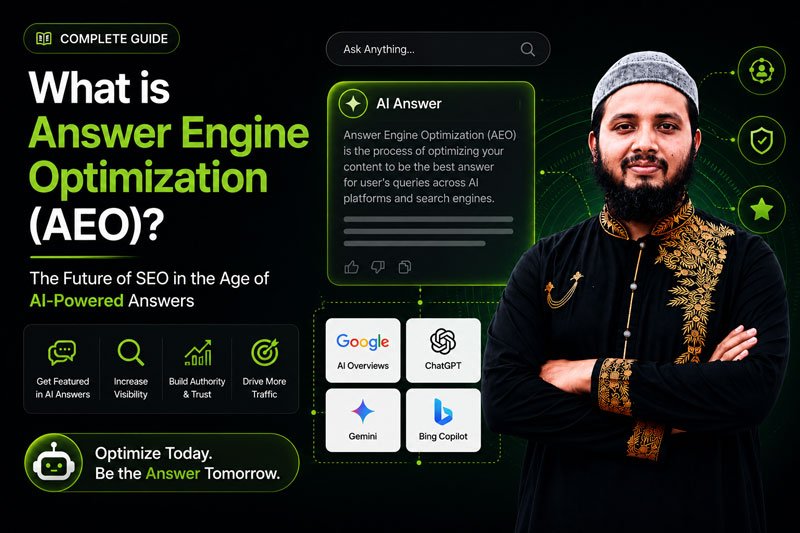
What is answer engine optimization? Answer Engine Optimization (AEO) is structuring your content so search engines, AI tools and voice assistants can pull it out as the direct answer to a question. You lead with a clear answer, support it with detail, and mark it up so machines can read it.
More searches now end on the results page. People read a snippet, an AI summary or a spoken answer and move on.
If your content is the source of that answer, you gain visibility even when nobody clicks. If it is not, a competitor owns that moment.
I’m Nazirul Islam Nakib. I use AEO on client pages every week, and this guide covers the tactics you can apply today.
What AEO means
Classic SEO competes for a spot in a list of links. AEO competes to be the one answer.
The targets include featured snippets, People Also Ask boxes, Google AI Overviews, voice assistants and chat tools like ChatGPT and Gemini.
AEO overlaps with GEO. AEO is about the answer to a specific question. GEO is wider and covers brand recommendations. Compare them in GEO vs AEO vs traditional SEO.
Which questions suit AEO?
AEO works best for questions with a clear, short answer:
- Definitions: “What is a canonical tag?”
- Steps: “How do I verify my Google Business Profile?”
- Quick facts: “How long does a site migration take?”
- Simple comparisons: “Subdomain vs subfolder for SEO”
It works less well for questions that need a recommendation or a judgement. Those are GEO territory.
How answer engines pick content
They look for pages that match the question and state the answer plainly.
They also prefer sources that look trustworthy: clear authorship, accurate facts and a technically sound site.
No one outside the platforms knows the full formula. These habits simply raise your odds.
AEO tactics that work
1. Use question-style headings
Write headings the way people ask. “How long does a site migration take?” beats a clever title like “Timing is everything”.
2. Answer first
Put a direct answer in the first one or two sentences under the heading. Keep it short and self-contained, so it still makes sense when lifted out of the page.
A good length is roughly 40 to 60 words for a snippet-style answer.
3. Add detail after the answer
Explain, give steps and add examples. Use short paragraphs. The answer wins the snippet, and the detail wins the reader.
4. Use lists and tables
Steps, comparisons and checklists are easy to lift. Use real list and table markup, not images of text.
5. Add an FAQ section
Cover the real follow-up questions at the end of the page, each with a short answer. These often feed People Also Ask and AI answers.
6. Add structured data
FAQ, HowTo, Article and Organization schema help machines understand what the page contains. Only mark up content that is visible on the page. See schema markup for AI search.
7. Be accurate and current
A wrong or outdated answer gets dropped. Review pages that target answers every few months.
8. Keep the page fast and crawlable
An answer on a slow or blocked page cannot be used. The technical basics still apply. See technical SEO checklist for AI search.
A before-and-after example
Before: A page about site migrations opens with 150 words about how stressful migrations are, then buries the timeline in paragraph six.
After: It opens with an “How long does a site migration take?” heading and a two-sentence answer: a small site often takes a few days to a couple of weeks, while a large site with many redirects can take a month or more. Then it explains the factors, with a table of site sizes and typical steps.
The second version is better for readers and far easier for a machine to quote.
How to measure AEO
- Check whether you hold featured snippets for your target questions.
- Look at impressions in Search Console for question-style queries.
- Test your questions in Google, ChatGPT, Gemini and Perplexity and note which sources appear.
- Watch branded search, because answers build awareness even without clicks.
For a fuller method, see how to track visibility in AI search engines.
Common AEO mistakes
- Burying the answer. If the answer is not near the top, it is rarely lifted.
- Writing only short answers. Thin pages lose to deeper ones. Give the answer, then the depth.
- Marking up content that is not on the page. This breaks guidelines and trust.
- Targeting the wrong questions. Opinion questions rarely produce a clean answer box.
- Forgetting to update. Old facts get replaced.
Frequently asked questions
What is answer engine optimization in simple words?
It is writing and structuring your pages so a search engine or AI tool can use them as the direct answer to a question.
Is AEO the same as SEO?
It is part of modern SEO. SEO covers everything that helps you rank. AEO focuses on being the answer itself.
What is the difference between AEO and GEO?
AEO targets a direct answer to one question. GEO targets being cited or recommended by AI tools more broadly. See what is GEO.
Does AEO help with voice search?
Yes. Voice assistants read short, clear answers, which is exactly what AEO produces.
How long should an AEO answer be?
Usually one to three sentences, around 40 to 60 words, followed by the detail.
Does AEO still bring clicks?
Sometimes fewer, but the clicks that come are more qualified, and you gain brand exposure in the answer itself.
Can I use AI to write AEO content?
AI can help draft, but you must add real experience and check every fact. Generic AI text rarely wins answers.
If you want help turning your key pages into answers, see my answer engine optimization service, request a free website audit, or visit the home page.