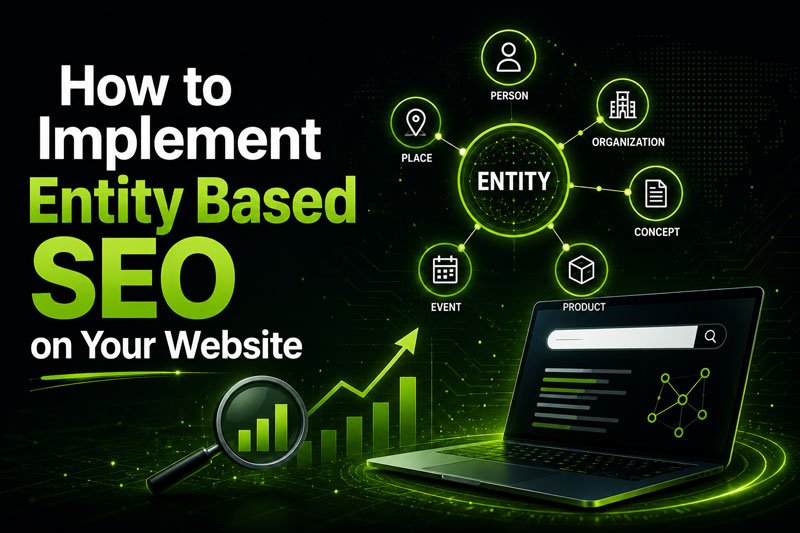
Entity based SEO is the practice of making it unmistakably clear to search engines and AI tools who you are, what you do and how you connect to the topics you cover. You do it with consistent facts, structured data, a clear About page and content that covers your subject properly.
Try a quick test. Ask ChatGPT or Gemini: “Tell me about [your business name].”
If the answer is vague, wrong, or mixes you up with someone else, you have an entity problem. Not a keyword problem.
I’m Nazirul Islam Nakib. This is the process I use on client sites, step by step.
What is an entity?
An entity is a specific, identifiable thing: a person, a brand, a place, a product or a concept. “Nazirul Islam Nakib” is an entity. So is “Dhaka” and so is “schema markup”.
Search engines and AI tools don’t only match words. They try to work out which things a page is about and how those things relate.
Google’s Knowledge Graph is one of the systems built around this idea. AI answers draw on many sources, so a clear, consistent identity across the web helps them describe you correctly.
Entity SEO vs keyword SEO
Keyword SEO asks: which phrase should this page rank for?
Entity SEO asks: does the web agree on who this brand is, and what it is known for?
You still need keywords. Entities make them work harder, because search engines are more confident about who is speaking.
Step 1: Map your entities
Before you touch code, write down three things.
Your brand entity. Name, what you do, where you operate, who leads it.
Your expertise entities. The topics you want to be known for. For me, that is AI SEO, technical SEO, local SEO, schema markup and similar.
Your relationship entities. The people, tools, places and organisations you are genuinely connected to.
This map guides everything below.
Step 2: Build a clear entity home
Your About page and home page are your main source of truth. Put plain facts there: name, location, what you do, who runs it, and how to contact you.
Then repeat those facts exactly the same everywhere else.
Add Organization schema in JSON-LD, so machines can read the facts directly. Here is a basic example. Replace every placeholder with your real details.
{
  "@context": "https://schema.org",
  "@type": "ProfessionalService",
  "@id": "https://yourdomain.com/#organization",
  "name": "Your Business Name",
  "url": "https://yourdomain.com",
  "logo": "https://yourdomain.com/logo.png",
  "description": "One clear sentence about what you do.",
  "founder": { "@type": "Person", "name": "Founder Name" },
  "sameAs": [
    "https://www.linkedin.com/company/your-profile",
    "https://www.facebook.com/your-page"
  ]
}
The sameAs field is the useful part. It tells search engines that your real profiles belong to the same entity as your site.
Need help? My schema markup service covers this. You can also read about my background on the about page.
Step 3: Consider Wikidata, if you qualify
Wikidata is an open knowledge base run by the Wikimedia Foundation. Search engines can use it as a structured source.
It has notability rules. A brand needs independent, reliable sources that mention it. Don’t create an entry for a business that doesn’t meet them, because it will be deleted.
If you do qualify, add the basics: label, description, official website and your main profiles.
Step 4: Extend schema across the site
Organization schema is the foundation. Then add the others where they truthfully apply.
- Article on blog posts, with a named author.
- Person for authors and key team members.
- Service on service pages.
- BreadcrumbList across the site.
- FAQPage where a page really answers questions.
Only mark up what is visible on the page. Invented schema is worse than none.
Step 5: Cover your topic properly
Entities live in a network. So should your content.
For each important concept in your map, publish one strong page. Then link those pages to each other, using anchor text that describes the relationship.
This builds topical authority and entity clarity together. For planning, see content SEO.
Step 6: Keep facts consistent across the web
Search engines gather information from many places. Mismatches create doubt.
Keep your business name, address, phone and description identical on your website, Google Business Profile, LinkedIn, social profiles and directories.
Small differences such as “Nakib IT” and “Nakibit SEO” make it harder to tell that these are the same brand.
Other helpful signals include press mentions, podcast guest spots, expert quotes and an active LinkedIn or YouTube presence. Earn these honestly; they take time.
If you serve a local area, a complete Google Business Profile is one of the clearest entity signals you can send.
Step 7: Give your content real authors
Anonymous content has no one standing behind it.
Create an author page for each writer, with a short bio, real experience, and links to their other work and profiles. Add Person schema to it.
This ties your content to a real person, which supports trust (E-E-A-T) as well as entity clarity.
How to measure progress
Rank tracking won’t tell you whether entity work is landing. Look at these instead.
- Knowledge panel. Does a panel appear when you search your brand?
- AI descriptions. Ask ChatGPT, Gemini and Perplexity about your brand each month. Is the description accurate?
- Branded searches. Are more people searching your name in Search Console?
- AI citations. Does your site get cited for queries in your niche?
Results vary and take time. Treat each as a trend, not a switch.
Entity based SEO and AI search
AI tools build answers from what they can find and verify. A clear entity makes you easier to describe and easier to trust.
It is not a trick, and nobody can promise citations. But it removes the guesswork that stops good brands from being mentioned. See how this fits into AI SEO and generative engine optimization.
Entity SEO checklist
- Entity map written down
- About page with accurate, consistent facts
- Organization schema with sameAs links
- Article, Person, Service and Breadcrumb schema where they apply
- Google Business Profile complete
- Name, address and phone identical everywhere
- One strong page per key concept, with internal links between them
- Named authors with bio pages
- Wikidata entry, only if you meet the notability rules
- Monthly check of how AI tools describe you
Frequently asked questions
What is entity based SEO?
It is optimising so that search engines and AI tools can identify your brand, understand what it does, and connect it to the right topics.
Is entity SEO the same as semantic SEO?
They overlap. Semantic SEO is about meaning and context in content. Entity SEO focuses on identifying the specific things, such as your brand and people, behind it.
Do I need a Wikipedia page?
No. Many strong entities don’t have one. Focus on consistent facts, schema and real mentions first.
How long does it take?
The on-site work can be done in days. Recognition across the web builds over months.
If you’d like help, start with an AI visibility audit, or see how I work on technical SEO. The home page lists everything I offer.