
Here’s a question that reveals everything about how SEO has changed.
Which page ranks higher for the query “can you get medicine for someone at a pharmacy?”
Page A: Contains the exact phrase “can you get medicine for someone at a pharmacy” twelve times throughout the content.
Page B: Never uses that exact phrase — but clearly explains how to pick up prescriptions on behalf of another person, who is authorized to do it, and what ID you might need to bring.
In 2015, Page A might have won. In 2026, Page B wins every time.
The reason? Google doesn’t read keywords anymore. It reads language — the way a human would. And the technology making that possible is Natural Language Processing.
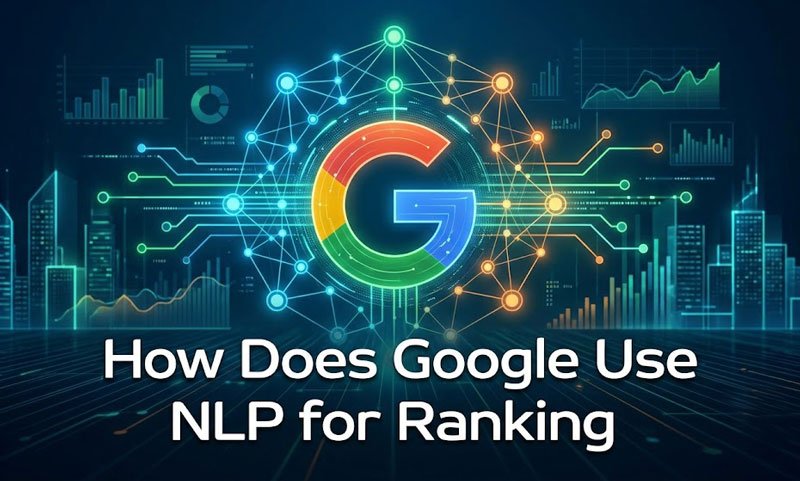
How Does Google Use NLP for Ranking? The Core Answer
Natural Language Processing (NLP) is the branch of artificial intelligence that enables computers to understand, interpret, and generate human language in all its complexity — including context, intent, ambiguity, and meaning beyond literal words.
Google uses NLP at multiple critical stages of search:
- Interpreting what a user’s query actually means
- Understanding what a webpage’s content is actually about
- Matching the right content to the right query based on meaning — not just word overlap
- Generating AI Overviews, featured snippets, and AI Mode responses from trusted sources
- Building and expanding the Knowledge Graph through entity extraction
Every major Google ranking system — RankBrain, BERT, MUM, and now Gemini — is built on NLP foundations. Understanding how these systems work is the most direct path to understanding what Google actually rewards in 2026.
Google’s NLP Evolution: From Keywords to Language Understanding
Google didn’t arrive at its current NLP capabilities overnight. The journey spans over a decade of research and implementation — each step moving further from keyword matching toward genuine language comprehension.
Hummingbird (2013) was the first signal that Google was moving beyond keyword matching. Instead of processing each word in a query separately, Hummingbird began processing entire queries as unified units of meaning. “What’s the best way to make pasta at home without a machine” became a single intent — not six individual keyword targets.
RankBrain (2015) introduced machine learning to query interpretation. Google could now handle queries it had never seen before — using vector space analysis to infer meaning from context and similarity to known queries. Google confirmed RankBrain as one of its top three ranking signals.
BERT (2019) was the breakthrough that changed everything. Bidirectional Encoder Representations from Transformers — trained to read text in both directions simultaneously — allowed Google to understand the relationship between every word in a sentence, not just individual words in isolation. By 2021, BERT was powering 99% of all English search results. That’s not a small update. That’s the entire English-language search index running on deep NLP.
MUM (2021) extended NLP to multimodal understanding — processing text, images, video, and audio simultaneously across 75 languages. MUM could answer complex research questions that required synthesizing information from multiple formats and sources.
Gemini (2023–2026) is the current state of the art. Built on Google’s most advanced language model, Gemini doesn’t just interpret language — it reasons about it. It evaluates source credibility, synthesizes multi-source answers, and generates AI Overviews with a level of contextual understanding that makes BERT look like an early prototype by comparison.
The trajectory is clear. Every step moved Google further from “find pages with the right words” to “understand what the user needs and find the best possible answer.”
The 6 Ways Google’s NLP Directly Affects Your Rankings
1. Query Interpretation: Understanding What Searchers Actually Mean
Before Google serves a single result, its NLP systems interpret the query.
This interpretation goes far deeper than synonym recognition. Google’s NLP breaks down the grammatical structure of the query, identifies the entities involved, determines the relationship between those entities, and classifies the underlying intent.
“Brazil traveler to USA need a visa” and “USA traveler to Brazil need a visa” contain almost identical words — but BERT correctly identifies that these queries are asking about completely different situations based on word order and grammatical relationships.
This matters for your content because Google isn’t looking for pages that contain the query. It’s looking for pages that answer the intent behind the query. A page built around exact keyword repetition can rank below a page that never uses the exact phrase — if the second page more clearly satisfies what the searcher actually needed.
2. Content Understanding: Reading Your Page Like a Human
When Google crawls your page, its NLP systems do far more than index the words present. They analyze the entire semantic structure of your content.
Entity extraction — Google identifies every named entity on your page (people, places, brands, concepts, products) and maps the relationships between them. A page about “technical SEO” that mentions Core Web Vitals, robots.txt, crawl budget, server-side rendering, and structured data signals deep expertise through entity density and relationships — not keyword repetition.
Salience scoring — Google assigns a salience score to each entity on your page, reflecting how central that entity is to the content. A page where “AI SEO” appears throughout and connects to multiple related concepts has high entity salience for that topic — which helps Google confidently classify your page’s subject matter.
Sentiment analysis — Google evaluates the sentiment of your content and how it relates to the entities discussed. This is particularly relevant for brand mentions across the web — negative sentiment signals around your brand can affect how Google perceives your credibility.
Content categorization — Google classifies your page into content categories using NLP-powered classification models. These categories inform which queries your page is eligible to rank for — and which it isn’t.
This NLP-driven content understanding is exactly why semantic SEO and entity optimization have become the foundation of content strategy in 2026 — because Google reads meaning, not keywords.
3. Intent Classification: Matching Content to the Right Queries
Every query Google processes gets classified into an intent category before a single result is served.
- Informational — the user wants to learn. “How does Google NLP work?” Serve educational content.
- Navigational — the user wants to find a specific site. “Google Search Console login.” Serve the brand’s own pages.
- Commercial — the user is comparing options. “Best AI SEO services for small businesses.” Serve comparison and review content.
- Transactional — the user is ready to act. “Hire SEO expert Bangladesh.” Serve service pages.
Mismatching your content format to the dominant intent for a query is one of the most common NLP-related ranking failures. Google’s NLP identifies the intent mismatch — and ranks content that matches correctly above content that doesn’t, regardless of other optimization signals.
Before optimizing any page, identify the dominant intent for your target query. Then structure your content — its format, depth, angle, and call to action — to satisfy that specific intent type.
4. Structured Content Signals: How Formatting Feeds NLP
Google’s NLP models don’t just process words. They process structure — and formatting communicates meaning to NLP systems that plain prose doesn’t.
When text appears in an HTML ordered list, Google’s NLP infers it’s likely a ranked list or step-by-step process. When text appears under an H2 heading, NLP infers it’s a major sub-topic of the page’s main subject. When text appears in a comparison table, NLP infers the content is evaluating options against defined criteria.
This means your formatting choices are semantic signals — not just readability improvements.
Practically:
- Use H2 and H3 headings that mirror the questions or topics your content answers
- Use numbered lists for processes and steps — NLP reads sequential structure
- Use comparison tables for evaluating options — NLP extracts structured comparisons accurately
- Keep paragraphs short and focused — NLP parses meaning more accurately from concise, well-structured sentences than from dense paragraphs
This structural understanding is what allows Google’s NLP to generate accurate featured snippets, AI Overviews, and “People Also Ask” answers — pulling the right section from the right page for the right query.
5. Entity Relationships and Knowledge Graph Building
NLP is the engine that builds and expands Google’s Knowledge Graph — the 5+ billion entity database that now serves as the foundation for AI-powered search.
When Google’s NLP systems crawl your content, they don’t just extract entities. They extract the relationships between entities. “Nazirul Islam Nakib is the founder of Nakibit, an AI SEO agency based in Bangladesh specializing in GEO and topical authority” — this single sentence allows NLP to map multiple entity relationships simultaneously.
These extracted relationships feed directly into the Knowledge Graph — strengthening the entity entries for your brand, your expertise areas, and your connections to related concepts. The stronger your entity representation in the Knowledge Graph, the more confidently Google and Gemini represent your brand in search results and AI-generated answers.
This is the direct connection between NLP, entity based SEO strategy, and AI search visibility — understanding this connection puts you ahead of the vast majority of businesses still optimizing for keywords alone.
6. AI Overview Generation: NLP Powering Gemini’s Answers
In 2026, NLP’s role in ranking extends beyond traditional blue-link results into AI Overview generation — which now appears in nearly 48% of Google searches.
When Gemini generates an AI Overview, it uses NLP to:
- Identify which pages best answer the query
- Extract the most relevant and accurate information from each source
- Evaluate the credibility and authority of each source
- Synthesize extracted information into a coherent, accurate answer
- Select which sources to cite visibly
Pages that are NLP-friendly — clear entity structure, direct answers in early paragraphs, descriptive headings, accurate factual content, proper schema markup — are significantly more likely to be selected as AI Overview sources than pages with equivalent keyword optimization but poor semantic structure.
Every piece of on-page SEO and content optimization at nakibit.com is built with NLP-friendliness as a core requirement — because the same content properties that help Google’s NLP understand your pages are the ones that earn AI Overview citations.
How to Use the Google Natural Language API to Test Your Content
Google offers a free Natural Language API demo that lets you see exactly how Google’s NLP interprets any piece of text. This is one of the most underused tools in SEO.
How to access it: Go to cloud.google.com/natural-language and click “Try the API.”
What to test: Paste in your page’s introduction, a key section, or your meta description. Run the analysis and review:
Entities tab — which entities did Google identify? Are your most important entities (your brand, your topic, your expertise area) showing up with high salience scores? Low salience on your core topic signals that your content isn’t communicating its subject clearly enough.
Sentiment tab — what’s the overall sentiment of your content? For most business content, neutral to mildly positive is appropriate. Unusually negative sentiment signals may affect how Google perceives your brand’s credibility.
Categories tab — what content categories did Google assign? Do these categories match the topic you’re trying to rank for? A mismatch here reveals that your content’s semantic signals are pointing Google in the wrong direction.
Syntax tab — review the grammatical structure analysis. Complex, ambiguous sentence structures that Google has difficulty parsing may indicate readability and NLP-friendliness issues.
Running your top-priority pages through this tool takes 10 minutes per page — and gives you direct insight into how Google’s actual NLP systems read your content.
7 Practical Ways to Optimize Content for Google NLP
1. Answer the question first, support it second. Google’s NLP extracts “answer sentences” for featured snippets and AI Overviews from early in your content. Put your direct answer in paragraph one — then build the supporting detail around it.
2. Use the vocabulary of your subject naturally. A genuinely comprehensive page about technical SEO will naturally include terms like crawl budget, Core Web Vitals, structured data, robots.txt, and server-side rendering — because these concepts belong to the subject. Include the full semantic vocabulary of your topic, not just the target keyword.
3. Name your entities explicitly. Don’t say “the company” when you mean Google. Don’t say “the tool” when you mean Semrush. Explicit entity naming gives Google’s NLP clear, unambiguous signals about who and what your content discusses.
4. Structure for NLP parsing. Descriptive headings, numbered lists for processes, tables for comparisons, and short focused paragraphs all make NLP extraction more accurate. Structure serves both human readability and NLP comprehension simultaneously.
5. Match your content format to search intent. NLP classifies intent before ranking. Ensure your page format — guide, list, comparison, definition, step-by-step — matches the dominant intent for your target query.
6. Build topical depth. Google’s NLP evaluates whether your domain demonstrates genuine expertise across a subject area. A topical cluster map built around your core niche tells NLP: this site is a comprehensive, reliable resource on this subject.
7. Implement schema markup. Schema markup reduces the interpretive burden on NLP by directly stating what your content means. Organization, Article, HowTo, and FAQPage schema are the highest-priority types for NLP-driven ranking improvement.
NLP and the Future of Search in 2026
Google’s NLP capabilities will only deepen as Gemini continues to evolve. The direction is clear: more semantic understanding, more intent precision, more entity relationship mapping, and more AI-generated answer synthesis from trusted sources.
The businesses that align their content strategy with how NLP works — rather than with how keyword-matching worked — are the ones building durable search visibility.
That means writing for meaning. Structuring for extraction. Building entity authority. Covering topics with genuine depth. Creating content that genuinely satisfies what searchers need.
That’s not just NLP optimization. That’s the entire philosophy behind AI-driven SEO services built for how search actually works in 2026.
NLP Optimization Quick Reference
| NLP Signal | What Google Evaluates | How to Optimize |
|---|---|---|
| Entity salience | How central your key entities are | Name entities explicitly, use them naturally throughout |
| Search intent | Does your content match query intent | Match format and depth to dominant intent type |
| Semantic vocabulary | Does your content use the full topic vocabulary | Cover the full semantic landscape of your subject |
| Content structure | Can NLP extract clear answers accurately | Descriptive headings, short paragraphs, structured lists |
| Sentiment | Is your content credible and accurate | Factual, well-sourced, authoritative writing |
| Entity relationships | How your entities connect to the Knowledge Graph | Schema markup + entity-rich content |