
Every single day, 15% of the searches Google processes have never been searched before.
That’s not a rounding error. That’s hundreds of millions of completely new queries — questions, phrases, and combinations that Google has never encountered. No historical data. No pattern to match against. No previous results to learn from.
For over a decade, this was one of Google’s most difficult challenges. How do you return relevant results for a query you’ve never seen?
RankBrain is Google’s answer. And understanding how it works — and how it evaluates your content — is one of the most practical things you can do to improve your rankings in 2026.
How to Optimize Content for Google RankBrain: What RankBrain Actually Does
Google RankBrain is a machine learning system that helps Google interpret search queries — especially new, ambiguous, or complex ones — and determine which results best satisfy the intent behind them.
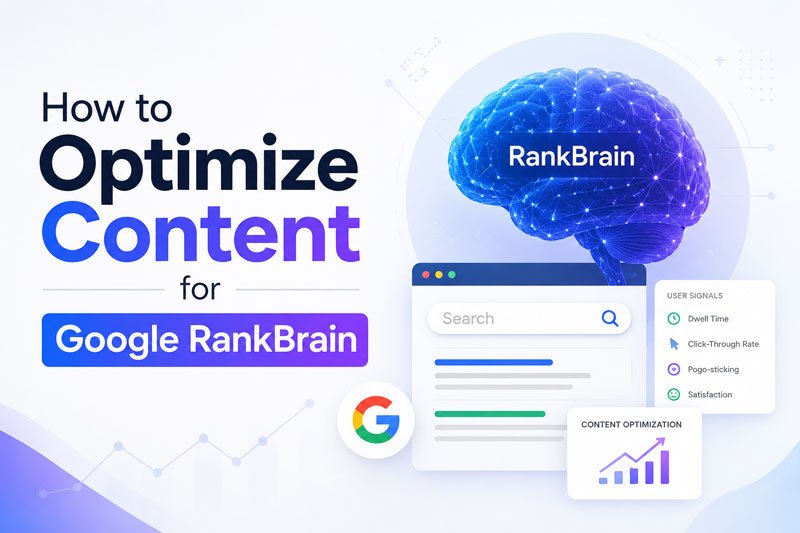
Here’s what makes RankBrain different from other ranking signals: it doesn’t just rank pages based on what’s in them. It observes how users interact with search results and adjusts rankings based on those behavioral signals.
When RankBrain serves a set of results for a query and users consistently ignore position one to click position three — and then stay on that page for a long time without returning to search — RankBrain interprets that as a quality signal. Over time, it adjusts the rankings to reflect what users actually found valuable.
This makes RankBrain a feedback loop between user behavior and search rankings. And it means that traditional on-page optimization, while still important, is only half the equation. The other half is what happens after someone lands on your page.
Google confirmed that RankBrain is among its top three most important ranking signals. In 2026, with Gemini now handling AI reasoning on top of RankBrain’s query interpretation, these two systems work together — RankBrain interprets the query, Gemini reasons about the best answer. Understanding both is what separates modern SEO from outdated SEO.
The Two Core Signals RankBrain Measures
Before diving into optimization strategies, understand exactly what RankBrain is watching.
Click-Through Rate (CTR)
When your result appears in search and users click it at a higher rate than expected for your position, RankBrain takes note. A page ranking in position four that gets clicked more than the pages in positions one, two, and three is sending a strong positive signal.
The inverse is also true. A page in position one that users consistently skip over — because the title or meta description doesn’t match their intent — will see rankings drop as RankBrain concludes that higher-ranked alternatives are consistently disappointing users.
Your title tag and meta description aren’t just labels. They’re your pitch to the searcher. RankBrain grades you on how well that pitch converts impressions into clicks.
Dwell Time and Pogo-Sticking
Dwell time is how long a user spends on your page before returning to search results. Pogo-sticking is when a user clicks your result, quickly returns to the search results, and clicks a different result instead.
High dwell time signals that your page delivered on its promise. Low dwell time and pogo-sticking signal that it didn’t.
RankBrain uses these signals to distinguish between pages that rank well on traditional signals but fail to actually satisfy users, versus pages that genuinely answer the question well. It’s a quality check that no amount of keyword optimization can fake.
Strategy 1: Match Search Intent Precisely
This is the highest-leverage thing you can do to optimize for RankBrain — and the most commonly misunderstood.
RankBrain is fundamentally an intent interpretation system. It doesn’t ask “does this page contain the keyword?” It asks “does this page satisfy what the searcher actually wanted when they typed that query?”
Before writing or optimizing any page, spend time studying the search results for your target keyword. Look at the top three to five results and ask:
What format are they in? List posts, step-by-step guides, comparison pages, definition pages, and product pages each signal a different dominant intent. If all top results are step-by-step guides and you publish a list post, you’re mismatching format to intent.
What depth do they cover? Are top results 600-word overviews or 2,000-word deep dives? Depth signals also reflect intent — a query looking for a quick answer doesn’t want a textbook, and a query looking for comprehensive guidance won’t be satisfied by a quick overview.
What angle do they take? “Best running shoes for beginners” and “best running shoes for marathon training” both contain “best running shoes” but serve completely different intent. The angle matters as much as the keyword.
When your page matches the dominant intent — format, depth, and angle — users find what they came for. Dwell time goes up. Pogo-sticking drops. RankBrain rewards the page.
This intent-matching process is built into every on-page SEO and content optimization strategy at nakibit.com because it’s the single most direct way to improve RankBrain performance.
Strategy 2: Write Titles That Win Clicks Without Misleading
Your title tag is your CTR lever. And CTR is one of RankBrain’s primary quality signals.
But there’s a critical balance to strike: a title that promises more than your content delivers increases clicks and destroys dwell time simultaneously. RankBrain sees both signals and penalizes accordingly.
The goal is a title that accurately represents your content while being compelling enough to earn the click over competitors.
What works for RankBrain-optimized titles:
Numbers and specifics — “7 Proven Strategies for…” outperforms “How to…” in most competitive queries because specificity signals substantive content.
Emotional triggers that align with intent — words like “Proven,” “Complete,” “Ultimate,” and “Step-by-Step” signal depth and reliability when the content actually delivers those things.
Year or recency signals — “(2026)” in a title signals current information, which is especially powerful for queries where freshness matters.
The power word + keyword formula — “[Compelling modifier] + [target keyword] + [outcome or qualifier].” Example: “How to Optimize Content for Google RankBrain (Practical 2026 Guide).”
Test your titles against the competition in search results. If your title blends into the other results on the page, it won’t stand out enough to earn a higher-than-expected CTR.
Strategy 3: Hook Readers in the First 100 Words
RankBrain watches dwell time from the moment a user lands. Pages that lose users in the first 30 seconds — because the opening is slow, vague, or fails to confirm the user found what they were looking for — see pogo-sticking spikes that RankBrain interprets as a quality failure.
Your first 100 words need to do three things simultaneously:
Confirm relevance — make the user feel immediately that they landed in the right place. Reference their problem or question in your opening so they know this page is for them.
Establish stakes — give them a reason to keep reading. What will they understand or be able to do after reading this page that they couldn’t before?
Signal credibility — a surprising statistic, a counterintuitive insight, or a specific real-world scenario establishes that this content has something genuinely valuable to offer — not just a repackage of what everyone else says.
The opening of this blog is an example of this approach: lead with a surprising statistic, immediately connect it to the problem being solved, then explain the solution. That structure converts impressions into engaged readers who stay.
Strategy 4: Structure for Readability and Scannability
Users who land on a page and see a dense wall of text frequently leave before reading a word. RankBrain sees that as a dwell time signal — and it’s not a positive one.
Structure your content so that a scanning user can immediately find the part most relevant to their specific need:
Short paragraphs — two to four sentences. White space signals approachability and keeps readers moving through the content.
Descriptive subheadings — H2 and H3 headings should tell the user exactly what each section covers. Vague headings force readers to read everything to find what they need. Specific headings let them navigate to their answer.
Bullet points and numbered lists — for processes, comparisons, or enumerated items. These are faster to scan and easier to absorb than equivalent prose.
Bold text for key insights — not for decoration, but to highlight the most critical sentences in each section. Bold text draws the eye of a scanning reader and keeps them engaged.
Images and visual breaks — relevant images, charts, or diagrams at regular intervals reduce cognitive fatigue and give readers visual confirmation that they’re progressing through substantive content.
Good readability structure is also directly connected to semantic SEO principles — structured, well-organized content is easier for both humans and search engines to process accurately.
Strategy 5: Use Medium-Tail Keywords as Your Target
Brian Dean at Backlinko popularized this approach — and it remains one of the most RankBrain-compatible keyword strategies available.
Short-tail keywords (one or two words) are too ambiguous for RankBrain to reliably interpret intent. “SEO” could mean a hundred different things. Long-tail keywords (five-plus words) are highly specific but low-volume.
Medium-tail keywords — typically three to four words, specific enough to carry clear intent but broad enough to generate meaningful traffic — are the sweet spot for RankBrain optimization.
When you build comprehensive, high-quality content around a medium-tail keyword, RankBrain understands your page’s subject clearly — and then surfaces it for dozens of related long-tail variations automatically. A page ranking for “how to improve website speed” will also surface for “how to improve website speed for WordPress,” “how to improve website speed for eCommerce,” “how to fix slow website load time,” and dozens of similar variations.
That’s RankBrain doing what it does — connecting content that genuinely covers a subject with every searcher who has a related need.
Strategy 6: Answer the Question, Then Go Deeper
RankBrain rewards pages that fully satisfy user intent. Not pages that answer the immediate question and stop there, but pages that anticipate what the user will want to know next and answer those follow-up questions too.
Think about how a genuinely helpful conversation works. You ask an expert a question. They answer it directly — then they mention the related things you’ll probably want to know, cover potential misunderstandings, and give you the full context you need to actually act on the answer.
That’s the content structure RankBrain rewards. Answer the core question clearly and early. Then cover the logical follow-up questions. Address common misconceptions. Provide context that makes the answer actionable. Give examples that make abstract concepts concrete.
This approach connects directly to building the kind of topical authority that compounds over time — because pages that satisfy intent fully tend to earn more organic links, more return visitors, and more positive behavioral signals that RankBrain feeds back into rankings.
Strategy 7: Optimize Your Meta Description for Clicks
Your meta description doesn’t directly affect rankings — but it directly affects CTR, which does.
A meta description that accurately previews what’s on the page and signals genuine value converts more impressions into clicks than a generic description or a truncated preview of your opening paragraph.
Write meta descriptions that:
- Include the primary keyword naturally (Google bolds it in results when it matches the query)
- Clearly state what the user will get from the page
- Create mild urgency or curiosity that makes clicking feel worthwhile
- Stay under 160 characters so they display in full on desktop
Think of your meta description as a 160-character sales pitch. RankBrain grades your actual delivery against that pitch through dwell time signals. Over-promise and you’ll pay for it in pogo-sticking.
Strategy 8: Improve Page Speed and User Experience
RankBrain doesn’t just evaluate your content — it evaluates the experience of consuming your content.
A page that loads in 4 seconds loses users before they read the first word. A page that bombards visitors with popups immediately signals a poor experience. A page that isn’t mobile-responsive frustrates the majority of users who arrive on mobile devices.
These UX failures produce behavioral signals — quick exits, immediate bounces — that RankBrain reads as quality failures, regardless of how good the content itself is.
Core Web Vitals — Largest Contentful Paint (LCP), Cumulative Layout Shift (CLS), and Interaction to Next Paint (INP) — are the technical metrics that proxy for user experience quality. Keeping these scores in the “good” range directly supports the positive behavioral signals RankBrain rewards.
A proper technical SEO audit and Core Web Vitals optimization addresses these UX signals at the technical level — because content quality and technical quality both feed into the same RankBrain performance outcome.
Does RankBrain Still Matter in 2026?
With Gemini now powering AI Overviews and AI Mode, some SEOs have started questioning whether RankBrain is still relevant.
The answer is yes — but its role has evolved.
RankBrain now operates as part of a broader AI stack within Google’s algorithm. It handles query interpretation and initial result quality assessment. Gemini handles reasoning, synthesis, and AI-generated answer production. These systems work in layers, not in competition.
What this means practically: optimizing for RankBrain — user intent alignment, strong CTR, high dwell time, comprehensive content — also improves your performance in Gemini-powered AI Overviews. The behavioral and quality signals that RankBrain measures are the same signals that tell Gemini a source is trustworthy enough to cite.
The AI-driven SEO approach at nakibit.com is built on this understanding — that optimizing for user experience, intent satisfaction, and genuine content quality serves every layer of Google’s algorithm simultaneously.
The RankBrain Optimization Checklist
Before you publish or update any important page, run through these:
✓ Search intent matched — format, depth, and angle align with top-ranking competitors
✓ Title is compelling, specific, and accurately represents the content
✓ First 100 words hook the reader and confirm relevance immediately
✓ Content answers the core question and logical follow-up questions
✓ Structure is scannable — short paragraphs, descriptive headings, visual breaks
✓ Medium-tail keyword targeted with natural semantic coverage
✓ Meta description previews value clearly in under 160 characters
✓ Page speed in “good” range for Core Web Vitals
✓ No intrusive popups or UX obstacles on mobile
The Bigger Picture
RankBrain taught the SEO world a lesson that still applies today: the algorithm isn’t trying to be fooled. It’s trying to find what users actually value.
Every optimization strategy built around faking quality signals eventually fails — because RankBrain watches real users making real decisions and adjusts accordingly.
The strategy that works — then and now — is building pages that genuinely satisfy what searchers need. Understand their intent. Answer their questions completely. Make the experience of reading your content better than the alternatives.
Do that consistently, and RankBrain doesn’t become an obstacle to rankings. It becomes the mechanism that rewards everything you’re already doing right.