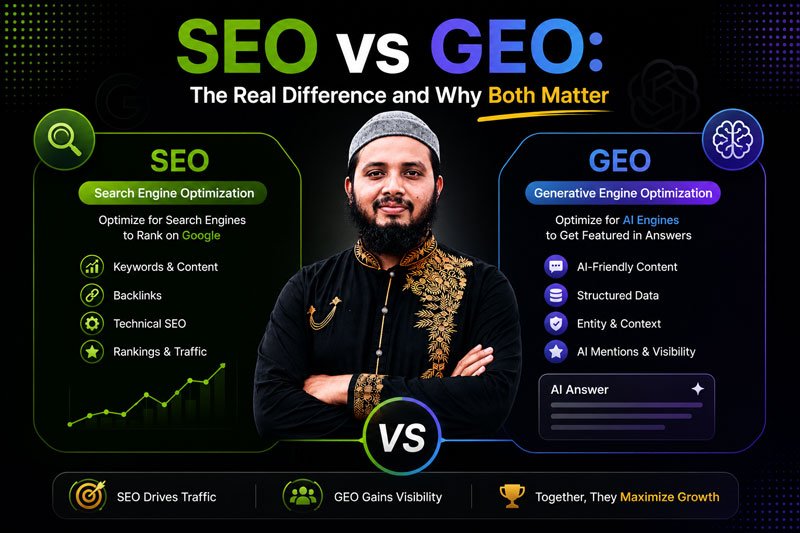
SEO vs GEO comes down to the goal. SEO aims to rank your pages in search results so people click. GEO aims to have your brand named or cited inside AI-written answers. You need both, because they share one foundation: useful content, a healthy site and real authority.
Picture two people looking for the same service.
One searches Google, scans the links and compares a few sites. The other asks ChatGPT and gets a short recommendation with a name or two.
Same need, different journey. Your business has to show up in both.
I’m Nazirul Islam Nakib. I work on classic SEO and AI visibility side by side, and here is how the two compare and how I would balance them.
SEO vs GEO at a glance
| SEO | GEO | |
|---|---|---|
| Main goal | Rank and earn the click | Be cited or recommended in an AI answer |
| Where it shows | Search results pages | ChatGPT, Gemini, Perplexity, Copilot and AI Overviews |
| What you measure | Rankings, clicks, conversions | Mentions, citations and how accurately AI describes you |
| Main levers | Keywords, links, technical health | Clear answers, structure, brand consistency and mentions across the web |
| User behaviour | Scans a list and chooses | Reads one answer, often without clicking |
| Speed of change | Months for most gains | Weeks for some tools, months for trusted mentions |
How SEO works
Google crawls your pages, stores them in an index and ranks them for searches using relevance, quality and many other signals.
The usual work covers search intent, on-page optimization, technical health and earning links. The result is a position in a list, and a click if your listing wins attention.
If you are new to it, start with what SEO is in digital marketing.
How GEO works
AI tools gather information from several places and write one combined answer.
So the question changes. It is no longer “does my page rank?” It becomes “will this tool understand me well enough to name me?”
GEO work focuses on:
- Direct, extractable answers on your pages.
- Accurate structured data.
- Consistent brand details across the web.
- Trust signals such as real authorship and genuine reviews.
- Presence on the sources AI tools often draw on.
The full method is in what is generative engine optimization.
Where they overlap
More than most people expect. Both reward:
- Helpful, original content that fully answers a question.
- A fast, crawlable, well-structured website.
- Clear expertise and honest authorship.
- Strong reputation signals such as reviews and mentions.
In practice, most of the work that helps one helps the other. That is why I never tell a client to “drop SEO for GEO”.
Where they differ in practice
Content style
SEO content can afford to build a story. GEO content has to state the answer plainly near the top, because machines lift short, self-contained passages.
Success measures
SEO has mature tools: rankings, Search Console, analytics. GEO measurement is rougher. You test prompts, track referral visits from AI tools and watch branded search. See how to track visibility in AI search engines.
Off-site signals
Links still matter for SEO. For GEO, plain mentions of your brand on trusted sites matter too, even without a link. See brand mentions and citations.
Click value
An SEO win is usually a visit. A GEO win may be a name in an answer and a later branded search. Both can lead to a sale, but the path looks different.
Which one should you focus on first?
- Your site has basic problems: start with SEO. Slow, thin or uncrawlable sites limit everything else.
- Your SEO is healthy and you sell to researchers: add GEO. Software, B2B and high-consideration purchases are asked about in AI tools often.
- You are a local business: get your Google Business Profile, reviews and website consistent. That helps both Google and AI tools recommend you.
- You are brand new: build clear pages and a consistent brand description first. Both channels use them.
A balanced plan
- Fix technical issues and cover your main topics well.
- Rewrite key pages so they lead with direct answers.
- Add schema markup for your business, authors and FAQs.
- Make your brand details identical across your site and profiles.
- Earn genuine reviews and mentions.
- Test AI tools monthly and note what they say about you.
Common mistakes
- Dropping SEO for GEO. You lose the foundation GEO stands on.
- Treating GEO as a trick. Hidden prompts or fake mentions backfire.
- Expecting identical results. The two channels reward different outcomes and move at different speeds.
- Judging only by clicks. Some AI value shows up as brand searches and direct visits.
Frequently asked questions
What is the difference between SEO and GEO?
SEO ranks pages in search results to earn clicks. GEO makes your brand more likely to be cited or recommended in AI-generated answers.
Is GEO replacing SEO?
No. GEO depends on the same foundation as SEO. See will AI search replace Google SEO.
Do I need both SEO and GEO?
For most businesses, yes. Good SEO is the base and GEO adds a layer on top.
Is GEO harder than SEO?
It is different. The tactics are simpler to start, but measurement is less mature and results are harder to guarantee.
How is GEO different from AEO?
AEO targets the direct answer to one specific question. GEO is wider and covers being recommended. See GEO vs AEO vs traditional SEO.
Can a small business benefit from GEO?
Yes. Local and niche businesses often win mentions because their information is clear, consistent and well reviewed.
How long until GEO shows results?
Some tools respond within weeks. Building trusted mentions usually takes months.
If you want help with both, see my AI SEO service, request a free website audit, or visit the home page.