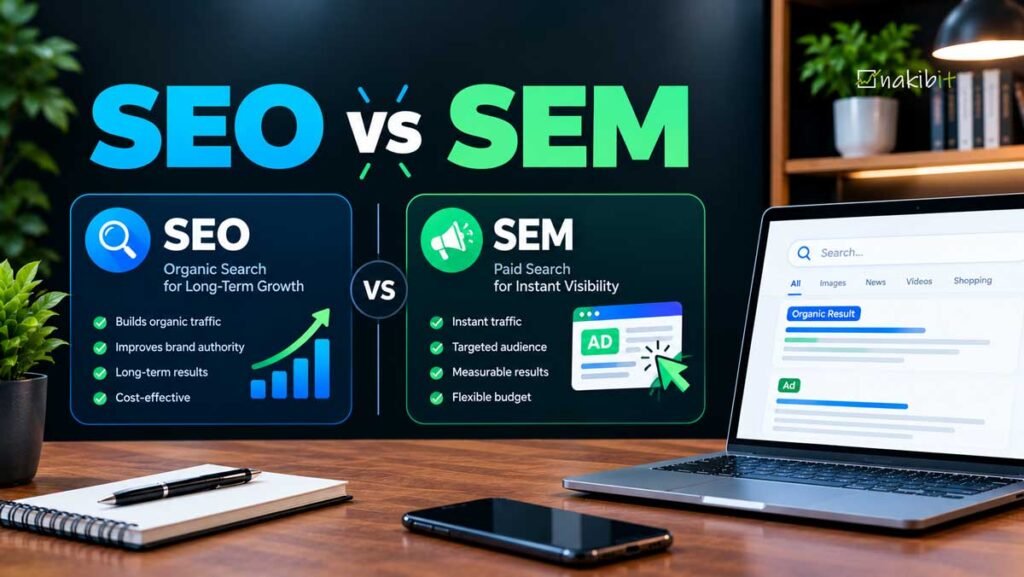
SEO vs SEM comes down to one split: SEO earns free (organic) rankings in search results over time, while SEM, in everyday use, means paying for ads in search results and getting clicks as soon as the campaign goes live. Strictly speaking, search engine marketing (SEM) is the whole discipline of getting visible in search, so it includes SEO and paid search together. Most marketers still use “SEM” to mean paid search, and I will point out which meaning I use each time. This guide compares the two on cost, speed, control, risk and AI search, and ends with a simple way to decide what your business should do first.
I am Nazirul Islam Nakib, a freelance SEO expert in Dhaka. I help businesses in more than 20 countries rank on Google and appear in AI answers, so I see both sides: businesses that burn their ad budget on weak landing pages, and businesses that wait a year for organic traffic when a small test campaign would have told them what works. If SEO itself is new to you, start with my plain guide on what SEO optimization is.
SEO vs SEM at a glance
| SEO (search engine optimization) | SEM as paid search (PPC, search ads) | |
|---|---|---|
| What you get | Unpaid, organic rankings | Paid ad placements labelled “Sponsored” or “Ad” |
| How you pay | Time, content, tools, expertise. No fee per click | You usually pay each time someone clicks |
| Speed | Weeks to months | Can start the day the campaign is approved |
| Staying power | Rankings can keep earning traffic if you maintain them | Traffic stops when the budget stops |
| Control | Indirect. You improve, the search engine decides | Direct. You choose keywords, budget, location, device and message |
| Risk | Slow start, algorithm changes | Rising click costs, wasted spend on poor targeting |
| Best for | Long-term growth and trust | Fast tests, launches and high-intent buyers |
Short version: SEO is like owning a shop on a busy street. SEM is like renting a billboard. Both bring people, but only one is yours when the rent stops.
What is SEO?
SEO means improving your website so search engines can find it, understand it and rank it higher in unpaid results. The main parts are:
- Keyword research: finding the words your customers type. See keyword research.
- On-page SEO: titles, headings, content and internal links. See on-page SEO.
- Technical SEO: crawling, indexing, speed and mobile usability. See technical SEO.
- Off-page SEO: links and mentions from other trusted sites. See backlinks and link building.
- Content: pages that answer real questions better than the ones already ranking. See content SEO.
A broader view sits in my SEO marketing strategy guide.
What is SEM?
SEM stands for search engine marketing. There are two meanings, and mixing them up is the main reason this topic confuses people.
- The wide meaning. Search Engine Land describes SEM as the combination of SEO and PPC in one search strategy, and says SEM is not the same as PPC. Under this meaning, SEO is the organic half of SEM.
- The everyday meaning. In job ads, agency proposals and many articles, “SEM” simply means paid search advertising, usually Google Ads or Microsoft Advertising.
Competitor pages split on this: Semrush uses the wide meaning but covers paid search in its SEM section, while TechTarget and BrightEdge say SEM usually means paid ads. In this guide, “SEM” means paid search unless I say otherwise, because that is how most people compare it with SEO when they search for “SEO vs SEM”. If you ever see “SEO and SEM” written together, the author is probably using SEM to mean paid search too.
Related acronyms
- PPC (pay-per-click): the pricing model of most search ads. SEM in the paid sense is mostly PPC.
- SEA (search engine advertising): another name for paid search, common in Europe.
- SMM (social media marketing) and SMO (social media optimization): work on social platforms. They are part of digital marketing, not part of search engine marketing.
- SME: small and medium enterprise. When people search “SME SEO” they usually mean SEO for a small business. See my guide on affordable SEO services for small business.
How paid search works
When someone searches, the search engine runs an auction for the ad spots. Google says Ad Rank decides whether your ad is eligible to show and where it appears relative to other advertisers. Ad Rank depends on:
- Your bid, the most you are willing to pay for a click. You often pay less than that.
- The quality of your ad and landing page, which Google summarises as Quality Score.
- Minimum thresholds an ad must reach to show.
- How competitive the auction is.
- The search context, such as the search words, location, device and time.
- The expected effect of ad assets and formats such as sitelinks.
The point many beginners miss is that a high bid alone does not win. A relevant ad that sends people to a good landing page can beat a bigger bid, and that is where SEO skill helps paid search.
SEO vs SEM: the main differences
1. Where you appear
Organic results are earned. Paid results are bought and carry a label such as “Sponsored” or “Ad”. Searchers can tell them apart, and many people skip ads on purpose. That is one reason a mix of both usually beats either alone.
2. Speed
Paid search can bring traffic quickly. SEO builds slowly. Published sources give very different ranges: BrightEdge says three to six months for competitive terms, TechTarget says three months to two years, and Semrush says six to twelve months for significant results. None gives a method, so I would not trust any single number. A fair answer: a clear niche with weak competition can move in weeks, a competitive keyword often takes many months, and the speed depends on how strong your site already is. See why your business needs SEO for the long-term case.
3. Cost structure
SEO has no per-click fee, but it costs time, content, tools and specialist work. Paid search charges for clicks. Real numbers are in the next section.
4. Lifespan
A page that ranks can keep bringing visitors for years if it stays accurate. An ad vanishes when you stop paying. That is why SEO is often described as an asset and paid search as a rental.
5. Control and testing
With paid search you can target by location, device, time of day and audience, and change a headline in minutes. With SEO you cannot force a result, but you can improve the odds with better content and a healthy site.
6. Trust and clicks
Both BrightEdge and TechTarget say organic results usually earn more clicks than ads, but neither names a study, so treat that as plausible rather than proven. What I can say from experience: people who already trust your brand click your organic listing, and people ready to buy often click the ad. You want both in front of them.
7. Measurement
Paid search shows spend, clicks, conversions and cost per lead almost instantly. SEO measurement is slower and uses Search Console, analytics and rank tracking. For paid campaigns, track conversions, not just clicks. For SEO, track qualified traffic and leads, not just rankings.
How much do SEO and SEM cost?
Costs vary by country, industry and competition. These figures are US benchmarks, useful as a scale rather than a quote.
| Item | Figure | Source |
|---|---|---|
| Average cost per click, Google Ads Search | $5.42 | WordStream 2026 benchmarks, 13,474 US search campaigns, April 2025 to March 2026 (medians) |
| Click-through rate | 6.64% | Same report |
| Conversion rate | 8.18% | Same report |
| Cost per lead | $66.69 | Same report |
| SEO monthly retainer, typical | $1,000 to $2,500 | Backlinko 2026 survey of 300+ SEO professionals (last updated December 2025) |
| SEO hourly rate, usual | $50 to $100 | Same survey |
| SEO project, general | $1,000 to $5,000 | Same survey |
A simple way to estimate paid search cost
Use this formula: cost per lead = cost per click ÷ conversion rate. With the benchmark numbers, $5.42 divided by 8.18% is about $66 per lead, which matches the report. If your site converts at 2% instead, the same click costs $271 per lead. That is why paid search punishes weak landing pages, and why an SEO-minded redesign can cut ad costs faster than a bigger budget.
The real cost of SEO
SEO is not free just because clicks are free. You pay in specialist time, writing, tools and patience. The fair comparison is cost per customer over twelve months, not cost per click. A page that ranks for two years and earns steady leads will usually beat the same money spent on one month of ads, but only if it ranks.
Pros and cons of each
| Pros | Cons | |
|---|---|---|
| SEO | Builds an asset. Brings trust. Lower cost per lead over time. Helps AI search visibility too | Slow. No guarantees. Needs steady work. Hard to attribute exactly |
| SEM (paid) | Fast. Controllable. Easy to test messages and offers. Good for launches and seasonal sales | Ongoing cost. Stops when you stop paying. Clicks can be expensive. Needs constant management |
Does paid search help your SEO?
No, not directly. Google states that running Google Ads has no impact on where your website appears in organic results. You cannot pay to rank higher organically. The two channels still help each other in practical ways:
- Keyword testing. Run a small ad campaign to see which phrases bring conversions before you invest months in content.
- Message testing. Ad headlines that get clicks show what language your market responds to. Use it in titles and meta descriptions.
- Landing page insight. Ads reveal which pages convert, so you know where SEO effort pays most.
- Brand awareness. People who see your ad may later search your name or click your organic result.
- Retargeting. You can bring back visitors who found you through organic search.
Does SEO help paid search?
Yes, in indirect ways. Landing page quality and relevance feed Quality Score. Fast, clear, mobile-friendly pages convert better, which lowers cost per lead. The technical work in Core Web Vitals and website speed optimization helps both channels.
SEO, SEM and AI search
People now ask ChatGPT, Gemini, Perplexity and Copilot, and Google shows AI Overviews and AI Mode. This changes the old split in two ways.
- Organic visibility matters beyond the blue links. AI tools tend to draw on pages that search indexes find and trust, but none publishes exact rules. Clear, well-structured, accurate pages are the best preparation. See AI SEO, SEO vs GEO and what is generative engine optimization.
- Ads are arriving in AI answers. BrightEdge says AI answers do not include paid placements the same way, but Google announced at Google Marketing Live on May 22, 2025 that Search and Shopping ads would show in AI Overviews and be tested in AI Mode, with a “Sponsored” label. Advertisers using Performance Max, Shopping or broad-match Search campaigns can be eligible, and Google does not give separate reporting or placement controls for these spots. For ChatGPT, Perplexity and Copilot, check each platform’s current policy before you plan around ads.
I have tracked 3,085 Google AI Overview appearances and 325 ChatGPT appearances for a luxury bag store, and Copilot citations grew 415% in six months for another client. These came from content and entity work, not ads. See the AI SEO case study.
When to choose SEO, SEM or both
| Your situation | Start with | Why |
|---|---|---|
| New website, no budget for ads | SEO | It builds a base while costs stay low |
| Launching a product or event next month | Paid search | You need visitors now |
| Service business in a competitive city | Both, plus local SEO | Ads for urgent searches, organic for trust and map results |
| Online store with margins | Both | Shopping ads for demand now, SEO for category and product pages. See ecommerce SEO |
| Tight budget and a slow sales cycle | SEO first, small paid test | Use ads to learn which keywords convert |
| Traffic dropped suddenly | SEO recovery, then decide on ads | See SEO recovery |
| Low conversion rate on the website | Fix the site first | Ads on a weak page just burn money |
A sensible plan for the first 90 days
- Month 1: audit the site, fix the biggest technical and content gaps, set up conversion tracking. See my SEO audit.
- Month 1 to 2: start a small paid test on the three or four keywords closest to buying. Keep the budget modest and the goal clear.
- Month 2 to 3: publish SEO content around the terms that converted, build internal links and earn a few relevant mentions.
- End of month 3: review leads, cost per lead and organic impressions. Keep what works, drop what does not.
Common mistakes with SEO and SEM
- Treating them as rivals. They are two tools for the same goal.
- Sending ad traffic to a weak page. Fix the page first.
- Paying for clicks you could win organically. If you already rank first for your brand name, check whether an ad on the same term adds anything. It sometimes helps against competitors who bid on your name, but test it.
- Letting paid and organic pages overlap. Several pages aimed at one keyword can compete. See keyword cannibalization.
- Judging SEO in two weeks. Give it a fair period, but still check progress monthly.
- Chasing clicks, not customers. Track leads and sales.
- Buying cheap SEO that promises page one. Nobody can guarantee a ranking.
Frequently asked questions
What is the difference between SEO and SEM?
SEO earns unpaid rankings over time. SEM, in everyday use, means paid search ads that can bring traffic quickly but stop when the budget ends. In the wider definition, SEM includes both.
Does SEM include SEO?
By the wider definition, yes: SEM is SEO plus paid search. Many marketers use SEM to mean only paid search, so always check which meaning an article or agency uses.
Which is better, SEO or SEM?
Neither is better in every case. SEO suits long-term growth and trust, and paid search suits speed and testing. Most businesses do best with a mix.
Is SEO cheaper than SEM?
Often over a year or more, because organic clicks have no per-click fee. In the short term SEO can cost more because the results take time. Compare cost per customer, not cost per click.
How long does SEO take compared with SEM?
Paid search can start the day your campaign is approved. SEO typically takes months, and the time depends on competition and site strength.
Does running Google Ads improve organic rankings?
No. Google says ads have no impact on organic ranking. Ads can still give you data and brand exposure that help SEO decisions.
Should a small business start with SEO or SEM?
If cash is tight and you can wait, start with SEO and basic local SEO. If you need leads this month, run a small, tightly targeted paid campaign while you build SEO.
What does an average Google Ads click cost?
WordStream’s 2026 US benchmark puts the median at $5.42 per click for Search campaigns, with large differences by industry.
What is the difference between SEM and PPC?
PPC is a payment model where you pay per click. SEM is the wider term. In everyday speech they are often treated as the same thing.
Do ads appear in AI search?
Google has announced ads in AI Overviews and has tested ads in AI Mode. Policies for other AI tools change quickly, so check them directly.
What is SEO vs SEA?
SEA means search engine advertising, another name for paid search. SEO vs SEA is the same comparison as SEO vs paid SEM.
Can you help with SEO and AI search for my business?
Yes. Send your site through the free website audit and I will reply within 24 hours with what to fix first.