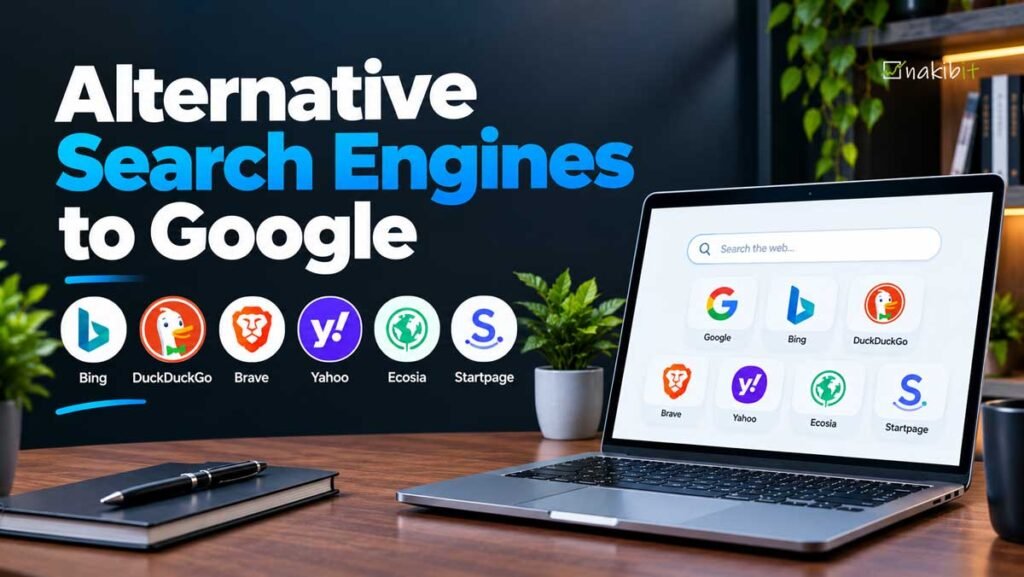
The best alternative search engines to Google are DuckDuckGo and Startpage for privacy, Brave Search for an independent index, Bing for the closest all-round match, Kagi for ad-free paid search, Mojeek for tracker-free results from its own crawler, and Perplexity or ChatGPT Search for AI answers with sources. Which one is right for you depends on what you dislike about Google: tracking, ads, AI summaries, or the feeling that everyone sees the same results. This guide covers 12 main search engines other than Google, plus four more worth knowing, with where each one gets its results, how many people use it, what it does well, where it falls short, and how to choose. The last section is for website owners, because every engine below can send you traffic.
I am Nazirul Islam Nakib, a freelance SEO expert in Dhaka. I help businesses in more than 20 countries rank on Google and appear in AI answers, so I look at search engines from two sides: as a user and as someone who needs to be found in them. Facts here were checked against each engine’s own pages and company statements in October 2026. Features, prices and traffic figures change, so confirm anything important before you rely on it.
Quick answer: which Google alternative should you use?
| If you want… | Try | Why |
|---|---|---|
| Privacy with little effort | DuckDuckGo | Simple, familiar results and a privacy-first policy |
| Google-style results without Google tracking | Startpage | Sends your query to Google and Bing on your behalf |
| A truly independent index | Brave Search or Mojeek | Both run their own index |
| The closest match to Google | Bing | A full web index, plus maps, images, video and news |
| No ads and more control | Kagi | Paid, so the business does not rely on ad clicks |
| Less AI in your results | DuckDuckGo (no-AI address) or Google’s Web filter | Both switch off AI summaries |
| Quick answers with citations | Perplexity or ChatGPT Search | Write an answer and link the sources |
| A search engine that gives back | Ecosia | Puts profits into climate projects |
Why look for search engines other than Google?
Google is still the default for most people. StatCounter’s worldwide figures for September 2026 show Google at 89.94%, Bing at 5.29%, Yahoo at 1.36%, Yandex at 1.3%, DuckDuckGo at 0.74% and Baidu at 0.44%. So an alternative is a minority choice, but people make it for good reasons:
- Privacy. You may not want searches tied to an account and an advertising profile.
- Ads. Many results pages now start with sponsored links before the first organic one.
- AI summaries. Some people want a list of links, not a generated answer at the top.
- Independence. Most smaller engines borrow results from Bing or Google. A few run their own index.
- Values. Some users prefer a European company, a nonprofit-style structure, or a company that funds tree planting.
- A second opinion. Different engines rank differently. For research, comparing two can show you what one misses.
How many people use each search engine? Traffic and user numbers
Search engines measure themselves differently. Some report users, some report queries, some publish nothing. So treat the table as a rough map of scale, not a league table. Where a number comes from the company, I say so. Where it comes from a third party, I say that too.
| Engine | Share of worldwide search (StatCounter, Sept 2026) | Usage figure | Who reported it |
|---|---|---|---|
| 89.94% | More than 5 trillion searches a year | Google, March 2025. Search Engine Land estimates this is roughly 14 billion a day | |
| Bing | 5.29% | 1 billion monthly active users | Microsoft CEO Satya Nadella, on the Q3 FY2026 earnings call (reported April 30, 2026). The metric is not defined, so it may include more than classic web search |
| Yahoo | 1.36% | No separate public figure for search | Its results come from Bing |
| Yandex | 1.3% | Used by about 73% of Russian internet users | Reported by Search Engine Journal, February 2026 |
| DuckDuckGo | 0.74% | Publishes its own daily traffic page. Its peak passed 30 million searches a day back in October 2018 | DuckDuckGo. The 2018 figure is old, so check its traffic page for the latest |
| Baidu | 0.44% | About 57% of search in China | Reported by Search Engine Journal, February 2026 |
| Brave Search | Under 1% | 2.46 billion queries in July 2026, up from more than 1.6 billion a month in September 2025 | Brave, in a LinkedIn post (August 2026), reported by PPC Land |
| Perplexity | Not tracked separately | 780 million queries a month in mid-2025. Third-party trackers put it above 1 billion in 2026, but without a named source | CEO Aravind Srinivas for the 2025 figure |
| Qwant | Not tracked separately | 5.07 million unique visits from France in one month (about 1.3 million a day) | Qwant, citing a Médiamétrie study, in a 2023 post. Old and France-only |
| Ecosia, Kagi, Mojeek, Startpage | Not tracked separately | No reliable public figure found | Treat any number you see for these as an estimate |
What the numbers tell you
- Google is in a different league. Even Bing, the second biggest, holds about 5% of worldwide search by this measure. Everything below it is a niche, which is fine, because a niche engine only has to be right for you.
- The independent index is growing fast. Brave reported 2.46 billion queries in a single month, and PPC Land notes that queries are growing faster than its browser users. Brave also said its Search was added to Chrome’s search engine list in July 2026. Brave’s global share is still under 1%.
- AI answer engines are growing from a small base. Perplexity’s query count is a small fraction of Google’s, but it nearly doubled between mid-2025 and 2026 on third-party estimates, which is why I treat it as a future traffic source.
- Regional engines dominate at home. Baidu leads in China and Yandex in Russia, which is why their worldwide share looks small.
- Different numbers do not compare. A monthly active user, a query and a visit are three different things. A person who searches 20 times a month counts as one user and 20 queries.
Sources of this kind are always partial. StatCounter measures page views on its own network of sites, so it can differ from what each company reports. Use these figures to understand scale, then decide with your own needs in mind.
How alternative search engines actually work
Building a web index means crawling billions of pages, which is very expensive. That is why most alternatives fall into three groups, and knowing the group tells you more than any marketing page.
- Own index. The engine crawls the web itself. Examples: Google, Bing, Brave Search, Mojeek, Yandex, Baidu.
- Borrowed index with a privacy layer. The engine sends your query to a bigger engine and removes your identity. Example: Startpage.
- Mixed. The engine uses its own crawler for some results and buys the rest. Examples: DuckDuckGo, Ecosia, Qwant.
This matters for quality. A borrowed index can only be as good as its source, and results from engines in the same group often look alike.
12 alternative search engines to Google
1. DuckDuckGo: best for easy privacy
DuckDuckGo is the best-known privacy search engine and the one most people try first. According to its help pages, its traditional web links and images mostly come from Bing, it runs its own crawler called DuckDuckBot, and it fills Instant Answers from specialist and crowd-sourced sources such as Wikipedia and Sportradar. It holds 0.74% of worldwide search in StatCounter’s September 2026 data.
- Good for: a simple switch that feels like Google, with privacy as the main promise.
- Weak spot: results lean on Bing, so it is not a fully independent index.
- AI note: DuckDuckGo offers a separate address, noai.duckduckgo.com, that turns off its AI features: AI-generated images are hidden, Duck.ai answers do not appear, and Search Assist is disabled.
If you are searching for sites like DuckDuckGo, the closest are Startpage, Brave Search and Mojeek below.
2. Brave Search: best for an independent index
Brave says every web result in Brave Search is now served from its own index. It removed its last calls to Bing, which had accounted for about 7% of query results. By Brave’s own figures, it handled 2.46 billion queries in July 2026. It says it does not profile users. The service is supported by privacy-respecting ads, and a paid Premium option removes them.
- Good for: people who want a real alternative index, not another Bing wrapper.
- Features: an optional “Answer with AI” summary built from search results, and Goggles, rules that let you filter or re-rank results.
- Weak spot: niche or very local queries can feel thinner than on Google. Brave notes that some image and video searches can be sent on to Bing or Google.
3. Startpage: best for Google-style results with privacy
Startpage describes itself as submitting your query to Google and Bing anonymously on your behalf. It is based in the Netherlands and, according to public records, majority-owned by the American advertising company System1 through Privacy One Group, which bought a majority stake in 2019. Its Anonymous View feature, introduced in 2018, opens a result through Startpage’s proxy so the site does not see your details.
- Good for: familiar, high-quality results without a Google profile.
- Weak spot: it does not run its own index, and the ownership is worth knowing about if privacy is your priority.
4. Bing: best all-round replacement
Bing is Microsoft’s search engine and the biggest real alternative by market share, at 5.29% worldwide in StatCounter’s September 2026 data. Microsoft says Bing reached 1 billion monthly active users. It has a large index of its own, plus images, video, maps, news and Copilot-based answers. It also supplies results to other engines, including Yahoo, and, according to their own pages, DuckDuckGo and Ecosia.
- Good for: people who want the same convenience as Google.
- Weak spot: it is not a privacy tool. Microsoft collects data under its own privacy statement, so check your settings.
5. Yahoo Search: familiar, but powered by Bing
Yahoo’s search has run on Bing results since the two companies signed a 10-year deal in July 2009. Yahoo still controls its own pages, news, finance and email around the results, and it holds about 1.36% of worldwide search. Use it if you like the Yahoo portal. If you want something truly different from Bing, look elsewhere.
6. Ecosia: best for climate-minded searchers
Ecosia is a Berlin company founded in 2009 and certified as a B Corp. It says it puts 80% of its profits into tree planting and other climate work, and its ads are served through Yahoo and Microsoft Advertising. Its results come from Microsoft Bing and from Staan, a European index being built by European Search Perspective, a joint venture between Ecosia and Qwant. The partial rollout started in August 2025.
One caution: a famous claim that each search removes a fixed amount of CO2 has been criticised, because planting depends on ad clicks. Treat Ecosia as a good-intentioned engine, not as a way to offset your carbon footprint.
7. Qwant: best European option
Qwant is headquartered in Paris and was founded in 2011. For years it relied heavily on Bing. It is now part of the same European index project as Ecosia, and the Staan index has been serving Qwant queries since August 2025. Qwant presents itself as a privacy-respecting engine, so read its current privacy policy if that is your reason for switching. People searching “Qwant vs Google” mostly want to know if a European index can keep up. Test it on the searches you actually make before you commit.
8. Kagi: best paid search, no ads
Kagi has no advertising. You pay instead. According to its help centre, the Starter plan is $5 a month for 300 searches, Professional is $10 a month with unlimited searches, and Ultimate is $25 a month with premium AI models. There is a limited trial. Kagi lets you raise or lower sites in your own results, which is why power users like it.
- Good for: researchers, writers and anyone who searches all day and wants a clean page.
- Weak spot: it costs money, and you need an account.
If you are comparing Startpage with Kagi, the real difference is the model: Startpage is free and borrows results, Kagi is paid and focuses on control.
9. Mojeek: best for a small, tracker-free crawler
Mojeek says its results are 100% independent, produced by its own crawler, MojeekBot, and ranked by its own algorithms. It says it does not use tracking, so people with the same country and language settings searching at the same time should see the same results. That makes it an interesting answer to people asking for an unbiased search engine, although no engine is free of ranking choices.
- Weak spot: the index is smaller than Google’s or Bing’s, so long-tail searches may return little.
10. Perplexity: best for answers with sources
Perplexity is an AI answer engine. It searches the web in real time and writes a short reply with numbered citations that link back to the source pages. Quick Search gives fast answers, and Pro Search goes deeper on harder questions. Its help page says free users get up to 5 Pro Searches a day, while subscribers get up to 600. Its CEO has said it handled 780 million queries a month in mid-2025.
- Good for: research questions where you want a summary and a trail to follow.
- Weak spot: it can still get things wrong, so open the sources for anything important. It is also the opposite of a search engine for people who do not want AI.
If you publish content, read my notes on Perplexity SEO.
11. Yandex: best for Russian-language search
Yandex is a Russian search engine with its own index, and it holds roughly 1.3% of worldwide traffic in the StatCounter data above. Search Engine Journal reports that about 73% of Russian internet users use it. It is strongest for Russian-language and nearby markets. Searchers looking for a Yandex alternative or sites like Yandex are usually after a similar large regional index, and the practical answers are Bing, DuckDuckGo or Brave Search.
12. Baidu: best for Chinese-language search
Baidu is China’s main search engine. It holds about 0.44% of worldwide traffic in the same data, because its users are mostly in one country, where Search Engine Journal puts its share near 57%. Use it when you need Chinese-language results or want to see what searchers in China find.
Four more alternatives worth knowing
- ChatGPT Search: OpenAI’s chatbot can search the live web and answer with links to its sources. It is an AI assistant first and a search engine second, so it suits questions that need explanation more than a list of pages. See my ChatGPT SEO guide if you want your site to be cited there.
- Google AI Mode: still Google, but a conversational format instead of ten blue links. If your issue is Google’s old results page, this is a different experience. If your issue is Google itself, it is not an escape.
- Swisscows: a Swiss, family-friendly engine. Its pages describe it as privacy-minded and filtered, and that suits households with children. Check its current privacy and ad policy, because free versions of search engines change over time.
- Naver: the main search engine in South Korea, combining search with blogs, news and shopping. Search Engine Journal puts its share there near 49%. It matters if you sell to Korean users.
Comparison table: results source, privacy and best use
| Engine | Where results come from | Privacy position | Best for |
|---|---|---|---|
| DuckDuckGo | Mostly Bing, plus its own crawler and specialist sources | Privacy-first | Easy private search |
| Brave Search | Own index | Says it does not profile users | Independent results |
| Startpage | Google and Bing, queried anonymously | Privacy-first, with a proxy view | Google-like results |
| Bing | Own index | Standard Microsoft data collection | All-round replacement |
| Yahoo | Bing | Standard Yahoo data collection | Yahoo portal users |
| Ecosia | Bing and Staan | Climate focus | Giving back |
| Qwant | Bing and Staan | European, privacy-focused | Europe-based search |
| Kagi | Blends several sources (see Kagi’s docs) | No ads, paid | Heavy searchers |
| Mojeek | Own crawler | No tracking | Unfiltered, independent |
| Perplexity | Live web search with AI summaries | Free tier; account for higher limits | Answers with sources |
| Yandex | Own index | Regional | Russian-language search |
| Baidu | Own index | Regional | Chinese-language search |
Best private search engines
If you came here for privacy, these are the options I would put on a shortlist. Searches for private search engines and privacy-focused search engines usually end at the same few names:
- Brave Search: own index, says it does not profile you.
- DuckDuckGo: the easiest to adopt, with a long privacy track record.
- Startpage: Google-style results with Anonymous View.
- Mojeek: no tracking, its own crawler.
- Kagi: paid, so there is no ad profile to build.
A private search engine does not make you anonymous. Your internet provider, your browser, the sites you click and any account you are logged in to can still see activity. Pair a private engine with a privacy-minded browser and sensible settings.
Search engines that do not use AI
Many people now ask for search engines that don’t use AI, or a way to search without AI. You have four realistic options:
- DuckDuckGo no-AI address: noai.duckduckgo.com turns off Search Assist, Duck.ai answers and AI-generated images in results.
- Google’s Web filter: it shows text-based results and removes extras such as knowledge panels, AI overviews and image carousels. You reach it with a custom search address,
https://www.google.com/search?q=%s&udm=14, which you can set as a search engine in your browser. - Mojeek: a plain list of links from its own crawler.
- Brave Search: AI answers are an add-on feature, so you can use it mainly as a results list.
Be careful with promises. Even engines that give you a plain list still use machine learning to rank pages. What you can remove is the generated summary.
Is there an unbiased or neutral search engine?
No search engine is neutral. Every one makes decisions about what to crawl, what to rank first and what to remove. The honest way to reduce bias is to compare. Run the same query on two engines with different indexes, for example Brave Search and Bing, and see what changes. Mojeek states that it does not personalise results, and Brave Goggles let you apply your own ranking rules. Those are real tools. A claim that one engine is simply “unbiased” is marketing.
Alternatives for images, video and academic search
- Images: Bing and DuckDuckGo both have image tabs, and DuckDuckGo lets you hide AI-generated images. If you want a Google Images alternative, start with Bing Images.
- Video: Bing has a video tab. For tutorials, YouTube’s own search is often the best video search engine, and I explain how it ranks in my YouTube SEO work.
- Academic papers: search the database of the publisher or your library. General engines are poor at paywalled research.
How to choose the right search engine
- Decide what bothers you. Tracking, ads, AI summaries and independence need different answers.
- Check the source. Ask: does it use its own index, Bing, Google or a mix? A privacy engine that uses Bing results still gives you Bing-quality results.
- Test it for a week. Search the things you really search for, not demo queries. Local searches and shopping show the gaps first.
- Keep a backup. Many people use a private engine daily and switch to Google or Bing for maps, shopping or rare queries. That is a sensible habit, not a failure.
- Read the privacy policy. It takes five minutes and tells you who owns the company and what it keeps.
A simple five-query test works well: one everyday question, one local search, one product search, one niche professional query and one news query. Run each on your current engine and the candidate, then note which results you would actually click.
How to change your default search engine
In Chrome, Edge, Firefox and Safari, open Settings, find Search or Search engine, and choose a new default. On iPhone and Android, change it in the browser app. If an engine you want is not in the list, add it as a custom engine with its search address, as shown above for Google’s Web filter.
What alternative search engines mean for website owners
If you run a website, this list is also a to-do list. Google sends most of the traffic, but not all of it, and the others are growing in importance for AI.
- Bing matters more than its share suggests. Because Yahoo, DuckDuckGo and Ecosia use Bing results to some degree, a page that ranks in Bing can show up in several places. Verify your site in Bing Webmaster Tools and submit your sitemap.
- Do not block the crawlers. Check your robots.txt and security tools so that Bingbot, DuckDuckBot and MojeekBot are not shut out by accident.
- Independent indexes are growing. Brave and the European Staan index both want to reduce reliance on Bing and Google. Clean technical SEO helps you across all of them. Start with my technical SEO guide.
- AI search is the new alternative. People ask Perplexity, ChatGPT, Gemini and Copilot instead of typing keywords. These tools tend to quote clear, well-structured pages from trusted sources. Read will AI search replace Google, SEO vs GEO and how LLMs like Perplexity pull data from websites.
- Measure it. In my work I have tracked 3,085 AI Overview appearances and 325 ChatGPT appearances for a luxury bag store, and Copilot citations grew 415% in six months for another client. See the AI SEO case study and my guide on tracking visibility in AI search engines.
For the full approach, see AI SEO and my generative engine optimization service.
Common mistakes when switching
- Assuming private means independent. Many private engines still use Bing or Google results.
- Expecting identical results. Ranking differs, so give yourself a short adjustment period.
- Trusting AI answers without checking. Open the cited pages.
- Ignoring your logged-in accounts. A private engine does little if you stay signed in to everything else.
- Switching everything at once. Change the default in one browser first.
Frequently asked questions
What is the best alternative to Google?
For most people it is DuckDuckGo for privacy or Bing for an all-round replacement. If you want an independent index, try Brave Search. If you want ad-free paid search, try Kagi.
What are the best search engines other than Google and Bing?
DuckDuckGo, Brave Search, Startpage, Mojeek, Kagi and Ecosia. Brave Search and Mojeek run their own indexes, while DuckDuckGo, Startpage and Ecosia draw on other engines to different degrees.
What is the second most used search engine?
Bing. StatCounter’s worldwide data for September 2026 puts it at 5.29%, ahead of Yahoo (1.36%), Yandex (1.3%), DuckDuckGo (0.74%) and Baidu (0.44%).
How many people use DuckDuckGo or Brave Search?
DuckDuckGo holds 0.74% of worldwide search in StatCounter’s data and publishes its own traffic page. Brave reported 2.46 billion queries in July 2026, and its global share is still under 1%.
Which search engine is the most private?
Brave Search, DuckDuckGo, Startpage and Mojeek all state privacy-first policies. Read their policies, because ownership and funding differ. No search engine can protect you from everything you do online.
Which search engines don’t use AI?
You can avoid AI summaries by using noai.duckduckgo.com, Google’s Web filter, or a plain results engine such as Mojeek. Rankings still use algorithms, but there is no generated answer on top.
Does DuckDuckGo use Google?
No. According to DuckDuckGo, its traditional web links and images mostly come from Bing, plus its own crawler and specialist sources.
Does Startpage use Google?
Yes. Startpage says it submits your query to Google and Bing anonymously on your behalf.
Which search engine has its own index?
Google, Bing, Brave Search, Mojeek, Yandex and Baidu run their own crawlers and indexes. Ecosia and Qwant are building a shared European index called Staan.
Is there a search engine that is better than Google?
Not overall, as far as I can tell. Google has the biggest index and strong local and shopping features. Other engines can be better for a specific need: privacy, no ads, no AI, or a different ranking approach.
What is a free alternative to Google?
DuckDuckGo, Brave Search, Startpage, Mojeek, Ecosia, Bing and Qwant are free to use. Kagi is paid, and Perplexity has a limited free tier.
What is the best Yandex alternative?
For a large general index, use Bing. For privacy, DuckDuckGo or Brave Search. For Russian-language results, Yandex itself is still the main choice.
Is ChatGPT a search engine?
It can search the web and cite sources, so it works as one for many questions. It is built as an assistant, though, so use a classic engine when you want a list of pages to compare.
Will these engines send traffic to my website?
Some, yes, but far less than Google. Their share is small today, so the best plan is to do solid SEO that works across all of them and also prepare for AI search.
Can you help my website rank in Google, Bing and AI search?
Yes. Send your site through the free website audit and I will reply within 24 hours with what to fix first.