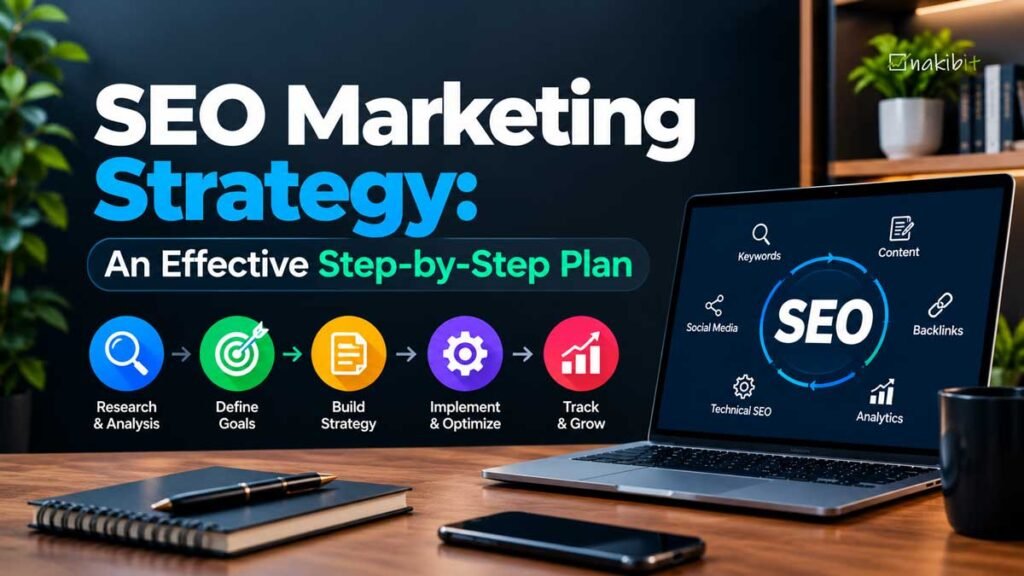
An SEO marketing strategy is a written plan for how your website will win customers from search engines and AI answers: who you want to reach, which searches they use, what pages you will build, and how you will measure the results. A good one has eight parts: goals, an audit, customer and intent research, a keyword-to-page map, a content plan, a technical foundation, trust building, and monthly measurement. This guide walks through each part and ends with a 90-day plan you can start this week.
I am Nazirul Islam Nakib, a freelance SEO expert in Dhaka. I have built SEO plans for clients in more than 20 countries, from online stores to local businesses. If you are new to the topic, start with my plain guide on what SEO optimization is, then come back here.
SEO marketing strategy meaning: what it is and what it is not
SEO marketing means using search engine optimization to get customers, not just visitors. A strategy is the plan behind it. It answers four questions:
- Who are we trying to reach, and what do they need?
- Where do they look: Google, Google Maps, YouTube, ChatGPT, Gemini, Perplexity?
- What will we publish and fix, in what order?
- How will we know it is working?
It is not a list of keywords, and it is not a promise of a ranking. Many guides online jump straight to a keyword list. That is step four of eight, and starting there is why so many plans fail.
Step 1: Set goals that a business can measure
Write one goal that ties to money or leads. Rankings and traffic are useful signals but poor goals. Better goals look like this:
- “Get 30 qualified enquiries a month from organic search.”
- “Increase online orders from search by a set share in six months.”
- “Be the business Google Maps shows first for our main service in our city.”
Pick numbers that fit your size and today’s baseline. Your Google Search Console and analytics data tell you where you start. If you have no data yet, your first goal is simply to set up tracking.
Step 2: Audit where you stand
You cannot plan a route without knowing your starting point. An SEO audit checks four things:
- Crawling and indexing. Can Google reach your pages, and are the right ones in its index?
- Content. Which pages bring traffic, which bring none, and which topics are missing?
- Technical health. Speed, mobile layout, broken links and structured data. See technical SEO.
- Authority. Who links to you and mentions you, compared with the competitors you want to beat.
The output should be a ranked list of problems, with the biggest wins first. If you want one, my free website audit is a good start.
Step 3: Research your customers and their search intent
Before you look at any tool, talk to the people who buy from you. Ask your sales team or your own inbox what customers ask before they buy. Write down their exact words. These questions are the seed of your strategy.
Then sort every topic by search intent, the reason behind the search:
- Informational: “how does X work”. Best met with guides.
- Commercial: “best X for Y”, “X vs Z”. Best met with comparisons and reviews.
- Transactional: “buy X”, “X near me”, “X services”. Best met with service, product or location pages.
- Navigational: your brand name. Best met by a clear, trusted homepage and profile.
Mixing intents on one page is a common mistake. A page that tries to teach and sell at once usually ranks for neither.
Step 4: Build a keyword-to-page map
Now use keyword research. For each topic, find the phrases people use, how often they are searched and how hard they are to win. Then build a simple map in a spreadsheet:
- One main topic per page. Never let two pages compete for the same phrase.
- Columns: page, main keyword, related keywords, intent, difficulty, current ranking, priority.
- Cluster related pages. A strong page on a broad topic, supported by detailed pages that link to it, builds topical authority. See my keyword topical cluster map guide.
Do not be afraid of big brands ranking for the broad term. Go for the questions they answer badly or skip. Reading the top three pages for any keyword and listing what they miss is one of the best ways to find an opening.
Step 5: Plan content that adds something new
Most search results look alike because every page repeats the others. Plan each page around what you can add: your own data, real examples, a clearer method, an honest comparison. This is called information gain, and it helps with both Google and AI answers.
A simple content plan has three layers:
- Money pages: service, product or location pages that bring enquiries.
- Support pages: guides and comparisons that answer questions before the sale and link to the money pages.
- Proof pages: case studies, reviews and results that show you deliver.
Publish on a rhythm you can keep. Two good pages a month beats ten thin ones and then silence.
Step 6: Fix the technical foundation
Great content on a slow or broken site underperforms. The basics:
- Mobile-friendly layout, because Google mainly uses the mobile version of a page.
- Good Core Web Vitals. See Core Web Vitals and website speed optimization.
- Clean site structure, working internal links, an XML sitemap and correct canonical tags.
- Structured data where it fits. See schema markup.
Step 7: Build trust and authority
Search engines and AI tools look for signs that other people trust you. The main sources are:
- Quality backlinks from relevant sites. See link building.
- Brand mentions across the web. See building brand mentions and citations AI models trust.
- Honest reviews and a clear about page with real people on it.
Be careful with link building. Buying links or joining link schemes can bring a penalty. Read white hat vs black hat SEO before you hire anyone for it.
Step 8: Add AI search to the plan
Customers also ask ChatGPT, Gemini, Perplexity and Copilot, and Google shows AI Overviews. A modern SEO marketing strategy includes these places. In practice that means:
- Opening pages with a direct answer to the question in the heading.
- Using specific facts, names and numbers you can defend.
- Making clear who wrote the page and who your business is.
- Keeping the site open to the crawlers you want.
- Checking a fixed set of customer questions each month to see whether AI tools mention you.
I explain each in what is generative engine optimization, how to track visibility in AI search engines and how to get featured in Google AI Overviews. In my own client work, a luxury bag store reached 3,085 AI Overview appearances and 325 ChatGPT appearances, and another client’s Copilot citations grew by 415% in six months. See the AI SEO case study and the Copilot case study.
How to measure your SEO marketing strategy
Track a few numbers at each stage rather than a long list. Review them once a month.
| Stage | What to track | Where to find it |
|---|---|---|
| Visibility | Impressions, pages indexed, AI mentions | Google Search Console, a monthly AI question check |
| Traffic | Clicks, click-through rate, top pages and queries | Google Search Console |
| Engagement | Time on page, scroll, return visits | Google Analytics |
| Results | Enquiries, calls, form fills, orders from organic search | Analytics goals, call tracking, your CRM or orders |
| Trust | Branded searches, new reviews, new links and mentions | Search Console, review platforms, a link tool |
A 90-day SEO marketing plan
Days 1 to 30: foundation
- Set up Google Search Console and analytics, and agree on one business goal.
- Run an audit and rank the problems.
- Fix indexing, speed, mobile and broken-link issues.
- Collect customer questions and build the first keyword-to-page map.
Days 31 to 60: content and structure
- Improve your five most important existing pages first.
- Publish the first support pages for your main service.
- Add internal links from strong pages to the ones you want to rise.
- Start asking happy customers for reviews.
Days 61 to 90: authority and review
- Publish proof pages such as a case study.
- Begin earning mentions and quality links.
- Run your first AI question check.
- Review results, keep what works and re-plan the next 90 days.
How long until SEO marketing shows results?
It depends on your competition, your site’s age and what is broken today. Fixes to crawling and indexing can show effect within weeks. Rankings for competitive terms usually take months. One of my clients, a marketing tool on Shopify, went from 30 to 16,600 clicks in three months. That is a real result, but it is one case, not a promise. Anyone who guarantees a date is guessing.
SEO marketing strategy by business type
- Local business. Put your Google Business Profile, reviews and local pages first. This is local SEO marketing. See local SEO and Google Business Profile optimisation.
- Online store. Focus on category and product pages, speed and structure. See ecommerce SEO.
- Service or B2B firm. Build clear service pages, case studies and comparison guides, and make it easy to enquire.
- Blog or publisher. Build topic clusters, update old posts and strengthen internal links.
Seven mistakes that sink an SEO marketing strategy
- Starting with keywords instead of customers.
- Having no goal beyond “rank higher”.
- Publishing many thin pages instead of a few strong ones.
- Mixing search intent on one page.
- Ignoring technical problems because content feels more exciting.
- Buying links or reviews.
- Not measuring, or measuring only rankings.
Frequently asked questions
What is an SEO marketing strategy?
It is a written plan for winning customers from search engines and AI answers, covering your goals, audience, keywords, content, technical health, trust building and measurement.
How do I create an SEO strategy step by step?
Set a business goal, audit your site, research customer questions and intent, map keywords to pages, plan content, fix technical problems, build trust, include AI search, and measure every month.
What is the difference between SEO and an SEO marketing strategy?
SEO is the set of practices. A strategy decides which practices to use, in what order, for which customers and how to judge success.
How much should I spend on SEO marketing?
It depends on your goals, competition and what needs fixing. Start with an audit so you know what the work involves, then decide. Be careful with anyone who quotes a price before looking at your site.
Can a small business do SEO marketing without an agency?
Yes, for the basics: Search Console, a Google Business Profile, clear service pages and honest reviews. Hire help for technical problems, competitive markets or when time is short. See affordable SEO services for small business.
How is local SEO marketing different?
It focuses on appearing in Google Maps and local results for searches near the customer, using your profile, reviews and local pages.
Does an SEO strategy need to include AI search?
Yes. People now get answers from ChatGPT, Gemini, Perplexity, Copilot and Google AI Overviews, and these tools draw on web pages. Clear, trusted, well-built pages help in all of them.
Can you build an SEO marketing strategy for my business?
Yes. Send your website through the free website audit and I will reply within 24 hours.