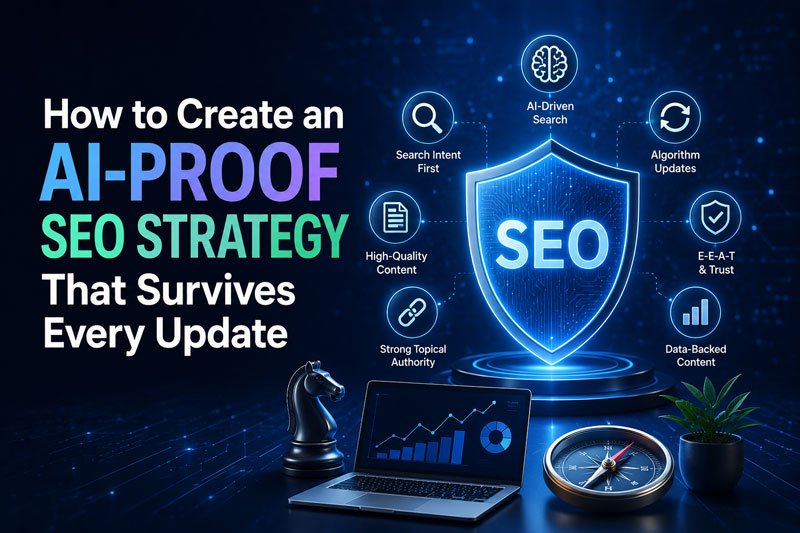
An AI-proof SEO strategy is one that keeps working whether people find you through Google, an AI Overview, ChatGPT, Gemini or Perplexity. You build it on five things: a technically clean site, pages that answer real questions directly, original expertise that cannot be copied, a recognisable brand with mentions on trusted sites, and measurement based on leads rather than rankings alone.
No strategy is truly “proof” against change. The word means resilient: you are not betting on one platform, one trick or one algorithm update. I’m Nazirul Islam Nakib, an SEO, AEO and GEO specialist, and this is the framework I use with clients.
Why a single-channel strategy is risky
If all your traffic comes from one kind of result, any change to that result hurts. A Google core update, a new AI Overview layout or a shift in where your audience searches can move your numbers overnight.
A resilient strategy spreads the risk: it makes the site useful to people, easy for machines to understand, and trusted across the web. Those three things carry over from one platform to the next.
The five pillars
1. A technically sound website
Crawlers, whether Google’s or an AI company’s, need to reach your pages and read them. That means a clean URL structure, working internal links, fast loading, mobile-friendly design, and important content in HTML rather than hidden behind scripts. Check that you are not blocking useful crawlers by accident. Start with technical SEO and the technical SEO checklist for AI search.
2. Answer-first content
Write each page around a specific question or task. Put the answer first, then explain, then give an example. This structure serves a person in a hurry and a system looking for a passage to quote. See how to get featured in Google AI Overviews.
3. Original expertise
This is the pillar AI cannot copy. Add what you have actually done: your process, your data, your mistakes, local knowledge, photos, case studies. Pages that only repeat what ten other pages say are the easiest to replace. Pages with something new to offer, what the industry calls information gain, are the hardest.
4. Brand and entity strength
AI answers often name businesses. To be named, you need to be recognised: a consistent name and description, a clear About page, author profiles, a Google Business Profile for local firms, reviews, and mentions on respected sites in your field. See building brand mentions and citations and semantic SEO.
5. Measurement that matches reality
Track enquiries, calls, bookings and sales, not only keyword positions. Add AI visibility checks: which questions mention you, which pages get cited, what is said about you. My guide on tracking visibility in AI search engines explains the method.
Build topical depth, not scattered posts
A site that covers a subject thoroughly from several angles is easier for search engines and AI tools to trust than a site with one post on each of fifty unrelated topics. Pick your core subjects, create a hub page for each, and support it with detailed articles that link back. Learn more in topical authority and how to create a keyword topical cluster map.
A 90-day starting plan
- Days 1 to 30: audit crawlability, indexing, speed and your top 20 pages. Fix blocking issues and broken links. List the 30 questions your customers ask most.
- Days 31 to 60: rewrite or create the pages for the highest-value questions, answer-first, with real examples. Strengthen author, About and contact information. Fix inconsistent business details across profiles.
- Days 61 to 90: earn mentions and links from relevant sites, add reviews if you are a local business, set up monthly tracking, and review Search Console and AI answers against your starting point.
What to avoid
- Mass-produced AI articles with no original input.
- Dropping classic SEO because “AI is the future.”
- Buying cheap links or fake reviews. They create risk and rarely build trust.
- Chasing every new file or format without evidence it helps. Test one thing at a time.
- Promising yourself guaranteed rankings in any system.
Frequently asked questions
What is an AI-proof SEO strategy?
A strategy built on fundamentals that survive platform changes: technical health, helpful answers, original expertise, brand trust and honest measurement.
Is traditional SEO still worth doing?
Yes. AI tools draw from the same web that search engines index, so strong SEO is the base for AI visibility too. See will AI search replace Google SEO.
Do I need a separate GEO plan?
You need GEO tasks inside your plan: checking AI answers, improving clarity and building mentions. For the difference, read SEO vs GEO.
How long until I see results?
Technical and content fixes can show movement within weeks to a few months, depending on your site and competition. Brand trust builds more slowly.
Can a small business do this?
Yes. A small business often has an advantage: real local knowledge and direct customer experience, which is exactly the original input AI cannot invent.
To build a plan for your own site, see my AI SEO service, order an AI visibility audit, or request a free website audit.