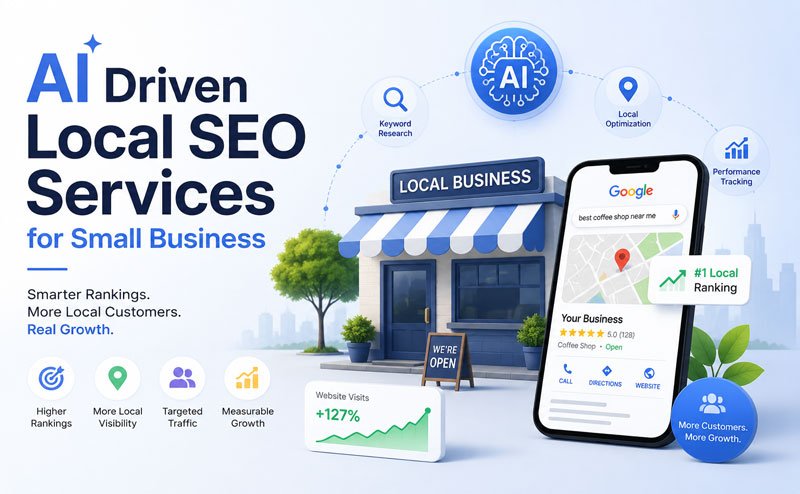
Local SEO services for small business come down to five jobs: a complete Google Business Profile, consistent listings, a steady flow of real reviews, a website with a page for every service and area you cover, and a few links from places in your own community.
You can do a good share of this yourself. The rest is where a specialist earns their fee.
This guide separates the two, so you know what to do this week and what is worth paying someone for.
I’m Nazirul Islam Nakib. I’ve done SEO for more than 8 years, across 1,200+ projects in 21+ countries. Small local businesses are some of the clients I enjoy working with most.
The pattern is always the same. The owner is busy running the shop, the clinic or the service van, and local search gets whatever time is left over.
What local SEO actually does for a small business
Local SEO makes your business show up when someone nearby searches for what you sell: “dentist near me”, “emergency plumber”, “bakery open now”.
Those searchers are usually ready to call, book or walk in. A few extra map-pack positions can matter more than a hundred blog visitors from far away.
Google decides local rankings on three things:
- Relevance: does your profile and site match the search.
- Distance: how close you are to the searcher.
- Prominence: how well known and trusted you look online.
You can’t change distance. You can improve the other two, and that is what everything below is for.
The five jobs that move local rankings
1. Set up your Google Business Profile properly
This is the most valuable free asset you have. Claim it and verify it.
Pick the most accurate primary category. This matters more than most owners realise.
List every service, add real photos of your premises and team, and keep your hours right, including holidays. Post an update now and then so the profile looks alive.
For the full checklist, my Google Business Profile optimization page walks through each field.
2. Keep your name, address and phone number identical everywhere
Search engines and AI assistants cross-check your details across directories. If one listing says “Suite 4” and another leaves it out, that small doubt can cost you.
Start with the big ones: Google, Bing Places, Apple Maps, Yelp, and the directories genuinely used in your industry. Then fix duplicates.
More on this is in local citations.
3. Ask for reviews every week, and answer every one
Review quantity, recency and the words customers use all feed local ranking. They also decide whether a stranger picks you over the next listing.
Ask at the moment a customer is happiest. Send a direct link by text or WhatsApp.
Reply to good and bad reviews politely and specifically. Never buy or fake reviews. A suspended profile is far worse than a slow start.
See review management for a simple process.
4. Give your website one clear page per service and per area
A single “Services” page rarely ranks for anything. A dentist who offers implants, braces and emergency care needs a page for each.
Write for real patients and mention the suburbs or districts you serve naturally.
Avoid copying the same page and swapping the town name. Google treats that as thin content.
Add LocalBusiness schema so search engines read your address, hours and services without guessing.
5. Earn a few local links and mentions
One link from a chamber of commerce, a local news site, a supplier or a sponsored community event is worth more for local rankings than dozens of random directory links.
Think about who in your area already knows you and would happily mention you.
Hyper-local: the shortcut for small businesses
You will rarely beat a national chain for “dentist New York”. But a practice in one neighbourhood can win “dentist Williamsburg”.
The competition is smaller and the searcher is closer to buying.
Hyper-local SEO means building pages, listings, reviews and content around the specific districts you serve. It sits inside my wider local SEO work.
What changed with AI search
People now ask ChatGPT, Gemini, Perplexity and Google’s AI Overviews things like “Which plumber nearby can fix a burst pipe today and has good reviews?”
These tools pull from the same raw material as classic local SEO: your profile, your reviews, your website and your listings. So the foundation above still matters most.
Two additions help:
- Write pages that answer real customer questions in plain language. A short FAQ on each service page works well.
- Keep your facts consistent, so an AI has nothing contradictory to choose between.
If this interests you, read how AI SEO works for visibility inside AI answers.
Do it yourself, or hire a specialist?
Do yourself: claiming and completing your profile, the first round of listings, asking for reviews, answering reviews, adding photos.
Worth hiring for: a proper local SEO strategy in a crowded market, service and area pages that actually rank, schema and technical fixes, local link outreach, and tracking what really brings calls rather than just rankings.
If you do hire, check a few things first:
- Real examples in your kind of business. Ask for before-and-after numbers from clients with similar markets, not just ranking screenshots. You can see how I report mine on the case study page.
- Plain-English reporting. You should know each month what was done and what changed in calls, direction requests and enquiries.
- No shortcuts. Fake reviews, keyword-stuffed business names and spam listings can get your profile suspended.
- No lock-in surprises. The terms should be clear before you start.
- No promised rankings. Nobody controls Google. Someone who guarantees position one is selling hope.
Not sure where you stand? A free website audit will show the gaps, and you can decide from there.
If you’d rather talk to me directly, hire an SEO expert shows how I work, or contact me.
A 30-day starter plan
- Week 1: Claim and complete your Google Business Profile. Fix your name, address and phone number on your website.
- Week 2: Add the main directories. Upload 10+ real photos. Add every service to your profile.
- Week 3: Start the review routine. Reply to all existing reviews.
- Week 4: Write or improve your top service page and your contact page with a map. Add LocalBusiness schema.
Local results build over months, not days. Track calls, direction requests and form fills each month, not just rankings.
Frequently asked questions
How long does local SEO take to work?
It depends on your market and where you start. A fixed-up profile and new reviews can show movement in a few weeks.
Competitive categories usually need several months of steady work. Anyone giving an exact date is guessing.
What is the difference between local SEO and hyper-local SEO?
Local SEO targets a city or metro area. Hyper-local SEO targets specific neighbourhoods, districts or streets.
That often means less competition and more ready-to-buy searches.
Is a Google Business Profile enough?
It is the best place to start, but a profile alone is limited. Your website, reviews and listings all support it, and AI tools read them too.
Can I do local SEO myself?
Yes, the basics above are very doable. Bring in a specialist when you are in a competitive market, need many service or area pages, or progress has stalled.
Does local SEO work outside Bangladesh?
Yes. I work from Dhaka and have helped clients in 21+ countries. The principles are the same, with local details adjusted per market.
How much does local SEO cost?
It varies with your market, competition and scope, so I don’t quote a number without seeing your situation. Ask for a clear breakdown of what each part includes, whoever you choose.
For more on specific industries, see local SEO for healthcare, restaurants and law firms, or start with the home page to see everything I do.