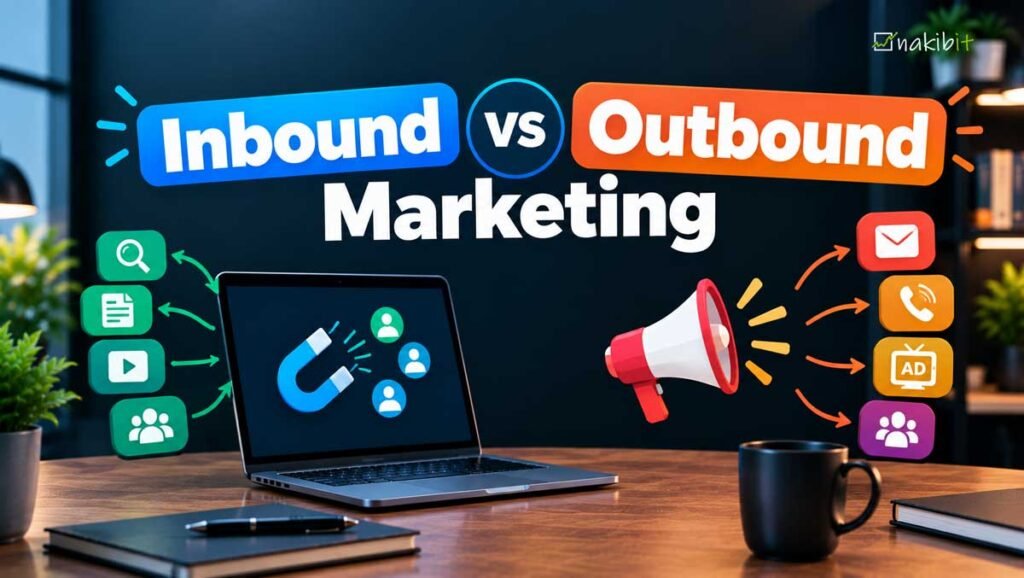
Inbound vs Outbound Marketing: Differences, Costs, Results and Which to Pick
Inbound vs outbound marketing explained plainly: how each works, where the popular statistics fall apart, and a simple framework to decide what fits your business.
Every business eventually faces the same question: do we wait for customers to find us, or do we go and find them? That is the heart of inbound vs outbound marketing, and the honest answer is rarely “pick one forever.”
In this guide you will get clear definitions, a side-by-side comparison, a look at which popular statistics you should not trust, a practical framework for choosing, and a hybrid approach that most healthy businesses end up using. It is written for owners and marketers who need to make a real decision, not memorise a glossary.
The short answer
Inbound marketing pulls people in. You publish useful content, rank in search, and let buyers who are already curious come to you. Outbound marketing pushes a message out. You start the conversation through cold email, calls, paid ads or events.
Inbound is slower to start and cheaper to sustain. Outbound is faster to start and stops the moment you stop paying or sending. If you need leads this month, outbound helps. If you want a business that is not rebuilt from zero every quarter, inbound is the foundation.
What is inbound and outbound marketing?
A useful way to separate them is by whose attention you are using. Inbound earns attention by being helpful at the moment someone is looking. Outbound buys or interrupts attention before the person has asked.
Inbound marketing
Inbound covers the channels where the buyer makes the first move: blog posts, search engine optimisation, YouTube, podcasts, email newsletters people signed up for, free tools, webinars, reviews and social posts people choose to follow. The common thread is that someone searched, clicked or subscribed on their own.
Outbound marketing
Outbound covers channels where you make the first move: cold email, cold calling, LinkedIn outreach, paid search and social ads, display and video ads, sponsorships, direct mail and trade shows. The person did not ask to hear from you. Good outbound is relevant enough that they are glad you did.
Push vs pull: an older idea with new names
Marketers did not invent this split recently. It is the classic contrast between push marketing (you send the message out, which is outbound) and pull marketing (you create a reason for people to come, which is inbound). “Outbound” is largely a newer label for traditional advertising, coined to contrast with inbound. Knowing that helps you cut through the jargon: the real question is simply whether you interrupt or you attract.
Inbound vs outbound marketing: side-by-side comparison
Factor
Inbound
Outbound
Who starts the conversation
The buyer
You
Typical channels
SEO, blog, video, email list, social, tools
Cold email, calls, paid ads, events, direct mail
Communication
Two-way, people comment, share and reply
Mostly one-way
Time to first leads
Months
Days to weeks
Cost curve
High upfront effort, falling cost per lead
Cost stays roughly flat or rises with scale
Stops when you stop?
No, content keeps working
Yes, almost immediately
Lead intent
Usually higher, they were searching
Mixed, you create the need
Control over who you reach
Lower, you attract who searches
Higher, you pick the exact list
Scalability
Compounds
Linear, needs more people or budget
Main risk
Patience and consistency
Spam complaints, ad fatigue, rising costs
Best for
Long-term brand and steady demand
Fast tests, new markets, high-value accounts
The difference between inbound and outbound marketing, in practice
Definitions are easy. The real difference shows up in how your week looks.
Inbound work is production. You research topics, write, publish, improve old pages, earn links and watch rankings. Results arrive late but pile up.
Outbound work is activity. You build lists, write sequences, make calls, adjust ad budgets. Results arrive fast but need constant feeding.
Inbound rewards depth. One excellent page can bring leads for years.
Outbound rewards volume and precision. A sharp list and a clear offer matter more than clever copy.
The communication difference people overlook
Traditional outbound, such as a TV or print ad, talks at people. Inbound talks with them. Readers comment, share, disagree and ask questions in public. That is a strength, because you get honest feedback and build loyalty. It is also a responsibility: criticism is visible, so you need to answer openly, admit mistakes and keep your claims honest. Brands that treat inbound as a broadcast channel lose the main advantage it has.
How inbound marketing works, step by step
Find what buyers search for. Good keyword research shows the real questions people type before they buy.
Create content that answers better than anyone else. Depth, original examples and clear structure win. See how content SEO turns a topic into a page that ranks.
Make the page findable. Technical health, internal links and backlinks help search engines trust it.
Capture interest. A clear next step, such as a guide, audit, calculator, free trial, webinar or newsletter, turns readers into contacts. Gated assets like white papers and e-books work when the offer is genuinely worth an email address.
Nurture and convert. Helpful follow-up emails and a sales conversation that continues what the content started.
Retain and turn customers into advocates. Keep educating people after they buy. Happy customers leave reviews, refer others and become your most believable marketing.
Measure and refresh. Update what works, merge what overlaps, retire what does not.
Content only works if people can find it, so promotion matters too: organic and paid social, partnerships and influencer mentions can widen reach and sometimes earn backlinks. Building topical coverage rather than isolated posts is what makes inbound compound. Our guide to topical authority explains how connected content earns trust faster.
How outbound marketing works, step by step
Define the ideal customer. Industry, size, role and the problem they have today.
Build a clean list. Accurate contacts matter more than a big list.
Write a short, specific message. Lead with their situation, not your company history.
Send through one or two channels. Email plus LinkedIn, or calls plus email, with sensible spacing.
Follow up with value. A useful link, a short insight or a relevant result, not “just checking in.”
Track replies and fix the weakest step. Low opens mean a deliverability or subject-line issue. Opens without replies mean the offer is weak.
Why mass-media outbound has lost ground
Outbound was extremely effective when everyone watched the same TV channels and read the same papers. Attention has since split: fewer people watch live TV, audio has moved to podcasts and streaming, print readership has fallen, and online many visitors block ads or simply stop seeing banners. Mass outbound also reaches plenty of people who will never buy, which makes it expensive. Outbound is not dead, but it works best today when it is narrow and relevant rather than broad.
Pros and cons of each approach
Inbound: strengths
Assets keep working after you publish them.
Visitors arrive with a question already in mind, so conversations start warmer.
Builds trust and brand recognition that also helps outbound replies.
Cost per lead tends to fall as the library grows.
Inbound: weaknesses
Slow start. Many businesses wait around six to twelve months before results become significant.
You cannot choose a specific company to reach.
Quality depends on real expertise. Thin content simply does not rank.
Algorithm and search-interface changes can shift results.
Outbound: strengths
Speed. You can test an offer in a couple of weeks.
Precision. You choose the exact accounts and roles.
Predictability once a sequence is proven.
Useful when no one is searching for your solution yet.
Outbound: weaknesses
Stops when budget or effort stops.
Rising ad costs and falling reply rates as inboxes fill up.
Legal and deliverability rules you must follow (covered below).
Poor targeting damages your brand quickly.
What the numbers actually say (and which ones to doubt)
Search for this topic and you will find the same statistics repeated everywhere, often without a source. Here is how to treat the common ones.
“Inbound leads cost 62% less.” This figure traces back to HubSpot research from around 2011 based on self-reported survey answers. It is a vendor’s claim from a different era, so treat it as a directional hint, not a fact about your business.
Sales-efficiency benchmarks. The Ebsta and Pavilion 2025 go-to-market benchmarks, drawn from B2B revenue data, report that pipeline from organic inbound is converted more efficiently than outbound, with paid channels lowest. Their index shows roughly 1.2 for organic inbound, 1.05 for outbound and 0.68 for paid. This is B2B software-heavy data, so it will not map neatly onto a local service business.
Outbound people costs. The Bridge Group’s 2025 sales development benchmarks put median on-target earnings for an SDR near $80,000 with attrition around 40%. That is the hidden cost of “cheap” outbound: hiring, training and replacing people.
Cold email reply rates. One outreach vendor published its own first-party figures with reply rates between roughly 0.92% and 3.47%. It is one company’s data, but it reflects what most teams see: single-digit replies at best.
The pattern across reliable sources is consistent: inbound is usually more efficient once it matures, outbound is faster early, and anyone quoting one neat percentage is selling something. Run your own numbers instead.
Inbound or outbound marketing: a decision framework
Ask these five questions. Your answers point the way better than any statistic.
Question
If yes, lean toward
Do people already search for what you sell?
Inbound
Do you need leads within 30 days?
Outbound first, inbound in parallel
Is your market small (a few hundred possible buyers)?
Outbound, account by account
Is your sales cycle long and trust-heavy?
Inbound for trust, outbound for access
Is your monthly budget small and steady?
Inbound, because assets keep paying back
Quick scenarios
Local service business (plumber, dentist, lawyer): inbound through local SEO and reviews, because customers literally search “near me.” Add paid ads for urgency.
B2B company selling to a short list of large accounts: outbound leads, supported by content that proves credibility when prospects check you out.
Online store: inbound for category and product discovery, paid ads for launches and seasonal pushes.
New product with no search demand: outbound and education first, because there is nothing to rank for yet.
The hybrid model: inbound and outbound digital marketing working together
The best teams stop treating this as a choice. They let each side strengthen the other.
Content warms cold outreach. A prospect who has read your guide replies far more readily than a stranger.
Outbound reveals content topics. The objections you hear on calls become your next articles.
Intent signals trigger outreach. When a company visits your pricing or service pages repeatedly, a personal message makes sense.
Retargeting bridges the two. Retargeting ads are technically outbound, but they only show to people who already visited your site through inbound. That makes them one of the most efficient ways to add short-term results to a long-term inbound plan.
A sensible starting split for many small businesses is to put the larger share of effort into inbound and use outbound, especially retargeting, as a controlled short-term channel, then adjust based on cost per qualified lead.
Inbound marketing vs SEO: are they the same thing?
No. People mix them up constantly, so here is the clean split. Inbound marketing is the overall strategy of attracting and nurturing customers with helpful content and experiences. SEO is one channel inside it, focused on earning visibility in search results.
SEO
Inbound marketing
Scope
One channel: search visibility
Whole strategy across several channels
Main goal
Rank and earn organic traffic
Attract, convert and nurture customers
Includes
Keywords, technical health, content, links
SEO plus email, social, video, lead magnets, nurturing
In other words, SEO vs inbound marketing is not a real either-or. SEO is usually the engine that feeds inbound with qualified visitors. If you are new to the discipline, start with our explanation of what SEO is in digital marketing, or look at how a dedicated SEO expert fits into the wider plan.
How AI search changes the picture
More buyers now ask AI assistants and read AI summaries in search before they visit any site. That changes inbound in one important way: being the source those answers cite becomes part of the job. Clear definitions, original data, named experts and well-structured pages are more likely to be picked up. Our guide to AI SEO covers how to prepare content for this, and the SEO vs GEO article explains where the two overlap.
Outbound is not immune either. Buyers research you before replying, and what they find, including what AI tools say about you, shapes whether your message lands.
Rules you must follow with outbound
CAN-SPAM (United States). Commercial emails need accurate sender details, a physical postal address and a working opt-out that you honour promptly. Penalties can run above $50,000 per violating email.
Gmail and Yahoo sender rules. Senders of roughly 5,000 or more messages a day to personal accounts must authenticate their domain, offer easy one-click unsubscribe and keep spam complaint rates low, with Google asking senders to stay under 0.3%.
GDPR and similar laws. In Europe and the UK, B2B outreach needs a lawful basis and a clear way to object. Check local rules before emailing across borders.
Rules change, so confirm current requirements with your legal adviser and the official sources before running a campaign.
How to measure each side fairly
Cost per qualified lead, not cost per click or per email sent.
Time to first qualified lead for each channel.
Lead-to-customer rate by source, because inbound and outbound leads close differently.
Payback period, meaning how many months until a channel earns back what you put in.
Assisted conversions. Inbound often starts journeys that outbound or sales finishes, so single-touch reporting undersells it.
Give inbound a realistic window of six to twelve months of consistent work before judging it, and give outbound at least a few hundred well-targeted contacts before judging a sequence.
Common mistakes
Quitting inbound at month three, just before it starts to compound.
Blasting outbound to an unfiltered list and burning the sending domain.
Publishing generic content that says what everyone else says.
Running both channels with no shared message or tracking.
Treating inbound as a one-way broadcast and ignoring comments and criticism.
Believing a single statistic from a vendor who sells the matching tool.
Ignoring the website. Both approaches send people to the same pages, so slow or confusing pages waste both. A free website audit is a quick way to see what is holding yours back.
Frequently asked questions
What is the main difference between inbound and outbound marketing?
Who makes the first move. In inbound, the customer finds you through content or search. In outbound, you contact them first.
Is inbound or outbound marketing better?
Neither wins everywhere. Inbound is usually more cost-efficient over time, while outbound is faster and more targeted. Your market size, budget and timeline decide.
Is SEO inbound or outbound marketing?
SEO is inbound. It earns visibility when people search, rather than interrupting them.
Is paid advertising inbound or outbound?
Most paid advertising is treated as outbound because you pay for attention. Search ads sit in a grey area since they appear when someone is already searching.
Is outbound marketing still useful?
Yes, mainly for speed and precision. Mass-media outbound has weakened, but targeted outreach and retargeting still deliver short-term results.
Can small businesses afford inbound marketing?
Yes, often more easily than outbound, because content and local search work keeps paying back without a per-lead fee. It does demand patience and consistency.
How long does inbound marketing take to work?
Many businesses see significant results after roughly six to twelve months, depending on competition, site authority and content quality.
Is cold email still effective?
It can be, with a clean list, a relevant offer and a compliant setup. Expect modest reply rates and treat it as a testing channel, not a guarantee.
Can I use inbound and outbound together?
Yes, and you should. Content makes outreach warmer, and outreach shows you which topics to write about next.
What is the difference between inbound marketing and content marketing?
Content marketing is the creation and distribution of useful content. Inbound marketing is the broader system that uses that content, plus SEO, email and nurturing, to attract and convert customers.
Which is better for B2B?
Most B2B teams combine both. Outbound opens doors with named accounts, and inbound content builds the credibility that makes those accounts reply.
Where to start
If you are unsure, begin with a small test on both sides: publish three strong pages on questions your buyers really ask, and run one tightly targeted outreach sequence. Compare cost per qualified lead after a few months and shift effort toward what earns its keep.
If you want a second pair of eyes on your plan, explore our competitor analysis to see what is already working in your market, or get in touch and we will tell you honestly where inbound can carry your growth.