

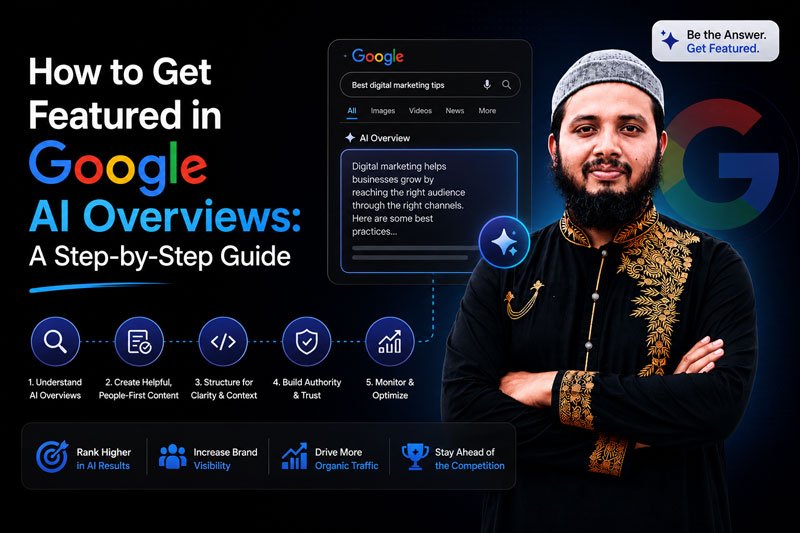
Picture this. Someone searches Google for “best SEO consultant for small businesses.” Before they even see a single blue link, Google generates a short, confident answer right at the top of the page — citing two or three websites it trusts.
Your competitor is one of them. You’re not.
That’s Google AI Overviews in action. And that placement at the very top of search results — before any traditional rankings — is now appearing in nearly half of all Google searches.
If your content isn’t structured to earn that spot, you’re handing your competitors a massive advantage every single day.
Here’s exactly how to get featured in Google AI Overviews.
How to Get Featured in Google AI Overviews: Understand How They Work First
You can’t optimize for something you don’t understand.
Google AI Overviews (previously called Search Generative Experience or SGE) are AI-generated summaries that appear at the top of Google search results. They’re powered by Google’s Gemini AI model, which reads and synthesizes content from multiple trusted sources across the web — then generates a concise, direct answer to the user’s query.
Here’s what makes this different from traditional SEO: Google isn’t just picking the highest-ranked page. It’s reading your content, extracting specific information from it, and weaving that information into a generated answer. Sometimes it cites your page. Sometimes it uses your content without a visible link.
As of early 2026, AI Overviews appear in approximately 48% of all tracked Google queries — up from 31% just a year ago. That number is climbing.
The types of queries that most commonly trigger AI Overviews include informational searches, how-to questions, comparison queries, and definition-based searches. Exactly the kind of content a business blog should be publishing.
Why Getting Featured Actually Matters for Your Business
Some marketers worry that AI Overviews steal clicks. And yes — users who get their answer directly from the overview sometimes don’t click through. But that’s only part of the picture.
When your website is cited as a source inside an AI Overview, several things happen:
Your brand appears at the very top of Google — above all organic results, above ads in many cases. That’s unprecedented visibility.
You earn instant trust. Google is essentially endorsing your content as reliable enough to cite. Users notice that.
You still get clicks. Research consistently shows that users click through to cited sources when they want more depth. High-intent, commercial queries especially drive click-throughs from AI Overviews.
You build AI visibility across platforms. Content that earns AI Overview citations tends to also get cited by ChatGPT, Perplexity, and Gemini. The same signals that earn you a spot in Google’s AI answer make you more trustworthy to every AI system.
Step 1: Target the Right Types of Queries
Not all searches trigger AI Overviews. Understanding which queries do is the first step.
AI Overviews most commonly appear for:
- Informational queries — “What is topical authority in SEO?”
- How-to queries — “How to improve Core Web Vitals for WordPress?”
- Definition queries — “What is generative engine optimization?“
- Comparison queries — “SEO vs GEO: what’s the difference?“
- Best-of queries — “Best eCommerce SEO strategies for 2026.”
Start by identifying which of your target keywords fall into these categories. These are your AI Overview opportunities. Build dedicated, well-structured content around each one — and you immediately put yourself in contention for a featured spot.
Step 2: Structure Your Content for Extraction
This is the most critical technical element of AI Overview optimization.
Google’s AI doesn’t read your page the way a human does. It scans for clearly structured, extractable information — and it rewards content that makes that process easy.
Lead with a direct answer. The first paragraph of every page or section should answer the target question clearly and concisely. Don’t build suspense. State the answer. Google’s AI pulls heavily from early-paragraph content.
Use question-mirroring H2 and H3 headings. If someone searches “how to get featured in Google AI Overviews,” your H2 should mirror that phrasing closely. This signals directly to Google’s AI what each section answers.
Keep paragraphs short and focused. Two to four sentences per paragraph. One clear idea per paragraph. Dense, long paragraphs are harder for AI to accurately extract — and they hurt human readability too.
Use numbered lists for processes. When explaining steps or sequences, numbered lists are significantly more likely to appear in AI-generated answers than prose descriptions.
Add summary sections. A brief “Key Takeaway” or summary section at the end of important content gives Google’s AI a clean, citable chunk to work with. Several studies show these sections appear in AI Overviews at a disproportionately high rate.
Step 3: Build Genuine E-E-A-T Signals
Google’s AI is trained to cite trustworthy sources. And trust isn’t built through keyword optimization — it’s built through demonstrable expertise and authority.
E-E-A-T stands for Experience, Expertise, Authoritativeness, and Trustworthiness. These signals matter enormously for AI Overview citations.
Here’s how to strengthen them:
Name your authors and show their credentials. Pages with a named expert author who has verifiable experience in the topic are cited significantly more than anonymous content.
Publish original research and data. Studies consistently show that content featuring original statistics sees 30–40% higher visibility in AI responses. If you can conduct original surveys, publish case studies, or compile proprietary data — do it.
Cite your sources explicitly. When you reference a statistic or study, name the source directly in the text — not just as a hyperlink. “According to a 2026 BrightEdge study” performs better in AI extraction than an unnamed linked source.
Display trust signals prominently. Certifications, awards, client results, years of experience — these belong on your website where Google can see them. An AI-driven SEO strategy built around E-E-A-T doesn’t just help with AI Overviews — it strengthens your entire search presence.
Step 4: Implement Schema Markup
Schema markup is one of the clearest signals you can send to Google about what your content means and how it should be used.
For AI Overview optimization, these schema types are most impactful:
- Article schema — for all blog content, marking publish and update dates, author information
- HowTo schema — for step-by-step guides; Google uses this to generate structured how-to responses
- FAQPage schema — frequently cited inside AI Overviews for question-and-answer content
- Organization schema — establishes your brand identity, contact information, and social profiles
- BreadcrumbList schema — helps Google understand your site structure and content hierarchy
If your technical SEO foundation isn’t already built on proper schema markup, this is one of the highest-ROI fixes you can make for AI visibility.
Step 5: Build Topical Authority Around Your Core Subject
Google’s AI doesn’t just evaluate individual pages. It evaluates whether your website is a genuine expert on the topic being asked about.
This is topical authority — and it’s one of the most powerful factors in earning consistent AI Overview citations.
If you publish one blog post about SEO and nothing else, Google’s AI has no reason to trust you as an SEO authority. But if your website covers SEO comprehensively — from technical SEO to local SEO, from keyword research to GEO — Google’s AI recognizes your site as a deep, reliable resource on the subject.
Building topical authority means:
- Creating content clusters around core topics
- Connecting related pages through strategic internal linking
- Publishing consistently in your niche
- Going deeper on subjects than competitors do
A well-structured on-page SEO and topical authority strategy is the single most sustainable way to earn AI Overview citations at scale — because authority compounds over time.
Step 6: Keep Your Content Consistently Fresh
Google’s AI balances freshness with reliability. It won’t always cite the newest content, but it does favor pages that are regularly updated over pages that have sat untouched for years.
Research shows that only about 12% of AI Overview citations come from content published within 30 days — meaning freshness alone isn’t enough. But regular updates significantly improve your citation chances by signaling that your content stays current.
Make it a habit to:
- Update key statistics and data every 6 months
- Add new sections to high-performing pages as the topic evolves
- Adjust publish dates when you make meaningful updates
- Incorporate recent examples and case studies into evergreen content
Step 7: Don’t Ignore Traditional SEO Rankings
Here’s a fact that surprises many people: you don’t have to rank in the top 3 to get cited in AI Overviews. Google’s AI can cite pages that rank anywhere in the top results.
But strong traditional rankings do significantly improve your chances. The better your organic SEO, the more opportunities you have to be cited.
This is why treating AI Overview optimization as a replacement for SEO is a mistake. It’s an enhancement. A strong professional SEO services strategy that covers both traditional rankings and AI citation optimization is what earns you consistent visibility across both surfaces.
How to Track Your AI Overview Performance
Measuring your AI Overview citations requires a slightly different toolkit than traditional SEO.
Google Search Console now includes AI Mode click data under the “Web” search type. Monitor impression patterns for queries where you want to be cited.
Manual spot checks are still essential. Run your target queries in Google regularly and note when your pages appear in AI Overviews and which sections get cited.
Dedicated AI visibility tools like SE Ranking’s AI Overviews Tracker, Semrush’s AI Toolkit, and Otterly.AI can automate monitoring across multiple queries and platforms.
Track both traditional metrics (rankings, organic traffic) and AI metrics (citation frequency, share of voice) side by side. The brands winning in search right now are excelling at both.
The Bottom Line
Getting featured in Google AI Overviews isn’t about gaming a new algorithm. It’s about building the kind of content and brand authority that AI systems genuinely trust.
Structure your content for extraction. Demonstrate real expertise. Keep your technical foundation strong. Build topical authority. Stay fresh.
Do those things consistently — and Google’s AI won’t just find your content. It’ll recommend it.
If you want a complete strategy built around both Google rankings and AI visibility, explore monthly SEO packages designed for exactly this new era of search.