
Zero-click searches just hit 69%.
That means nearly 7 out of every 10 Google searches end without a single click to any website. Users get their answer directly on the search results page — from a featured snippet, an AI Overview, or a voice assistant — and they’re done.
If your entire digital strategy depends on people clicking through to your site, that number should make you stop and think.
That’s the world Answer Engine Optimization (AEO) was built for. And understanding it could be the difference between staying visible in the age of AI search — or slowly becoming irrelevant.
What is Answer Engine Optimization (AEO)?
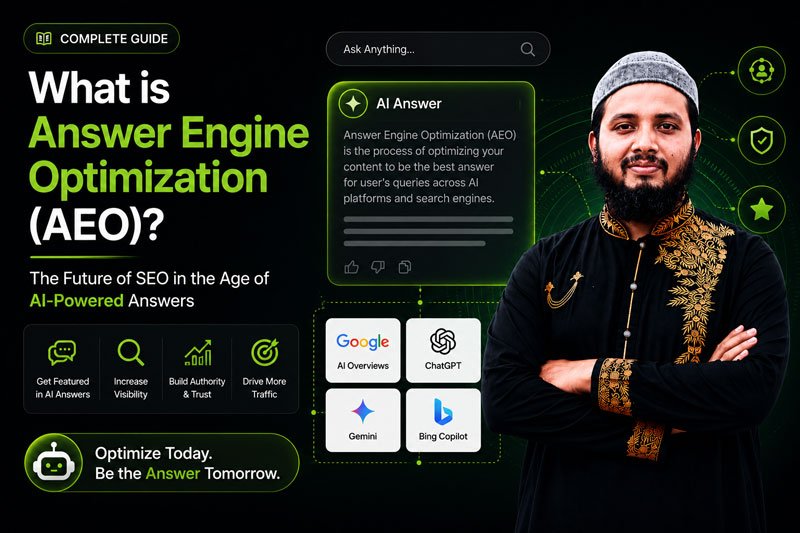
Answer Engine Optimization (AEO) is the practice of structuring and optimizing your content so that AI-powered platforms — ChatGPT, Google AI Overviews, Perplexity, Gemini, Microsoft Copilot, and voice assistants — select your content as the source when generating direct answers to user queries.
In traditional SEO, you compete for a position on a list of links. Users see that list and choose which link to click.
In AEO, there is no list. There is one answer. And either your content powers that answer, or someone else’s does.
The goal of AEO isn’t to get clicked. It’s to get cited. It’s to become the source that AI trusts enough to quote, summarize, and recommend — even when the user never visits your website.
How AEO Fits Into the Bigger Picture: SEO, AEO, and GEO
These three terms get used interchangeably, but they’re not the same thing. Understanding how they relate helps you build a strategy that covers all three.
SEO (Search Engine Optimization) — optimizing for rankings in traditional search engine results pages. Goal: earn clicks through organic search.
GEO (Generative Engine Optimization) — the broader discipline of optimizing your entire brand presence for AI-powered search platforms. Goal: get your brand recommended and cited by AI systems.
AEO (Answer Engine Optimization) — a specific component of GEO. It focuses specifically on the answer-retrieval layer: making sure your content is the one AI picks when it needs a source for a specific fact, definition, step, or recommendation.
Think of it this way: GEO is the strategy. AEO is one of the most critical tactics within that strategy.
All three matter. And as you’ll see, the foundation of each one is exactly the same — high-quality, authoritative content structured for clarity and trust.
Why AEO Is Urgent Right Now
The numbers tell the story clearly.
Zero-click searches climbed from 56% in 2024 to 69% in 2026. ChatGPT now serves over 800 million users weekly. Google AI Overviews appear in more than half of all Google searches. And according to G2’s 2026 AI Search Insight Report, 51% of B2B buyers now begin their research with an AI chatbot — more often than Google.
That last statistic is the one that should hit hardest for any business.
Your potential customers are asking AI for recommendations before they ever open a search results page. If the AI doesn’t know your brand, doesn’t trust your content, or can’t extract clear information from your site — you don’t exist in that conversation.
The brands establishing AEO authority in 2026 are building a compounding advantage. Every page they publish that earns AI citations reinforces their authority. And reversing a 6–12 month head start in AI citation authority is expensive and slow.
The window to get ahead is right now.
How Answer Engines Actually Work
To optimize for answer engines, you need to understand how they retrieve and use information.
When a user asks ChatGPT or Perplexity a question, the AI doesn’t search for the “best” website on the topic. It retrieves multiple sources, evaluates them for credibility and relevance, and synthesizes a direct answer — citing the sources it found most trustworthy and extractable.
The key factors in that selection process:
Can the AI read your content easily? Pages with clean HTML, server-side rendering, clear headings, and well-structured text are significantly easier for AI crawlers to process. JavaScript-heavy, unstructured pages often get skipped entirely.
Does your content answer the question directly? AI systems favor content that provides a clear, concise answer in the first few sentences of a section — not buried three scrolls down the page.
Is your source credible? Backlinks from authoritative sites, named expert authors, original data, and consistent brand mentions across the web all signal to AI that your content is trustworthy.
Is your content structured for extraction? Schema markup, descriptive headings, numbered lists, and comparison tables make it dramatically easier for AI to pull specific facts, steps, or recommendations from your content.
The 5 Core Pillars of AEO
1. Direct Answer Content
Every important page on your website should lead with the answer. If someone asks “What is AEO?” — your first paragraph should answer that question clearly and completely. Don’t make AI (or your reader) dig for it.
This doesn’t mean sacrificing depth. It means leading with the conclusion, then supporting it with detail. This structure serves both human readers and AI extraction equally well.
2. Structured Data and Schema Markup
Schema markup is your most direct line of communication with answer engines. It tells AI exactly what your content is — an article, a how-to guide, an FAQ, a product, a local business.
For AEO, the most impactful schema types are FAQPage, HowTo, Article, and Organization. These signal to AI the type of answer your content can provide — and dramatically improve citation rates for those query types.
A properly structured technical SEO foundation that includes comprehensive schema markup is non-negotiable for serious AEO performance.
3. Topical Authority
Answer engines don’t just evaluate individual pages. They evaluate whether your domain is a genuine authority on the subject.
A website that has published 50 well-structured, interlinked pieces about SEO will consistently outperform a site with one brilliant SEO post — because topical depth signals expertise that AI systems are trained to trust.
Building topical authority means creating comprehensive content clusters, linking related pages intelligently, and going deeper on every subject than your competitors do. This is the core of what on-page SEO and topical authority optimization looks like in practice.
4. E-E-A-T Signals
Experience, Expertise, Authoritativeness, Trustworthiness. These aren’t just Google quality guidelines anymore — they’re the criteria every AI answer engine uses to decide which sources to trust.
Display your expertise clearly: named authors with real credentials, original research, verifiable case studies, client results, certifications. The more evidence of genuine expertise on your website and across the web, the more confidently AI systems will cite you.
5. Conversational Content Targeting
People search Google with keywords. People ask AI in full sentences.
“Best SEO tool” is a keyword. “What’s the best SEO tool for a small business with a limited budget?” is a conversational query — and that’s what AEO content needs to answer.
Identify the exact questions your target audience is asking AI platforms. Build content that answers those questions directly, thoroughly, and in the natural language your audience actually uses.
AEO and the Zero-Click Challenge
Here’s the concern most business owners raise when they first hear about AEO: if AI answers the question without the user clicking my link, how does that help my business?
It’s a fair question. And the answer has two parts.
First, AI citations still drive meaningful traffic. When users want more depth — when they’re comparing options, evaluating a service provider, or making a purchasing decision — they click through. The higher the purchase intent, the more likely a user is to click the cited source.
Second, and more importantly: brand visibility without a click still has real value. When AI recommends your brand by name as the answer to a user’s question, that recommendation registers. Users remember it. When they’re ready to buy, they search for you directly. This is brand authority at scale — earned through AEO, not paid for.
The businesses that understand this are the ones investing in AI SEO services built for the full picture — not just the click.
Practical AEO Checklist
Before you move on, make sure you can check these off:
✓ Every key page leads with a direct, clear answer to its target question
✓ FAQPage, HowTo, and Article schema implemented sitewide
✓ Named authors with verifiable credentials on all content
✓ Content organized in topical clusters with intelligent internal linking
✓ Conversational, question-based content for AI query formats
✓ Original data, statistics, or research cited on authority pages
✓ Technical foundation clean — fast load times, server-side rendering, crawlable pages
✓ Brand mentions building across third-party platforms and publications
AEO Is Not the Future. It’s Right Now.
The search landscape has already shifted. Zero-click searches dominate. AI-generated answers appear in more than half of all Google queries. Hundreds of millions of people use ChatGPT and Perplexity weekly for recommendations that used to come from Google.
AEO isn’t a strategy you can plan to implement “when it becomes more mainstream.” It’s mainstream. And every month you delay is a month your competitors spend building AI citation authority that compounds over time.
Start with your most important pages. Structure them for direct answers. Build your topical authority. Strengthen your E-E-A-T signals. Layer in schema markup.
That’s how you become the answer — not just a link.
If you want a complete strategy that covers AEO, GEO, and traditional SEO together, explore the professional SEO services and monthly SEO packages built for exactly this new era of search.