
You’ve probably heard the terms thrown around in every marketing meeting, YouTube video, and SEO course — white hat SEO and black hat SEO. But what do they actually mean? And more importantly, which one should you be using?
Here’s the truth: the difference between white hat SEO vs black hat SEO isn’t just about tactics. It’s about whether your website survives long-term or gets wiped out overnight by a Google algorithm update.
Let’s break it all down — no fluff, no jargon.
What is White Hat SEO?
White hat SEO refers to all the optimization strategies and techniques that follow Google’s official guidelines. It’s the ethical, sustainable way to grow your organic traffic.
Think of it this way: white hat search engine optimization is playing the game by the rules. You’re not trying to trick search engines. You’re helping them do their job — matching the right content to the right people.
Core White Hat SEO Techniques
1. Publishing High-Quality, Original Content
Google’s entire algorithm is built around one thing: serving the best possible answer to a user’s query. If your content genuinely helps people, Google will reward you for it. That means in-depth articles, original research, step-by-step guides, and content that actually answers what people are searching for.
2. Keyword Research Done Right
White hat SEO isn’t about stuffing keywords into every sentence. It’s about understanding search intent — what people actually want when they type a query — and building content around that. Tools like Google Search Console, Ahrefs, or Semrush can help you find the right keywords without guessing.
3. On-Page Optimization
This includes crafting clear title tags, writing compelling meta descriptions, using proper header structure (H1, H2, H3), adding internal links, and optimizing images with alt text. These are technical tweaks that help both users and search engines understand your content.
4. Earning Backlinks Naturally
Links from other trusted websites are still one of Google’s strongest ranking signals. White hat link building means earning those links — through great content, digital PR, guest posting on reputable sites, and building genuine relationships in your industry.
5. Technical SEO
Page speed, mobile-friendliness, crawlability, Core Web Vitals, secure HTTPS connections — these are all technical factors that tell Google your site is reliable and worth ranking. Fixing technical issues is one of the fastest white hat SEO wins.
6. Great User Experience (UX)
If visitors land on your site and immediately bounce back to Google, that’s a strong signal that your content didn’t deliver. White hat SEO prioritizes easy navigation, fast load times, clean design, and content that keeps people engaged.
White Hat SEO Examples in Action
- Writing a detailed “how-to” guide that ranks because it’s genuinely the best resource on the topic
- Getting featured in an industry publication that links back to your website
- Fixing broken internal links to improve crawl efficiency
- Optimizing your page titles to match what your target audience searches for
The results from white hat search engine optimization aren’t instant. But they compound over time. A page that earns authority today will keep bringing in traffic months and years from now.
What is Black Hat SEO?
Black hat SEO is the opposite. It refers to tactics designed to manipulate search engine rankings — often in direct violation of Google’s Webmaster Guidelines.
The goal of black hat SEO is simple: get to the top of Google as fast as possible, by any means necessary. And while some of these tactics can produce short-term results, the risks are enormous.
Black Hat SEO Techniques (And Why They’re Dangerous)
1. Keyword Stuffing
This is when a page repeats a target keyword so many times it becomes unreadable. “Buy cheap shoes. If you’re looking for cheap shoes, our cheap shoes store sells the cheapest shoes…” — you’ve seen it. Google’s algorithm has been trained to detect and penalize this.
2. Cloaking
Cloaking means showing different content to Google’s crawlers than what human visitors actually see. For example, a page might show Google a keyword-packed article while users see a completely different (often spammy) page. This is one of the most serious violations of Google’s guidelines.
3. Private Blog Networks (PBNs)
A PBN is a network of websites created for the sole purpose of building links to a main site. These links are fake authority signals — they’re not earned, they’re manufactured. Google has gotten extremely good at detecting PBNs, and the penalties are severe.
4. Buying Backlinks
Paying for links is explicitly against Google’s guidelines. It used to work well, but Google’s Penguin algorithm was specifically designed to catch and penalize paid link schemes. The risk far outweighs any temporary ranking bump.
5. Hidden Text and Hidden Links
Placing white text on a white background, or hiding links in tiny punctuation marks — these are classic black hat tricks. Google’s bots easily detect these now, and any site caught doing it risks being removed from search results entirely.
6. Doorway Pages
These are low-quality pages created purely to rank for specific keywords and then redirect visitors to a different page. They add no value to users and exist only to game rankings.
7. Negative SEO
Some practitioners actually use black hat techniques against competitors — building spammy links to a competitor’s site to tank their rankings. This is not only unethical, it can sometimes be illegal depending on jurisdiction.
8. Scraped or Spun Content
Taking content from other websites and either republishing it directly (scraping) or running it through software that swaps words to make it look original (spinning) — both are clear violations and do nothing to help users.
Black Hat SEO Examples in the Real World
- A travel site that built thousands of spammy links through PBNs, ranked #1 for two months, then got deindexed entirely
- An e-commerce store that stuffed product descriptions with repetitive keywords and saw rankings drop after a Google core update
- A local business that paid for links from link farms and received a manual penalty from Google
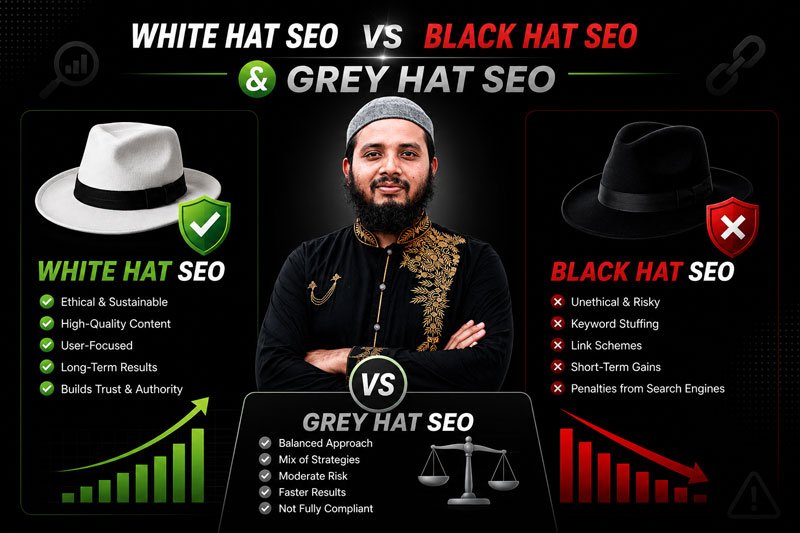
Key Differences Between White Hat and Black Hat SEO
Here’s a clear comparison to understand the difference between white hat and black hat SEO:
| Factor | White Hat SEO | Black Hat SEO |
|---|---|---|
| Goal | Sustainable long-term rankings | Fast, short-term rankings |
| Focus | Users first | Search engines first |
| Techniques | Quality content, ethical link building, on-page optimization | Keyword stuffing, cloaking, PBNs, link buying |
| Risk | Very low | Very high (penalties, deindexing) |
| Cost | Higher upfront investment | Often cheaper short-term |
| Longevity | Results compound over time | Results can vanish overnight |
| Google compliance | Fully compliant | Violates Google’s guidelines |
Does Black Hat SEO Still Work?
This is a question people keep asking — and the honest answer is: sometimes, temporarily.
There are still black hat practitioners who see short-term ranking gains. But Google releases hundreds of algorithm updates every year specifically to catch and penalize these tactics. The window is getting smaller, and the consequences are getting harsher.
The real question isn’t “does black hat SEO work?” It’s “is it worth the risk?” And for 99% of businesses, the answer is no.
Google Penalty for Black Hat SEO
Google has two types of penalties:
Algorithmic Penalties — These happen automatically when an algorithm update (like Penguin or Panda) detects manipulative tactics. Your rankings drop, sometimes dramatically, without any manual intervention from Google.
Manual Penalties — These are issued by a human reviewer at Google after a manual review of your site. You’ll see a notification in Google Search Console. These are serious and can result in your site being partially or fully removed from search results.
Recovering from either type of Google penalty for black hat SEO is painful, time-consuming, and never guaranteed.
Is Black Hat SEO Illegal?
Black hat SEO itself isn’t technically illegal in most countries — but some tactics cross into legal territory. Negative SEO campaigns, hacking competitors’ sites, or creating fraudulent content can open you up to lawsuits or criminal charges depending on local laws.
More importantly, violating Google’s terms of service can get your site permanently deindexed — which for most businesses is as damaging as being shut down entirely.
What About Grey Hat SEO?
Grey hat SEO sits in the middle — tactics that aren’t explicitly against Google’s guidelines but aren’t exactly “clean” either. Examples include buying aged domains, aggressive link exchanges, or over-optimized anchor text.
Grey hat SEO might feel like a safer middle ground, but the risk is unpredictable. As Google’s algorithms evolve, what’s grey today can become black tomorrow. If you’re building a serious online presence, it’s not worth the gamble.
Why You Should Only Hire a White Hat SEO Expert
If you’re thinking about hiring an SEO professional or agency, this section might be the most important part of this entire article.
The SEO industry has no universal licensing or certification requirements. That means anyone can call themselves an “SEO expert” — including people who rely entirely on black hat tactics.
Here’s why hiring a white hat SEO expert is non-negotiable:
Your business reputation is on the line. If your site gets penalized or deindexed, it doesn’t just hurt your traffic. It damages your brand, your credibility, and your revenue. Some businesses never recover.
You can’t separate yourself from your agency’s tactics. Even if you didn’t know your agency was building spammy links, Google doesn’t care. It’s your website that gets penalized.
Long-term ROI is incomparably better. A site built on white hat foundations grows steadily. Organic traffic compounds like interest. A black hat site is a house of cards.
Google is getting smarter every year. With AI now powering a significant portion of Google’s algorithm (and AI-driven search results becoming the new normal), manipulative tactics are becoming detectable faster than ever before.
How to Spot a White Hat SEO Expert
- They talk about content strategy, user experience, and earning authority — not just “getting you to #1 fast”
- They can clearly explain every tactic they use and why
- They set realistic expectations (real SEO takes 3-6+ months to show meaningful results)
- They provide transparent, detailed reporting
- They follow Google’s Search Essentials (formerly Webmaster Guidelines)
Red Flags When Hiring an SEO Agency
- Guarantees of #1 rankings in 30 days
- Vague explanations of their “proprietary methods”
- Prices that seem too good to be true
- No mention of content creation or technical audits
- Reluctance to share what they’re actually doing
The Bottom Line
The debate between white hat SEO vs black hat SEO ultimately comes down to one question: are you building something that lasts, or chasing a shortcut that could destroy everything you’ve built?
White hat SEO is slower. It requires real effort, genuine content, and patience. But it builds real authority — the kind that holds up through algorithm updates, AI search changes, and competitive shifts.
Black hat SEO is a gamble. Sometimes you win for a while. But eventually, Google always catches up. And when it does, the damage can be irreversible.
Build your SEO foundation the right way. Focus on creating content that genuinely serves your audience, earning links the right way, and optimizing your site for real people — not bots. That’s not just the ethical approach to SEO. It’s the smart one.