
Every few months, something shifts in search — a new Google update, a Gemini model upgrade, a new AI platform capturing market share — and another wave of businesses watches their traffic tank.
The businesses that survive? They built something different from the start.
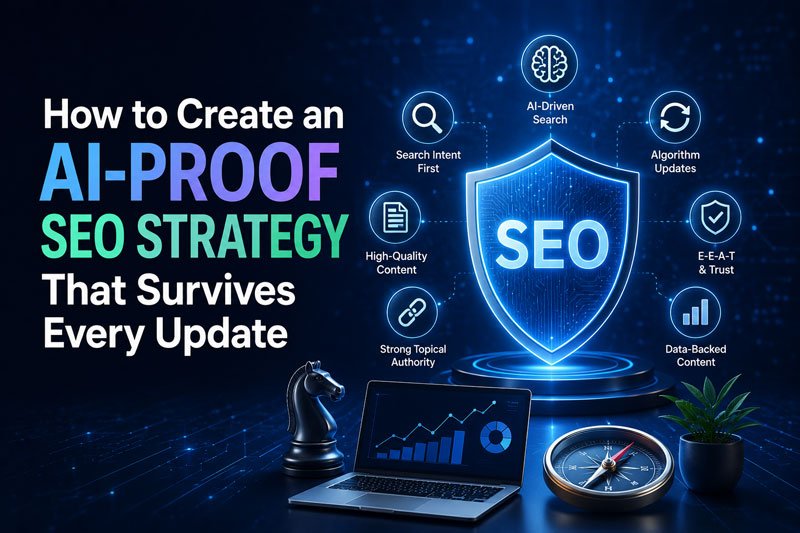
They didn’t build an SEO strategy optimized for a specific algorithm. They built an SEO strategy that is, by design, resistant to the constant changes that define search in 2026. They built what you could genuinely call an AI-proof SEO strategy.
Here’s exactly what that looks like — and how to build one for your business.
What Does an AI-Proof SEO Strategy Actually Mean?
Before anything else, let’s be clear about what AI-proof doesn’t mean.
It doesn’t mean immune to change. No strategy is. It doesn’t mean ignoring AI entirely. That ship has sailed.
An AI-proof SEO strategy is one built on signals that every search evolution — traditional algorithm updates, AI model upgrades, new platforms — consistently rewards. Not signals that game a specific ranking factor. Signals that represent genuine value: real expertise, real authority, real usefulness to real people.
When Gemini 3 replaced 42.4% of previously cited domains in AI Overviews earlier this year, the domains that survived weren’t the ones with the most backlinks or the highest keyword density. They were the ones with the deepest topical authority, the strongest E-E-A-T signals, and the most extractable content structure.
That’s the pattern. Every major search evolution rewards the same underlying qualities. Build those qualities into your strategy, and you stop chasing algorithm changes — because the changes keep pointing back to what you already built.
How to Create an AI-Proof SEO Strategy: The 7 Core Pillars
Pillar 1: Build Genuine Topical Authority
This is the single most durable competitive advantage in search — whether we’re talking about Google rankings, ChatGPT citations, Perplexity answers, or Gemini AI Overviews.
Topical authority means your website is recognized as a trusted, comprehensive expert on a specific subject. Not a generalist that touches everything lightly. A specialist that covers its niche so thoroughly that search engines and AI platforms have no reasonable alternative to citing you.
The way to build it: create a content cluster for every major topic in your niche. Each cluster has a central pillar page covering the broad topic, with multiple supporting pages going deep on specific subtopics. These pages link to each other intelligently, reinforcing the topical connection.
A website that covers SEO from technical foundations to local strategies to AI search optimization — with dozens of detailed, interlinked pages on each subject — tells Google and Gemini and Perplexity: this domain knows SEO. Trust it.
That recognition doesn’t happen overnight. But once it builds, it compounds. Every new piece of content you publish earns faster traction because you’ve already established authority in the space.
This is the core of on-page SEO and topical content authority — building a content architecture that signals expertise at the domain level, not just the page level.
Pillar 2: Demonstrate Real E-E-A-T
Experience. Expertise. Authoritativeness. Trustworthiness. Google introduced these quality signals years ago — and in 2026, they’ve become the primary filter both traditional search and AI platforms use to decide which sources deserve visibility.
Here’s the thing about E-E-A-T: you can’t fake it at scale. Generic content mills can’t manufacture it. AI alone can’t produce it. It requires real human expertise, demonstrated consistently over time.
What E-E-A-T looks like in practice:
Named authors with verifiable credentials on every piece of content. An SEO guide written by a named SEO specialist with 8 years of results is fundamentally different from an anonymous post — in Google’s eyes and in Gemini’s.
Original case studies and real results. Not theoretical advice — actual examples from actual work. What changed, what result followed, what the data showed.
Transparent business information. Who you are, what you do, who you’ve helped, how long you’ve been doing it. This information belongs on your About page, your author profiles, your service pages.
Third-party validation. Press mentions, industry recognitions, certifications, client reviews on external platforms. The more credible sources that verify your expertise, the stronger your E-E-A-T becomes.
Pillar 3: Structure Content for AI Extraction
Every AI platform in 2026 — Gemini, Perplexity, ChatGPT, Copilot — retrieves and synthesizes content through the same underlying process: it scans your page, extracts the most relevant information, and uses it to generate an answer.
Content that makes this process easy gets cited. Content that makes it hard gets skipped.
Structuring for AI extraction means:
Leading every page and every major section with a direct, clear answer. Don’t warm up to the point. Make the point. The supporting detail comes after.
Using descriptive, question-mirroring headings. Each H2 and H3 should tell AI exactly what that section covers — so it can pull from the right section for the right query.
Keeping paragraphs short and focused. One idea per paragraph. Two to four sentences maximum. Dense walls of text are extraction obstacles.
Using numbered lists for processes and steps. Tables for comparisons. These structured formats get pulled into AI-generated answers at disproportionately high rates compared to equivalent prose.
Pillar 4: Build a Technical Foundation That AI Can Actually Read
An AI-proof SEO strategy requires a technical foundation that both Google and AI crawlers can navigate cleanly. If your pages are blocked, unreadable, or slow — no content strategy will save you.
The non-negotiables in 2026:
Allow AI crawlers explicitly. Your robots.txt must permit GPTBot, PerplexityBot, ClaudeBot, and GoogleBot-Extended. Many websites are blocking these crawlers accidentally — and wondering why they’re invisible in AI answers.
Use server-side rendering. Content loaded via JavaScript after page render is often invisible to AI crawlers. Your critical content needs to be readable in the raw HTML source.
Create an llms.txt file. This new standard tells AI systems which pages on your site are most important, what your brand represents, and how to navigate your content. Think of it as a sitemap specifically designed for AI crawlers.
Implement comprehensive schema markup. Article, HowTo, Organization, LocalBusiness, FAQPage — these structured data types make your content machine-readable and dramatically improve AI citation rates.
Keep Core Web Vitals strong. Slow, unstable pages signal low quality to both Google and AI systems. Speed and stability are trust signals.
A professional technical SEO and AI visibility audit catches every one of these issues systematically — often revealing problems that have been silently killing AI visibility for months.
Pillar 5: Build Cross-Web Authority
Your SEO strategy can’t live only on your website. AI systems evaluate your brand’s entire presence across the web — and their confidence in recommending you is directly proportional to how consistently and credibly you appear across multiple independent sources.
This means building authority everywhere your audience and your industry exist:
Backlinks from trusted sources. Links from authoritative sites in your niche still matter — both for traditional rankings and as trust signals that AI systems pick up. SEO backlink and trust building from genuine, relevant sources is a core component of cross-web authority.
Brand mentions without links. When your brand name appears in forum discussions, news articles, YouTube videos, and industry publications — even without a hyperlink — AI systems track those mentions and build a more confident picture of who you are.
Reddit and community presence. Reddit content is heavily indexed and cited by AI platforms. Genuine, helpful contributions to subreddits in your niche build brand visibility in training data that compounds over time.
YouTube content. Video content from YouTube appears regularly in AI-generated responses. If your competitors have YouTube channels and you don’t, they have an AI visibility advantage you haven’t countered yet.
Review platform presence. Google Business Profile reviews, Trustpilot, industry-specific directories — these third-party trust signals feed directly into how AI platforms perceive your credibility.
Pillar 6: Optimize for Multi-Platform Visibility
An AI-proof SEO strategy doesn’t optimize for one platform. It builds visibility across every surface where your potential customers might find answers.
In 2026, that means:
- Google traditional search (still 14 billion daily queries)
- Google AI Overviews (48%+ of searches)
- Google AI Mode (growing rapidly)
- ChatGPT (800 million weekly users)
- Perplexity (1 billion monthly queries)
- Microsoft Copilot (integrated across Microsoft’s ecosystem)
- Voice search (Siri, Alexa, Google Assistant)
The good news: optimizing well for one of these surfaces tends to improve visibility across all of them. The underlying requirements — quality content, genuine authority, strong technical foundation, clear structure — are shared.
The AI SEO services built for 2026 treat multi-platform visibility as a single integrated strategy — not six separate optimization projects running in parallel.
Pillar 7: Treat Freshness as a Competitive Advantage
Search platforms — both traditional and AI-powered — consistently favor content that stays current. In 2026, the freshness bar has risen significantly.
An AI-proof strategy treats content maintenance as an ongoing priority, not an afterthought.
Practically, this means:
- Scheduling quarterly reviews of your most important pages
- Updating statistics and data whenever newer research becomes available
- Adding new examples and case studies to evergreen content
- Refreshing introductions and conclusions to reflect current conditions
- Updating schema markup dates when meaningful changes are made
Businesses that publish content and never touch it again are slowly losing ground to competitors who treat their content library as a living asset. The gap compounds over time.
The Keyword Research Foundation Every AI-Proof Strategy Needs
One thing traditional SEO and AI search optimization share: they both start with understanding exactly what your audience is searching for.
But the nature of that research has evolved. Traditional keyword research found high-volume, short-tail phrases. AI search optimization requires understanding conversational queries — the full-sentence questions people type into ChatGPT and Perplexity.
Both matter. And keyword research and competitor analysis built for 2026 covers both: traditional keyword opportunities for Google rankings and conversational query patterns for AI visibility.
The businesses with the most durable search presence in 2026 aren’t choosing one or the other. They map both — and build content that serves both simultaneously.
What an AI-Proof Strategy Looks Like Month by Month
Building this kind of strategy isn’t a one-time project. It’s an ongoing process of publishing, optimizing, and expanding your authority over time.
A typical 90-day foundation looks like this:
Month 1 — Technical foundation.
Fix crawler permissions. Implement schema markup. Improve Core Web Vitals. Set up GA4 AI referral traffic tracking. Create llms.txt. These are the infrastructure changes that make everything else possible.
Month 2 — Content architecture.
Map your topical clusters. Identify content gaps. Begin publishing high-priority pillar and supporting content. Structure existing high-traffic pages for AI extraction.
Month 3 — Authority building.
Start cross-web brand mentions. Pursue backlinks from relevant industry sources. Build community presence. Track AI visibility baselines across ChatGPT, Perplexity, and Gemini.
From month 4 onward: publish, refresh, build, and track. The authority compounds. The citations accumulate. The visibility grows across both traditional and AI search surfaces.
If you want this process mapped out specifically for your business, the monthly SEO packages at nakibit.com are built around exactly this framework — or start with a full professional SEO audit to see exactly where you stand today.
The Honest Truth About AI-Proof SEO
No strategy is literally immune to change. Search will keep evolving — that’s been true for 25 years and it’ll be true for the next 25.
But the businesses that consistently survive and grow through every search evolution share one thing in common: they built real authority, demonstrated real expertise, and created content that genuinely helps real people.
That’s not a hack. It’s not a trick. It’s just doing the work properly.
Build that — and every algorithm update, every new AI platform, every Gemini model upgrade becomes an opportunity rather than a threat. Because every search evolution keeps rewarding the same underlying thing: trust earned through genuine expertise.
That’s what AI-proof SEO looks like. And it’s the only strategy worth building.