
Imagine two people looking for the same service — say, a local SEO expert in Bangladesh .
The first person opens Google, types in the query, and scans the search results. They click a few links, compare websites, and make a decision.
The second person opens ChatGPT and types: “Who is the best SEO expert in Bangladesh?” They don’t see ten links. They get a direct answer — a recommendation with a name, a reason, and sometimes a website.
Same intent. Completely different journey.
That difference — right there — is the entire SEO vs GEO conversation. And understanding it could be the most important strategic decision you make this year.
The Difference Between SEO and GEO That Actually Matters
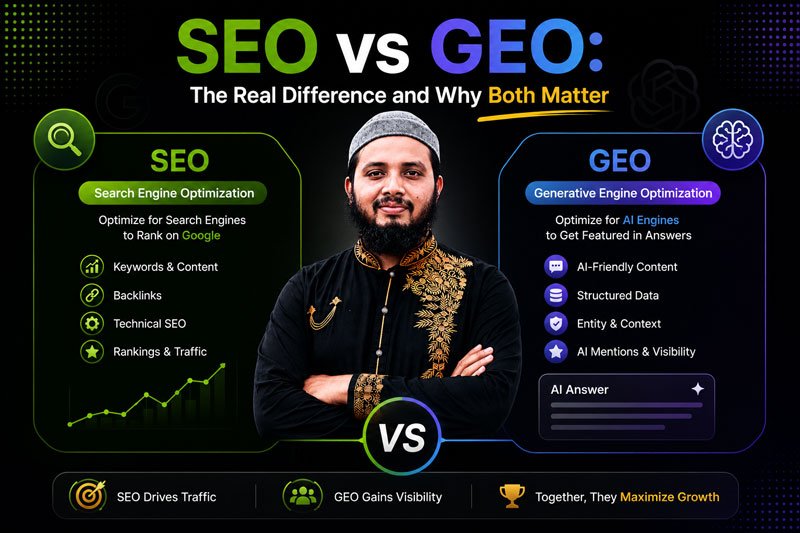
SEO (Search Engine Optimization) is the practice of optimizing your website so it ranks higher in traditional search engine results — primarily Google and Bing. You’re competing for a spot on a list of links. Success is measured in rankings, clicks, and organic traffic.
GEO (Generative Engine Optimization) is the practice of optimizing your content and brand so that AI-powered platforms — ChatGPT, Google AI Overviews, Perplexity, Gemini, Microsoft Copilot — include your business in their generated answers. You’re not competing for a link position. You’re competing to be the answer.
One simple way to remember it: SEO gets you found. GEO gets you recommended.
Both matter. But they work differently, they measure success differently, and they require different strategies to win.
How SEO Works
SEO has been around since the late 1990s. Over the decades, it evolved from keyword stuffing into a sophisticated discipline built on hundreds of ranking signals.
Here’s what traditional SEO focuses on:
Keywords and search intent. You research what people are searching for, then create content that matches that intent. The better your content matches what the user needs, the higher Google ranks you.
Backlinks and authority. Links from other websites act as votes of confidence. The more authoritative sites linking to you, the more Google trusts your content.
Technical health. Site speed, mobile-friendliness, crawlability, Core Web Vitals — all of these signal to Google that your website is trustworthy and worth serving to users.
On-page optimization. Title tags, meta descriptions, heading structure, internal linking — these help Google understand what each page is about.
The outcome of good SEO? A page-one ranking on Google. Users see your link, click it, and visit your website.
How GEO Works Differently
GEO operates on a fundamentally different model.
AI search engines don’t crawl your site and rank it against competitors. They synthesize information from multiple sources — your website, third-party mentions, forums, reviews, publications — and generate a single, conversational answer.
Your goal with GEO isn’t to rank. It’s to become a source that AI trusts enough to cite.
Here’s what GEO focuses on:
Brand authority across the web. AI systems build their understanding of your brand from everything published about you online — not just your own website. Mentions on Reddit, YouTube, review platforms, industry publications, and forums all feed into how AI perceives your credibility.
Content extractability. AI needs to be able to pull specific, accurate information from your pages quickly. Clear headings, direct answers, structured data, and short focused paragraphs make your content easier for AI to extract and cite correctly.
E-E-A-T signals. Experience, Expertise, Authoritativeness, and Trustworthiness. AI systems prioritize sources that demonstrate real expertise — named authors, original research, verifiable credentials, and transparent business information.
Entity recognition. AI understands the web through entities — people, places, businesses, concepts. The clearer and more consistent your brand information is across the web, the more confidently AI can represent your business in its answers.
The outcome of good GEO? Your brand gets mentioned, recommended, or cited inside an AI-generated response — without a user ever needing to search Google.
SEO vs GEO: Side-by-Side Comparison
| SEO | GEO | |
|---|---|---|
| Goal | Rank higher in search results | Get cited in AI-generated answers |
| Platform | Google, Bing | ChatGPT, Perplexity, Gemini, Copilot |
| Success metric | Rankings, organic traffic | AI mentions, brand citations, AI share of voice |
| Content focus | Keywords, search intent | Clarity, authority, extractability |
| Key signals | Backlinks, technical health | Entity recognition, E-E-A-T, brand mentions |
| User action | Clicks a link | Reads an AI-generated recommendation |
| Result type | List of ranked links | Single synthesized answer |
What SEO and GEO Have in Common
Here’s the good news: if you’ve been doing solid SEO, you already have a head start with GEO.
Both disciplines reward the same fundamentals:
- High-quality, accurate content
- Strong technical website health
- Genuine authority in your niche
- Clear, well-structured pages
- Trust signals that prove your expertise
The difference is in the layer on top. GEO requires you to think beyond your own website — to your entire brand presence across the web. And it requires your content to be structured not just for search crawlers, but for AI systems that extract and synthesize information differently.
A strong on-page SEO and topical authority strategy serves both goals simultaneously — which is why smart businesses aren’t treating them as two separate strategies.
The Real-World Business Impact of Getting Both Right
Let’s go back to that example from the beginning.
A potential client in Dhaka searches Google for “SEO expert in Bangladesh.” If your SEO is strong, your website appears on page one. They click. They read. They consider hiring you.
Another potential client asks ChatGPT: “Who is a reliable SEO expert in Bangladesh that understands AI search?” If your GEO is strong, ChatGPT recommends your name — with a brief explanation of why you’re trustworthy.
Which of those two clients is more likely to convert?
The second one. Because they didn’t find you through a list — they were told about you by an AI they trust. That’s the power of GEO done right.
This is exactly what AI SEO services built for the modern search era look like — optimizing for both the traditional search result and the AI recommendation simultaneously.
When Should You Prioritize SEO vs GEO?
The honest answer: you shouldn’t have to choose.
Google still processes over 14 billion searches per day. ChatGPT processes around 2.5 billion daily prompts. Both audiences are enormous. Both represent real potential customers for your business.
That said, here’s a practical framework:
Prioritize SEO if:
- You’re a new website with no traffic yet
- You’re targeting high-volume informational or commercial keywords
- Your audience is older and more traditional in their search behavior
- You need short-term traffic growth
Prioritize GEO if:
You’re building a brand in a competitive niche
You want to influence purchasing decisions at the research stage
Your audience is tech-savvy and uses AI tools regularly
You want long-term brand authority that compounds over time
Do both if:
- You’re serious about sustainable business growth in 2026 and beyond
The smartest move is to build a strategy where every piece of content serves both goals — ranking on Google while also being citable by AI. That dual optimization is what the next generation of professional SEO services is built around.
The Bottom Line
SEO and GEO aren’t opponents. They’re partners.
SEO has been the backbone of digital visibility for over two decades, and it isn’t going anywhere. But GEO is the new layer your strategy needs to stay competitive as billions of users shift toward AI-powered search.
The businesses that master both — building technical SEO excellence while earning genuine brand authority that AI systems recognize — are the ones that will dominate search visibility for the next decade.
Start with a strong SEO foundation. Then layer in GEO. And if you want help building that combined strategy from scratch, a comprehensive monthly SEO package tailored to your business is the fastest way to get there.