What is Semantic SEO and Why It Matters for Google in 2026

NAZIRUL ISLAM NAKIB
Here’s a scenario that plays out thousands of times every day.
Someone types “how to fix slow website” into Google. Their real problem is a poor Core Web Vitals score that’s killing their rankings. The page they actually need talks about page speed optimization, LCP, CLS, render-blocking resources, and server response time — but it never once uses the exact phrase “how to fix slow website.”
In 2015, Google might have struggled to connect that query to that page.
In 2026? Google surfaces it confidently at position one — because Google no longer reads keywords. It reads meaning.
That’s semantic SEO. And if you’re still building your content strategy around exact-match keyword placement, you’re fighting the algorithm with a strategy the algorithm outgrew years ago.
What is Semantic SEO?
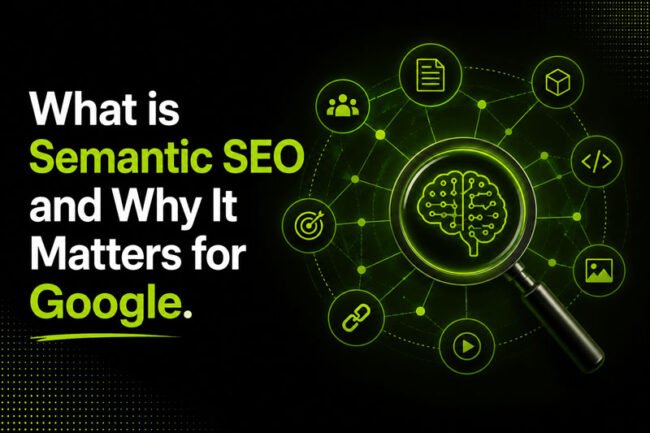
Semantic SEO is the practice of optimizing your content for meaning, context, and user intent — rather than exact keyword repetition.
The word “semantic” comes from semantics, the study of meaning in language. In SEO terms, it means helping Google understand not just what words appear on your page, but what your page is actually about, what problem it solves, and how it relates to the broader subject it belongs to.
Traditional keyword SEO asked: “what phrase is the user typing?” Semantic SEO asks: “what does the user actually mean, and what answer would fully satisfy them?”
Those two questions lead to very different content strategies. And in 2026, the second approach wins every time.
Why Google Moved to Semantic Search
Google didn’t shift to semantic understanding because it wanted to make SEOs’ lives harder. It shifted because keyword-based ranking was producing terrible results for users.
Consider the word “apple.” A keyword-based system sees one word. A semantic system understands that “apple recipes” means something completely different from “apple stock price” and “apple customer service” — even though all three queries contain the same word.
Multiply that ambiguity across billions of daily searches and you understand why Google had to evolve beyond keyword matching.
The evolution happened through a series of landmark updates:
Hummingbird (2013) was the first major shift — Google started processing entire search queries as units of meaning rather than bags of keywords.
RankBrain (2015) introduced machine learning, allowing Google to handle queries it had never seen before by inferring meaning from context.
BERT (2019) brought deep natural language understanding — Google could now interpret the relationship between words in a query, understanding that “can you get medicine for someone at a pharmacy” is asking about picking up prescriptions for another person, not asking if pharmacies sell medicine.
MUM (2021) extended this to multimodal, multilingual understanding — Google could process text, images, and audio simultaneously while understanding nuanced context across languages.
Gemini (2023–2026) represents the current state — a reasoning-level AI that doesn’t just match meaning but infers intent, evaluates credibility, and synthesizes answers from multiple sources simultaneously.
Each update moved Google further from “find the page with the most keyword matches” to “find the page that most completely and accurately answers what this person actually needs.”
Semantic SEO is the strategy built for where Google is now — not where it was in 2010.
Why Semantic SEO Matters More Than Ever in 2026
The case for semantic SEO in 2026 goes beyond better rankings. It extends directly into AI search visibility — which is where search behavior is rapidly heading.
When Google’s Gemini generates an AI Overview, it doesn’t scan for keyword density. It evaluates which sources semantically cover the subject most comprehensively and accurately. When Perplexity synthesizes an answer, it pulls from pages that demonstrate contextual depth — not pages stuffed with the query phrase.
Semantic SEO and AI search optimization are the same strategy expressed at different layers. Build content that demonstrates genuine, contextually rich expertise, and you win on both surfaces simultaneously.
There’s a practical traffic implication too. Research consistently shows that semantically optimized content ranks for 3 to 5 times more keyword variations than keyword-targeted content — because when you cover a topic in full, you naturally incorporate the full vocabulary of that subject. Every related phrase, every synonym, every user variation of the query finds a match in your content.
A page that genuinely covers “website speed optimization” in depth will naturally rank for “how to fix slow website,” “improve page load time,” “Core Web Vitals optimization,” “reduce LCP,” “fix render-blocking JavaScript” — and dozens of related queries — without ever explicitly targeting each one.
That’s the compounding power of semantic SEO. And it connects directly to the topical authority strategy that drives long-term search visibility.
The Core Elements of Semantic SEO
1. Search Intent Alignment
Every search query carries intent. Not just the words — the underlying goal behind the words.
Google classifies intent into four primary categories:
Informational — the user wants to learn something. “What is semantic SEO” is informational.
Navigational — the user wants to find a specific site or page. “Semrush login” is navigational.
Commercial — the user is researching before making a decision. “Best SEO agency for small businesses” is commercial.
Transactional — the user is ready to act. “Hire SEO expert in Bangladesh” is transactional.
Mismatching your content to search intent is one of the most common semantic SEO failures. A transactional query met with a 2,000-word educational guide frustrates the user and signals to Google that your page isn’t the right fit — even if your content is excellent.
Before writing any page, identify the intent behind the target query. Then structure your content to satisfy that intent directly, completely, and without making the user go elsewhere for the answer.
2. LSI Keywords and Semantic Keyword Clusters
LSI stands for Latent Semantic Indexing — a technical term for the related terms, synonyms, and conceptually connected phrases that appear naturally when a subject is covered thoroughly.
If you write a genuinely comprehensive page about technical SEO, you’ll naturally use terms like crawl budget, Core Web Vitals, robots.txt, sitemap, server-side rendering, structured data, and page speed — because these concepts are inseparable from the subject.
These related terms signal to Google that your content covers the topic in real depth — not just the surface level that a keyword-focused piece would hit.
You don’t need a special tool to find LSI keywords. Look at the “People Also Ask” boxes and “Related Searches” at the bottom of Google results for your target topic. Study the top-ranking pages and note the vocabulary they share. These recurring terms are the semantic landscape of your subject — and your content should cover them naturally.
3. Entity-Based Optimization
Google understands the world through entities — named people, places, brands, concepts, and things — and the relationships between them.
When Google evaluates a page about SEO, it’s not just reading words. It’s mapping entities: the entity “SEO” connects to entities like “Google,” “keywords,” “backlinks,” “rankings,” “content strategy,” “BERT,” “topical authority.” The richer and more accurate those entity connections on your page, the more confidently Google understands what your content is about.
Entity optimization means:
- Mentioning relevant named entities (people, tools, companies, concepts) in your content where they genuinely belong
- Using schema markup to define your brand as an entity with a clear subject area
- Building consistent entity signals across your website and across the web
This is exactly what separates a page that talks about “the topic” generically from a page that demonstrates genuine expertise through rich, specific, accurate connections between ideas.
The technical SEO and AI visibility work at nakibit.com includes entity optimization through structured data and schema markup as a core component — because entity clarity directly improves both traditional rankings and AI citation frequency.
4. Comprehensive Topic Coverage
Semantic SEO rewards completeness. A page that answers the main question but leaves sub-questions unanswered scores lower on Google’s contextual relevance assessment than a page that covers the subject from every relevant angle.
Before publishing any important page, ask:
- What is every question a user might have about this topic?
- What background knowledge do they need to fully understand the answer?
- What follow-up questions naturally arise after the main question is answered?
- What related topics connect directly to this subject?
A page that answers all of these questions doesn’t just rank for the primary keyword. It ranks for dozens of related queries because it genuinely satisfies the full information need behind the search.
This is why creating a topical cluster map is the structural foundation of semantic SEO at the site level — each cluster page covers one aspect of the subject comprehensively, and together they build a complete semantic picture of the topic.
5. Natural Language and Conversational Structure
Google’s AI evaluates not just what you say but how naturally you say it. Content that reads like a human wrote it for humans performs better than content that feels engineered for a search algorithm.
This doesn’t mean avoiding structure. It means using structure in service of clarity — not in service of keyword placement.
Write the way you’d explain the topic to a knowledgeable colleague. Use the vocabulary of someone who genuinely understands the subject. Ask and answer follow-up questions naturally within the content. Let the structure emerge from the topic’s logic rather than from a keyword placement checklist.
Ironically, the more naturally you write about a subject you understand deeply, the better you’ll perform on semantic search signals — because natural language from a genuine expert is exactly what Google’s language models are designed to reward.
6. Structured Data and Schema Markup
Schema markup is semantic SEO made explicit. It’s the machine-readable layer that tells Google precisely what your content means — not just what words it contains.
Where natural language requires Google’s AI to infer meaning, schema markup states it directly. “This page is an Article. The author is Nazirul Islam Nakib. The topic is semantic SEO. It was published on this date and last updated on this date.”
That directness reduces interpretation errors and improves the accuracy of how Google represents your content — in traditional results, in featured snippets, in AI Overviews, and in Knowledge Graph entries.
How to Implement Semantic SEO: A Practical Starting Point
You don’t overhaul your entire website overnight. You build semantic depth systematically.
Start with your most important pages. Identify the 5 to 10 pages that should drive the most traffic and business value. These get semantic optimization first — comprehensive coverage, entity connections, schema markup, and intent alignment.
Research the semantic landscape of each topic. For each target topic, spend 20 minutes studying the top-ranking pages, the “People Also Ask” boxes, the related searches, and the vocabulary used consistently across multiple high-ranking results. This is the semantic territory you need to cover.
Expand thin content into comprehensive coverage. Pages that answer one question but leave obvious follow-ups unaddressed are leaving semantic authority on the table. Expand them to cover the full topic scope.
Add schema markup to every important page. Article, HowTo, Organization, LocalBusiness — implement every type that’s relevant to your content. This is the quickest win in semantic SEO because it directly improves how search engines interpret your content.
Build your internal linking to reflect semantic relationships. Pages on related topics should link to each other with descriptive, semantically meaningful anchor text. These links communicate to Google how your content pieces relate within your topical domain.
The on-page SEO and content authority services at nakibit.com are built around semantic SEO principles — structuring content, entities, and internal linking to build topical authority that ranks across both traditional and AI-powered search.
Semantic SEO and AI Search: The Direct Connection
Here’s the piece most semantic SEO guides don’t connect clearly enough.
AI search platforms — ChatGPT, Perplexity, Google Gemini — are essentially semantic search systems taken to their logical conclusion. They don’t retrieve pages based on keyword matches. They retrieve pages based on semantic relevance, contextual depth, and topical authority — then synthesize the most trustworthy sources into a direct answer.
If your content is semantically optimized, it’s already positioned to be cited by AI platforms. The same signals that help Google understand your content deeply help AI systems extract, summarize, and recommend it accurately.
This is why AI-driven SEO expert services treat semantic optimization as the foundation — it’s the strategy that earns you visibility across every search surface simultaneously, whether someone is typing into Google or asking ChatGPT for a recommendation.
Semantic SEO vs. Keyword SEO: The Practical Difference
| Keyword SEO | Semantic SEO | |
|---|---|---|
| Focus | Exact keyword placement | Topic coverage and intent |
| Content strategy | One keyword per page | Comprehensive topic treatment |
| Ranking mechanism | Keyword match signals | Contextual relevance signals |
| Traffic outcome | Ranks for one phrase | Ranks for dozens of related phrases |
| AI visibility | Limited | Strong |
| Longevity | Vulnerable to algorithm updates | Durable across updates |
The businesses that built keyword-focused strategies are the ones seeing traffic volatility with every Google update. The businesses that built semantic strategies are the ones whose authority compounds.
The Shift Is Already Complete
Google doesn’t grade your keyword density anymore. It evaluates your semantic depth, your topical authority, your entity connections, and your ability to fully satisfy the intent behind a query.
That shift happened gradually over the last decade — and it’s now complete. The algorithm Google runs in 2026 is a semantic reasoning system, not a keyword matching engine.
The question isn’t whether to adopt semantic SEO. It’s how quickly you can build the content depth and topical authority that Google’s current system rewards.
Start with your most important pages. Cover your topics completely. Structure your content for meaning. Build your entity connections. And let the compounding authority do what compounding authority does.
Table of Contents
Related Articles