


When the average person needs legal help these days, the first thing they do is pull out their phone and search online. They’re not just looking for a lawyer; they’re looking for a local expert who can solve their specific legal problem. This is where mastering local SEO for lawyers becomes crucial to your profession.
A strong local search engine optimization (SEO) strategy can significantly increase your firm’s visibility to potential clients in your geographic area, generate more qualified leads, and ultimately, improve your career.
This comprehensive guide will give you an idea of what local SEO is, from the basics of local SEO to advanced techniques, covering everything you need to know about local SEO.
What is Local SEO for Lawyers?
Local SEO is the process of optimizing your online presence to attract more clients from local searches on search engines like Google.
When someone searches for “personal injury lawyer near me” or “family law lawyer in [your city],” local SEO helps your law firm appear prominently in search results.
Unlike general SEO, which casts a wide net, local SEO is highly targeted, focused on connecting you with potential clients in your specific service area.
Google’s algorithm for local search considers three primary factors: relevance, distance, and prominence. While you can’t change your physical distance from a searcher, you do have significant control over your relevance and prominence.
The Undeniable Benefits of Local SEO for Lawyers
Investing in a strong local SEO strategy provides many benefits for your law firm. It not only increases website traffic; it also attracts potential clients for lawyers who are actively looking for legal services in your area and are more likely to convert into paying clients.
It helps establish your firm as a thought leader and builds trust with potential clients before they even contact you.
In short, local SEO can provide a shortcut to the top of search engine results pages (SERPs), allowing smaller firms to compete with larger, established law firms without a huge marketing budget.
Local SEO vs. Organic SEO
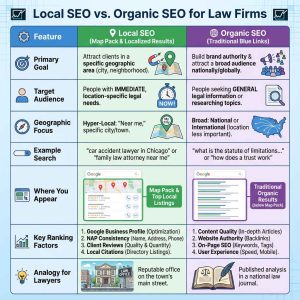
It’s important to distinguish between local SEO and organic SEO. While they are related, they serve different purposes.
Organic SEO focuses on improving your website’s ranking in national or even global search results for broader keywords.
Local SEO, on the other hand, is geographically focused, aiming to get your firm in front of potential clients in your immediate vicinity. Think of organic SEO as a highway billboard and local SEO as a digital welcome mat for your local community.
For law firms that primarily serve clients in a specific city or region, a strong local SEO strategy is paramount. However, the most effective approach often involves a combination of both local and organic SEO to build a comprehensive online presence.
How to Optimize for Local SERPs?
There are two ways to do local SEO optimization for your law firm. First, you can hire a law firm SEO service by hiring an SEO expert. Second, you can do it yourself.
Let’s take a look at the practical steps you can take to optimize your law firm website for local search engine results pages.
1. Master Your Google Business Profile
Your Google Business Profile (GBP) is the cornerstone of your local SEO efforts.
It’s a free tool that allows you to manage how your law firm appears on Google Search and Google Maps.
A complete and optimized GBP listing is crucial for ranking in the “Local Pack,” the block of three business listings that appear at the top of the search results for local queries.
- Claim and Verify Your Listing: The first step is to claim and verify your GBP listing. This proves to Google that you are the legitimate owner of the business.
- Complete Every Section: Fill out every section of your profile with accurate and up-to-date information, including your firm’s name, address, phone number, website, and hours of operation.
- Choose the Right Categories: Select specific categories that accurately describe your practice areas, such as “Personal Injury Attorney” or “Family Law Attorney,” rather than the generic “Law Firm.”
- Add High-Quality Photos: Include professional photos of your office, your team, and even your firm in action (with client permission, of course).
- Utilize Google Posts: Regularly create Google Posts to share updates, blog articles, and special offers. This keeps your profile active and engaging.
- Enable Messaging: Allow potential clients to message you directly from your GBP listing for quick and easy communication.
2. The Power of Online Reviews
Online reviews are a critical ranking factor for local SEO and play a critical role in a potential client’s decision-making process. Positive reviews build social proof and signal to Google that your organization is trustworthy and provides a positive client experience.
- Actively seek reviews: Encourage satisfied clients to leave reviews on your Google Business Profile and other relevant legal directories. Make the process as easy as possible by providing direct links to clients.
- Reply to all reviews: Take the time to respond to all reviews, both positive and negative. A thoughtful response to negative reviews can demonstrate your commitment to client satisfaction and mitigate its impact.
- Display reviews on your website: Display positive reviews and testimonials prominently on your website to further build trust and credibility.
3. Building Local Citations and Listings
A citation is any online mention of your law firm’s name, address, and phone number (NAP). Consistent and accurate citations across a variety of online directories are essential for local SEO.
- Ensure NAP Consistency: Your NAP information should be identical across all online platforms, including your website, GBP, social media profiles, and online directories. Even minor inconsistencies can confuse search engines and hurt your rankings.
- Get Listed in Key Directories: Submit your firm’s information to major legal directories like Avvo, FindLaw, and Justia, as well as general business directories like Yelp and the Better Business Bureau.
- Utilize a Citation Building Service: To save time and ensure consistency, consider using a citation building service to manage your listings across a wide range of directories.
4. On-Page SEO for Local Targeting
On-page SEO refers to the optimization of your website’s content and HTML source code to improve its visibility in search results. For local SEO, this involves incorporating location-specific keywords into your website.
- Local Keyword Research: Identify the keywords and phrases that potential clients in your area are using to search for legal services. Tools like Ahrefs and Google Keyword Planner can help you with this research. Think about terms like “[practice area] lawyer in [city]” or “best [practice area] attorney near me.”
- Optimize Your Website Content: Naturally incorporate your target keywords into your website’s page titles, meta descriptions, headers, and body content.
- Create Location-Specific Pages: If your firm has multiple office locations, create a dedicated page on your website for each location. Each page should be optimized with location-specific keywords and content.
- Embed a Google Map: Embed a Google Map of your office location on your website’s contact page. This not only helps potential clients find you but also sends a strong local signal to Google.
5. The Role of Local SEO Tools for Lawyers
A variety of tools can help you streamline your local SEO efforts and track your progress. While some are paid, many offer free versions or trials that can be incredibly valuable.
- Google Search Console: A free tool from Google that helps you monitor your website’s performance in search results, identify technical issues, and see which keywords are driving traffic.
- Google Analytics: Another free tool from Google that provides detailed insights into your website’s traffic, including where your visitors are coming from and how they are interacting with your site.
- Ahrefs and Semrush: These are comprehensive SEO platforms that offer a wide range of features for keyword research, competitor analysis, backlink analysis, and rank tracking.
- BrightLocal and Whitespark: These tools specialize in local SEO and offer features for citation building, review management, and local rank tracking.
- Local Falcon: This tool allows you to track your local rankings with a high degree of granularity, showing you how your firm ranks in specific neighborhoods and ZIP codes.
Parting Thoughts on Local SEO for Lawyers
In the competitive legal marketplace, a strong local SEO strategy is no longer a luxury; it’s a necessity. By following the steps outlined in this guide, you can significantly improve your law firm’s visibility in local search results, attract more qualified leads, and ultimately, transform your law firm business into a successful one.
Remember that local SEO is an ongoing process that requires consistent effort and adaptation. So, set goals and work on them regularly.